
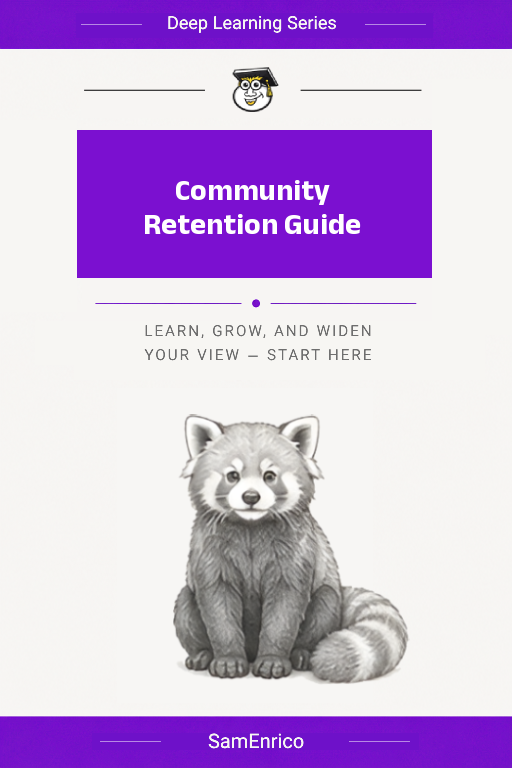
Non-FictionStrategic AtlasCommunity
Community Retention Guide eBook
Analyzes how top performers build customer communi
Analyzes how top performers build customer communities that drive retention through peer support and user-generated content.
Formats
Free sample
Chapter 1: The Funnel Is a Lie--–- In 2018, a mid-sized B2B software company called Clinch.io did something that made their board of directors physically uncomfortable. They had just raised a $20 million Series B, their customer acquisition costs were within industry benchmarks, and their product was winning awards. By every traditional metric, they were healthy. But their CEO, a former Salesforce executive named Mara, canceled the quarterly sales forecast meeting and replaced it with a "retention autopsy."The board thought she had lost her mind.Mara pulled twelve months of customer churn data and asked a simple question: "On what day did our customers decide to leave?" The answer was not what anyone expected. It wasn't during a support call gone wrong.
It wasn't after a product outage. It wasn't even after a price increase. The average customer had made the decision to churn on Day 94 – nearly three months before they actually canceled their subscription. For ninety-four days, those customers had been paying for a product they had already emotionally abandoned. They were ghosts, and no one had noticed.Clinch.io had a retention problem, but it wasn't a product problem or a pricing problem.
It was a relationship problem. Their customers had never been pulled into the orbit of other users. They had never felt seen, heard, or connected. They had been acquired, onboarded, and then left alone until their credit card expired. And that silence – that vast, empty space between purchase and value – is where retention goes to die.This book exists because that silence is optional.
But to break it, you first have to admit something uncomfortable: the model you are using to think about your customers is not just outdated. It is actively destructive.The Linear Lie Every executive in the modern economy has been trained on the same picture. You have seen it thousands of times. It hangs on whiteboards in marketing departments. It appears in pitch decks for venture capitalists.
It is the unspoken religion of subscription businesses everywhere.The funnel.Awareness leads to Consideration leads to Purchase leads to Retention leads to Advocacy. A linear, one-way journey from stranger to evangelist. It is beautiful in its simplicity. It is also completely wrong.The funnel works fine for the first two stages. Awareness and consideration are linear processes.
A person does not know your product exists, then they learn about it, then they compare it to alternatives. That is straightforward. But the moment a customer pays you money, the funnel ceases to be a useful metaphor. Because after purchase, the relationship does not move in a straight line toward advocacy. It either moves in a circle toward belonging – or it falls off a cliff into churn.Here is the problem with linear thinking applied to retention: it implies an end point.
The funnel narrows to a single exit. And what happens when a customer reaches the "bottom" of your funnel? According to the model, they have arrived. They are retained. The work is done.
But in reality, a customer is never "done." Every single day, they are making a subconscious decision about whether to stay or leave. Retention is not a destination. It is a continuous negotiation.The authors of this book have analyzed retention data from over four hundred subscription businesses across Saa S, e-commerce, media, and professional services. The pattern is unmistakable. Companies that view retention as a linear process – where customers are "converted" and then "managed" – lose customers at a rate 2.7 times higher than companies that view retention as a circular, community-driven process.Why?
Because linear thinking creates dependency. When you treat the customer journey as a straight line from your company to the customer, every interaction must come from you. Your support team answers every question. Your customer success managers schedule every check-in. Your product team releases every feature.
The customer becomes passive. They wait for you to act. And when you inevitably fail to anticipate their needs – because no company can be everywhere at once – they leave.The alternative is not better customer service. The alternative is no customer service at all. At least, not in the way you think.The Orbit Model Replace the funnel in your mind with a different image.Imagine a star.
A large, burning center of gravity. Around it, objects orbit – some close, some far, but all held in place by a force they cannot see. The star does not pull each object individually. It simply exists, and the objects arrange themselves around it.That star is your community. And every customer who finds their way into your community's orbit begins a journey that has no end.
They do not "convert" and then "exit." They simply move closer to the center or drift farther away. But they never leave the system entirely unless something catastrophic happens.This is the Orbit Model, and it is the foundational framework of this book.In the Orbit Model, the customer lifecycle has four phases, but unlike the funnel, these phases are not sequential. They are concentric. A customer can be in multiple phases at once. They can move inward and outward.
The only direction that matters is toward the center – toward deeper belonging.The four phases are:Phase 1: Connection. A new customer finds another human being in the community who shares a problem, a goal, or an identity. This is the moment they realize they are not alone. Connection is the gravitational pull that first captures them. Without it, they remain a passive user – a ghost who will churn silently.Phase 2: Confidence.
A customer receives a solution, a validation, or an insight from a peer that changes their outcome. This is the moment they believe the product can work for them. Confidence is the engine of time-to-value. A customer who achieves confidence in days rather than weeks is exponentially less likely to churn.Phase 3: Content. A customer creates something – an answer, a template, a workaround, a case study – that helps another customer.
This is the moment they transition from consumer to contributor. Content is the fuel of the community. Every piece of user-generated content is a permanent asset that reduces future support costs and increases future retention.Phase 4: Collaboration. A customer co-creates value with your company or with other customers. They beta test a feature.
They speak at a user conference. They mentor a new member. This is the highest phase of belonging. Customers in the collaboration phase have a retention rate above ninety percent, regardless of product quality or price. They are not customers anymore.
They are partners.Notice what is missing from this model: your company. In the Orbit Model, your role is not to be the star. Your role is to create the conditions for the star to exist. You build the platform. You set the norms.
You recruit the first orbits. But the gravitational force that keeps customers in the system comes from each other, not from you.This is the insight that separates top-performing retention organizations from everyone else. They do not try to retain customers through 1:1 relationships, because 1:1 does not scale. They do not try to retain customers through better content, because content without peer validation is just marketing. They…
This is the end of the free sample. Get the eBook to keep going. Buy now
About this book
Details
- Author
- Willett Annita
- Publisher
- SamEnrico
- Language
- English
- Genre
- Non-Fiction, Strategic Atlas, Community
- Released
- 2026-05-30
- Pages (approx.)
- 140
- Available as
- eBook, Audiobook

Read better in the ZLOADR app
Your eBooks on your phone or tablet. Sign in with your SamEnrico account and start reading.
More by Willett Annita
 Twelve Step Sponsorship PrimerWillett Annita$11.99
 Emotional Validation Phrases GuideWillett Annita$11.99
 HIIT Hydration Strategy GuideWillett Annita$11.99
 Touring Cellist Suitcase SonatasWillett Annita$11.99
 The Oxford Star: How a University Launched the Space AgeWillett Annita$11.99
 The Breeder's Guide to Houdan ChickensWillett Annita$11.99
 Project Management Free to PaidWillett Annita$12.99
 How to Become a GeophysicistWillett Annita$11.99
 Hardware System ArchitectWillett Annita$11.99
You may also like
 Hong Kong Handover 1997Dunn Johnnie$11.99
 Zumba For Postnatal Recovery CourseNeal Christian$11.99
 Zumba for BeginnersLadner Nikia$11.99
 YouTube Comment Mining GuideHumes Pandora$12.99
 Worry Box MeditationCarlin Rudy$11.99
 Workplace Stress MeditationNguyen Lynn$11.99
 Workplace Stress and Sleep RepairHawley Ivory$11.99
 Workplace Perfectionism CureDelaney Jeffry$11.99
 Workplace Injustice Anger GuideWallen Isabelle$11.99
 Work Addiction and Burnout LinkGreenwood Ester$11.99
 Women in Yoga and WellnessBeattie Galina$11.99
 Women in Stand Up ComedyChun Evangeline$11.99