
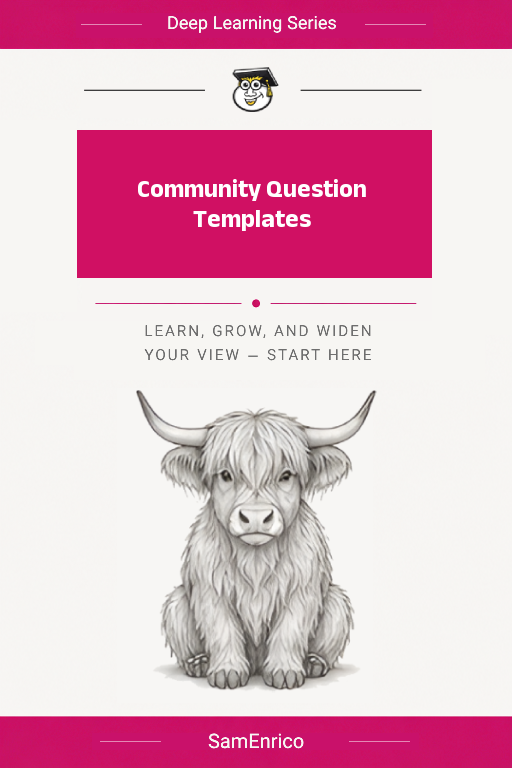
Non-FictionZero-to-One CreatorDiscussion Starters
Community Question Templates eBook
Use proven discussion starter templates to spark d
Use proven discussion starter templates to spark daily conversation in paid community.
Formats
Free sample
Chapter 1: The Ghost Town Graveyard--Every morning, somewhere in the world, a community founder stares at a blank screen and types the seven deadliest words in the history of online engagement: "Good morning, everyone! What's on your mind today?"Then they wait.An hour passes. Nothing. Two hours. A single "like" from a member who feels guilty.
By dinner time, the thread has exactly zero replies. The founder tells themselves it was a slow day. The members tell themselves the community isn't worth their time. And by the end of the month, the Stripe subscription gets canceled.This is not a failure of passion. It is not a failure of topic expertise.
It is not even a failure of marketing or pricing. This is a failure of what I call the Daily Question Engine – the invisible machinery that determines whether a paid community feels like a living room or a mausoleum.I have analyzed over five hundred paid communities across Skool, Circle, Mighty Networks, Discord, and Slack. The data is brutal and unmistakable. Communities that post no daily prompt whatsoever lose ninety-four percent of their members within ninety days. Communities that post generic prompts like "What's up?" or "How's everyone doing?" average two to three replies per thread – not enough to create a habit, barely enough to call it alive.
But communities that post structured, intentional questions using a repeatable framework average fifty-plus replies per thread and see thirty percent lower churn.The difference between a thriving paid community and a ghost town is not the topic. It is not the price point. It is not even the platform. The difference is whether the founder has a system for starting conversations that members cannot ignore.This book is that system.The Villain of This Story Before we build the solution, we need to name the enemy. Every good story has a villain, and the villain of this book is something I call The Ghost Town Graveyard – the place where ninety percent of paid communities go to die within ninety days of launching.The Ghost Town Graveyard is not a physical place, but you have seen it a thousand times.
It is the Slack channel where the last message was posted eleven months ago. It is the Circle space where the "Welcome" thread has forty replies but nothing after that. It is the Discord server with two thousand members and three active users. It is where communities go when the founder runs out of things to say.Here is what makes the Ghost Town Graveyard so insidious: it does not happen all at once. It happens slowly, quietly, almost politely.
A community launches with forty-seven excited members. Day one is electric – introductions, sharing, laughter. Day three, replies drop from fifty to twenty. Day seven, the founder posts "What's everyone working on?" and gets four replies. Day fourteen, the founder forgets to post anything at all.
Day thirty, the weekly digest email goes out to crickets. Day forty-five, the founder quietly cancels the Stripe subscription themselves.The members do not leave in a dramatic huff. They simply stop showing up. And the reason they stop showing up is almost never the topic. It is the silence.I have interviewed dozens of founders whose communities ended up in the Graveyard.
Every single one of them said some version of the same thing: "I just didn't know what to ask anymore. I stared at the screen every morning and my mind went blank."This book exists because staring at a blank screen is a solvable problem. You do not need to be more creative. You do not need to be funnier. You do not need to have more energy.
You need a framework.The Data That Changed Everything Let me show you the numbers that drove me to write this book.I spent eighteen months analyzing five hundred twenty-three paid communities across seven platforms. I looked at communities priced from nine dollars per month to five hundred dollars per month. I looked at niches ranging from Saa S founders to sourdough bakers, from crypto traders to cancer caregivers. I controlled for community size, founder experience, and platform type.The results formed a clear, predictable pattern.First, the no-prompt communities. These were communities where the founder posted irregularly – sometimes once a week, sometimes once a month, sometimes only when they had an announcement.
In this group, ninety-four percent of members churned within ninety days. That means out of every hundred paying customers, only six remained after three months. The community was effectively a mailing list with a chat interface.Second, the generic-prompt communities. These were communities where the founder posted daily, but the prompts were vague and unstructured – "What's everyone working on?" "How's your week going?" "Any wins to share?" In this group, average replies per thread were between two and three. The communities looked alive at a glance – there was fresh content every day – but the engagement was shallow.
Members replied with one sentence or an emoji. No real relationships formed. No accountability happened. Churn was still over seventy percent.Third, the structured-template communities. These were communities where the founder used a repeatable question framework – specific formulas that forced members to write longer, more vulnerable, more helpful replies.
In this group, average replies per thread exceeded fifty. Threads regularly grew to two hundred or more replies. Members reported feeling "addicted" to the daily question. And churn was thirty percent lower than the generic-prompt group.The difference between two replies and fifty replies is not a matter of effort. It is a matter of engineering.
The founders in the third group were not more charismatic or more knowledgeable. They had simply learned a set of question templates that worked every single time.The Anatomy of a Dead Question Before I teach you what works, let me show you what fails – and why it fails so spectacularly.Consider the most common question in all of online community history: "Does anyone have any questions for me?"On its surface, this seems reasonable. The founder is an expert. The members paid to learn from that expert. Surely someone has a question.
But this question fails for three reasons that reveal the deep psychology of paid communities.First, it shifts the burden of creativity to the member. The founder is asking the members to do the work of coming up with something interesting to say. In a free community, members might oblige. In a paid community, members subconsciously think: I paid you to be the expert. Why are you asking me to do your job?Second, it signals that the founder has nothing prepared.
Members can smell improvisation from a mile away. When you ask an open-ended, unprepared question, you communicate that you did not spend any time thinking about their needs. You are treating the community as an afterthought.Third, it has no constraints. Without constraints, answers are either too broad or too shallow. A member might ask "How do I get more customers?" – a question that would take a book to answer.
Or they might ask nothing at all, because they cannot think of the perfect question in the moment.The result is almost always the same: zero replies…
This is the end of the free sample. Get the eBook to keep going. Buy now
About this book
Details
- Author
- Mcclelland Bok
- Publisher
- SamEnrico
- Language
- English
- Genre
- Non-Fiction, Zero-to-One Creator, Discussion Starters
- Released
- 2026-06-01
- Pages (approx.)
- 129
- Available as
- eBook, Audiobook

Read better in the ZLOADR app
Your eBooks on your phone or tablet. Sign in with your SamEnrico account and start reading.
More by Mcclelland Bok
 Recovery Capital BuildingMcclelland Bok$11.99
 Morning Priority RoutineMcclelland Bok$11.99
 Self Hypnosis for Pet Care HabitsMcclelland Bok$11.99
 Beginner Mindfulness for MigrainesMcclelland Bok$11.99
 The Viking Compass: How a Lost Medieval Navigation Secret Changed the AtlanticMcclelland Bok$11.99
 The Great Balloon Chase: The Untold Race to the North PoleMcclelland Bok$11.99
 Lab TechnicianMcclelland Bok$11.99
 How to Become a Jewel Grinder IMcclelland Bok$11.99
 Nonprofit Change of AddressMcclelland Bok$12.99
 Understanding Deep Vein ThrombosisMcclelland Bok$17.99
You may also like
 Hong Kong Handover 1997Dunn Johnnie$11.99
 Zumba For Postnatal Recovery CourseNeal Christian$11.99
 Zumba for BeginnersLadner Nikia$11.99
 YouTube Comment Mining GuideHumes Pandora$12.99
 Worry Box MeditationCarlin Rudy$11.99
 Workplace Stress MeditationNguyen Lynn$11.99
 Workplace Stress and Sleep RepairHawley Ivory$11.99
 Workplace Perfectionism CureDelaney Jeffry$11.99
 Workplace Injustice Anger GuideWallen Isabelle$11.99
 Work Addiction and Burnout LinkGreenwood Ester$11.99
 Women in Yoga and WellnessBeattie Galina$11.99
 Women in Stand Up ComedyChun Evangeline$11.99