
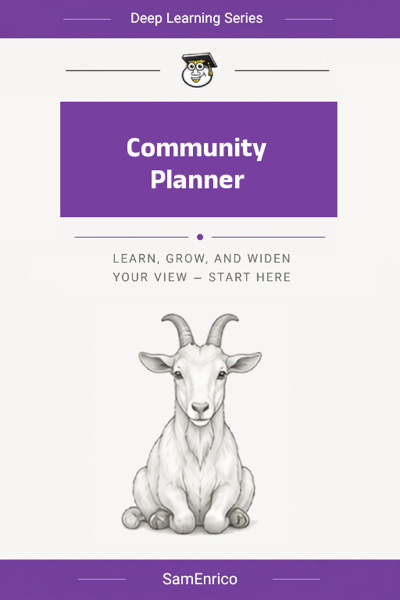
Non-FictionInformativeEducational
Community Planner eBook
A Coursebook on Community Planner
by Kay Dorotha
A Coursebook on Community Planner
Formats
Free sample
Chapter 1: The Planner's Paradox--–- The first time I watched a perfectly good comprehensive plan die, I was sitting in a folding chair in a church basement in Lancaster, Ohio. The plan had taken eighteen months to write, involved forty-seven community meetings, and cost taxpayers $230,000. It was beautiful. It had color-coded maps, a thirty-page implementation matrix, and a vision statement that included the word "vibrant" three times. Six hours after it was presented to the city council, it was dead—not because the data was wrong, not because the community hated it, but because the city manager looked at the recommended zoning changes and said, "We'll get to this after the budget." They never got to it.
Two years later, the plan sat on a shelf in the planning department, gathering dust, while the same problems it had solved on paper—crumbling sidewalks, a downtown with five payday lenders and zero grocery stores, a complete absence of missing-middle housing—continued to fester. That plan was a masterpiece of technical planning. It was a complete failure of strategic planning. This chapter is about the difference between those two things, and why understanding that difference is the first and most important test of the benevolent guerrilla.The Difference Between a Document and a Strategy Most people—including, tragically, most planning students—believe that a comprehensive plan is a document. They are wrong.
A comprehensive plan is a strategy that happens to be written down. The document is merely the fossilized remains of the strategy after it has been exposed to the air of city hall. The distinction matters because documents can be perfect while strategies fail. Documents live on shelves. Strategies live in the messy, glorious, infuriating world of city council votes, budget hearings, community meetings, and the thousand small negotiations that determine whether a crosswalk gets painted or a zoning change gets adopted.Let me be precise about what I mean.
A document has pages, headings, maps, and appendices. A strategy has goals, allies, opponents, timelines, and—most critically—a theory of power. A document answers the question, "What would a good community look like?" A strategy answers the question, "How do we get from here to there given that people will fight us every step of the way?" Most comprehensive plans are written as if the second question doesn't exist. They assume that good ideas, clearly presented, will persuade reasonable people to do the right thing. This is a fantasy.
The world is not run by reasonable people persuaded by good ideas. The world is run by people with competing interests, limited attention spans, and deep suspicion of anything that threatens their property values, their parking spots, or their sense of how things have always been done.The comprehensive plan, properly understood, is the constitution of the community. This analogy is not rhetorical; it is legal and operational. Just as the United States Constitution establishes the framework within which all laws must operate, the comprehensive plan establishes the framework within which all zoning decisions, capital investments, and land-use regulations must operate. This is the doctrine of consistency, and it is the most powerful tool the planner possesses.
When a city council tries to approve a suburban-style big-box development in direct contradiction of the comprehensive plan's stated goal of "promoting walkable, mixed-use infill development," the planner can—and should—say, "You cannot do that without amending the plan first." That is power. That is the legal teeth that turn a vision into a binding constraint.But here is the paradox that gives this chapter its name. A constitution that cannot be amended is a tyranny. A comprehensive plan that cannot be changed is a suicide pact. Communities evolve.
Economies shift. Climate patterns change. Political coalitions dissolve and reform. The plan that was perfect in 2025 will be obsolete in 2035—not because it was badly written, but because the world it was written for no longer exists. The benevolent guerrilla must hold two contradictory truths in her head simultaneously: the plan must be treated as authoritative to have legal teeth, and the plan must be treated as provisional to have any hope of surviving.
The resolution to this paradox is the concept of amending cycles, which we will explore in detail later in this chapter.The Five Components of Any Real Plan Before we can resolve the paradox, we have to understand what a plan actually contains. Not what a plan should contain in some ideal world, but what a plan must contain to function as a binding strategic document. Drawing from Eric Kelly's Community Planning and decades of legal precedent, I have distilled every functional comprehensive plan down to five essential components. If your plan is missing any of these, it is not a plan. It is a wish list.Component One: The Vision Statement.
This is the aspiration. The vision statement answers the question, "What kind of community do we want to become in twenty or thirty years?" It is supposed to be lofty, inspirational, and slightly vague. A good vision statement is memorable. A great vision statement is short enough to fit on a coffee mug. "A walkable, equitable, and sustainable community for all generations." That is a vision statement.
"We will leverage our unique historic assets and strategic transportation corridors to create a thriving mixed-use downtown that serves as a regional destination for commerce, culture, and community" is not a vision statement. It is a run-on sentence that belongs in a grant application. The vision statement is the only component of the plan that is allowed to be vague. Everything else must be precise.Component Two: Goals. Goals are broad statements of intent.
They translate the vision into categories of action. A typical comprehensive plan might have eight to twelve goals covering topics like housing, transportation, economic development, environment, parks, public facilities, and community character. A goal is not measurable. "Increase housing affordability" is a goal. "Provide safe and convenient transportation options for all ages and abilities" is a goal.
Goals set the direction of travel. They do not tell you when you have arrived.Component Three: Objectives. Objectives are specific, measurable targets that operationalize the goals. This is where the plan moves from inspiration to accountability. An objective is not a goal.
A goal is "increase housing affordability." An objective is "increase the share of households spending no more than 30 percent of income on housing from 58 percent to 65 percent by 2035." An objective has four characteristics that we will return to in Chapter 12: it is Specific, Measurable, Achievable, Relevant, and Time-bound. SMART objectives are the difference between a plan that can be evaluated and a plan that can only be admired.Component Four: Actions. Actions are the specific policies, programs, capital projects, and regulatory changes that will achieve the objectives. If objectives tell you what you want to accomplish, actions tell you how you will accomplish it. An action is not an objective.
An objective is "increase the share of commuters biking or walking from 5 percent to 15 percent by 2035." An action is "adopt a complete streets policy by 2026," "install protected bike lanes on Main Street by 2027," "reduce speed limits on all residential streets to…
This is the end of the free sample. Get the eBook to keep going. Buy now
About this book
Details
- Author
- Kay Dorotha
- Publisher
- SamEnrico
- Language
- English
- Genre
- Non-Fiction, Informative, Educational
- Released
- 2026-06-02
- Pages (approx.)
- 148
- Available as
- eBook, Audiobook

Read better in the ZLOADR app
Your eBooks on your phone or tablet. Sign in with your SamEnrico account and start reading.
More by Kay Dorotha
 Pete Sampras Pistol ServeKay Dorotha$11.99
 Summer Melt Prevention HandbookKay Dorotha$11.99
 Promotion Self Worth GuideKay Dorotha$11.99
 Green Beret Weapons SergeantKay Dorotha$11.99
 Equifax Response Failure GuideKay Dorotha$11.99
 Loki’s Lost Gambit: The Trickster’s Roman RuseKay Dorotha$11.99
 Fire Below: The Birth of the Pacific Ring of FireKay Dorotha$11.99
 Understanding Gangliosidosis Type1Kay Dorotha$17.99
 How to Become a Dipping-machine OperatorKay Dorotha$11.99
 African Digital Marketing HandbookKay Dorotha$12.99
 Chinese Idioms Teaching GuideKay Dorotha$12.99
You may also like
 Hong Kong Handover 1997Dunn Johnnie$11.99
 Zumba For Postnatal Recovery CourseNeal Christian$11.99
 Zumba for BeginnersLadner Nikia$11.99
 YouTube Comment Mining GuideHumes Pandora$12.99
 Worry Box MeditationCarlin Rudy$11.99
 Workplace Stress MeditationNguyen Lynn$11.99
 Workplace Stress and Sleep RepairHawley Ivory$11.99
 Workplace Perfectionism CureDelaney Jeffry$11.99
 Workplace Injustice Anger GuideWallen Isabelle$11.99
 Work Addiction and Burnout LinkGreenwood Ester$11.99
 Women in Yoga and WellnessBeattie Galina$11.99
 Women in Stand Up ComedyChun Evangeline$11.99