
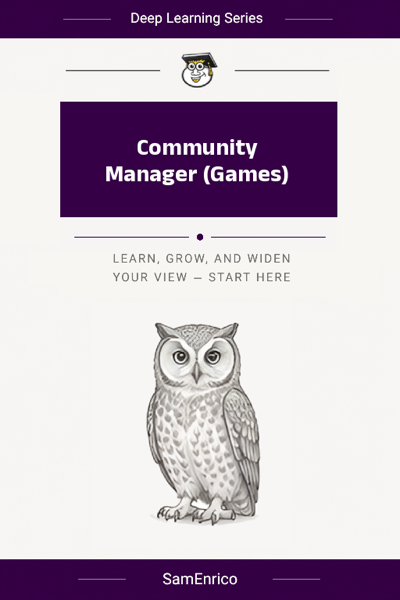
Non-FictionInformativeEducational
Community Manager (Games) eBook
A Coursebook on Community Manager (Games)
by Stein Dalia
A Coursebook on Community Manager (Games)
Formats
Free sample
Chapter 1: The Avatar in the Room--– In 2012, a community manager for a then-popular multiplayer online battle arena game watched as a single forum post turned into a 48-hour firestorm. A player had discovered that a newly released “premium” skin — sold for $25 — was actually a recolored version of a free skin with three pixels changed. The thread began with a screenshot. Within six hours, it had 12,000 replies. By morning, the game’s Metacritic user score had dropped from 8.2 to 3.4.
The studio’s response? Silence for 72 hours while “legal reviewed” the situation. When the CM was finally allowed to post, the message was a sterile, lawyer-approved four sentences that acknowledged nothing, apologized for nothing, and offered nothing. The thread exploded again. Two weeks later, the game’s active player count had halved.
The CM quit within a month. The studio never fully recovered.That community manager was not incompetent. She was trapped. Trapped between a leadership team that saw players as ATMs, a legal department that saw communication as liability, and a product team that saw bugs as “technical debt” rather than broken promises. She had the title.
She had the login credentials. She did not have the authority, the frameworks, or — most critically — the organizational permission to treat the community as anything other than a noise generator that occasionally needed to be sprayed with corporate febreeze.This book exists because that story has repeated itself, in different flavors, across thousands of games — from indie Discord servers with twelve members to AAA launches with twelve million. And the root cause is almost never a single bad decision. It is a systematic failure to understand what a game community manager actually is, what they actually do, and why the difference between “moderator” and “strategic community lead” is often the difference between a game that lives for a decade and a game that dies in a quarter.This chapter is called “The Avatar in the Room” for a reason. In game development, the “elephant in the room” is usually the impossible crunch schedule, the broken build, or the executive who refuses to delay a launch.
But the avatar — the player’s representation of themselves in your world — is something else entirely. The avatar is the player’s time, money, identity, and social standing, all compressed into a collection of pixels and stats. And the community manager is the only person in the studio whose job is to sit in the room with the avatar, not just the player data. The producer sees retention curves. The designer sees engagement funnels.
The community manager sees the human being on the other side of the screen who just lost their hard-earned legendary item to a server rollback and is crying — actually crying — in a DM.If that sounds dramatic, you have not done this job. If it sounds exaggerated, you have not been the person who has to type “we understand your frustration” for the thirtieth time while internally agreeing that the frustration is entirely justified. And if it sounds like something that could be automated, you are about to learn exactly why the best AI moderation bot in the world cannot replace the person who remembers that a player’s child just got diagnosed with something, or that a guild is celebrating its fifth anniversary, or that a quiet forum lurker has been quietly translating patch notes into Spanish for three years without ever asking for recognition.This chapter establishes the foundation for everything that follows. It will answer three questions: What makes game community management fundamentally different from any other community role? What are the five archetypes every game CM must learn to embody — and why trying to be all five at once is a path to burnout?
And what are the core skills that no tool, template, or automation can replace? By the end, you will have a self-assessment of your dominant archetype, a clear understanding of where your current team or studio sits on the maturity curve, and — most importantly — the language to explain to your boss why “just post an update” is never a sufficient instruction.The Great Misunderstanding: Social Media Manager vs. Game Community Manager Let us begin with a statement that will anger some people in marketing departments: A game community manager is not a social media manager who happens to work in games.Social media managers operate in a broadcast paradigm. They push content — trailers, announcements, promotional art — to an audience. Their metrics are impressions, clicks, and shares.
Their success is measured in reach. When a social media manager goes silent for a week, the audience might not notice until the next scheduled post. The relationship is transactional: the brand speaks, the follower listens, and the transaction ends when the scroll continues.A game community manager operates in a reciprocal paradigm. They do not broadcast to players; they inhabit a space with players. Their metrics are retention lift, sentiment shift, and behavioral change.
When a game CM goes silent for a week, players notice within hours. They fill the silence with speculation, anxiety, and — in the worst cases — hostile takeovers of the narrative. The relationship is invested: the player has spent hours, money, and social identity on the game. The avatar is not a follower. The avatar is a second self.Consider the concrete differences.
A social media manager for a movie franchise posts a trailer. A viewer watches for two minutes and moves on. A game CM posts a patch note that changes a character’s damage output by 4%. A player who has mained that character for 800 hours feels that change as a personal affront. They have mastered that character’s combos, collected every skin, and built a reputation in their guild around that specific playstyle.
A 4% adjustment is not a balance tweak to that player. It is a betrayal of their competence, an invalidation of their time, and a signal that the developer does not understand them. The CM’s job is not to defend the 4% change. It is to understand why that player feels betrayed — and to translate that feeling into something the design team can actually use, without letting the player’s anger burn down the community in the meantime.This distinction has practical consequences. Social media managers are trained to avoid engagement with angry comments.
Game CMs are trained to lean into carefully selected angry comments — not to argue, but to listen, to validate, and to signal that the studio is present. Social media managers optimize for viral reach. Game CMs optimize for trust velocity: how quickly a new player goes from “who are these people?” to “I would defend this community against trolls.” Social media managers have a delete button. Game CMs have an escalation path, and they know that deleting a frustrated player’s post without explanation is often more damaging than the post itself.The game industry has learned this distinction the hard way. In 2018, a major studio hired a social media manager from a consumer packaged goods brand to run their “community” accounts.
Within three months, she had posted a meme that mocked a accessibility feature request, replied to a bug report with “have you tried turning it off and…
This is the end of the free sample. Get the eBook to keep going. Buy now
About this book
Details
- Author
- Stein Dalia
- Publisher
- SamEnrico
- Language
- English
- Genre
- Non-Fiction, Informative, Educational
- Released
- 2026-05-06
- Pages (approx.)
- 154
- Available as
- eBook, Audiobook

Read better in the ZLOADR app
Your eBooks on your phone or tablet. Sign in with your SamEnrico account and start reading.
More by Stein Dalia
 The Emotion Diary Card CourseStein Dalia$11.99
 Plane Hijacking SurvivorStein Dalia$11.99
 Boardroom Presentation Calm GuideStein Dalia$11.99
 Digital Age Parental Anger TriggersStein Dalia$11.99
 Panic Disorder Medication ManualStein Dalia$11.99
 The Last Broadcast: The Mysterious Case of the War of the Worlds PanicStein Dalia$11.99
 Neon Oracle: The AI That Dreamed the FutureStein Dalia$11.99
 Understanding Brachioskeletogenital SyndromeStein Dalia$17.99
 Workday Remote HR Intern GuideStein Dalia$12.99
 Executive Summary Ask ArticulatorStein Dalia$12.99
 How to Start a Sailing Club without Marinas BusinessStein Dalia$11.99
You may also like
 Hong Kong Handover 1997Dunn Johnnie$11.99
 Zumba For Postnatal Recovery CourseNeal Christian$11.99
 Zumba for BeginnersLadner Nikia$11.99
 YouTube Comment Mining GuideHumes Pandora$12.99
 Worry Box MeditationCarlin Rudy$11.99
 Workplace Stress MeditationNguyen Lynn$11.99
 Workplace Stress and Sleep RepairHawley Ivory$11.99
 Workplace Perfectionism CureDelaney Jeffry$11.99
 Workplace Injustice Anger GuideWallen Isabelle$11.99
 Work Addiction and Burnout LinkGreenwood Ester$11.99
 Women in Yoga and WellnessBeattie Galina$11.99
 Women in Stand Up ComedyChun Evangeline$11.99