
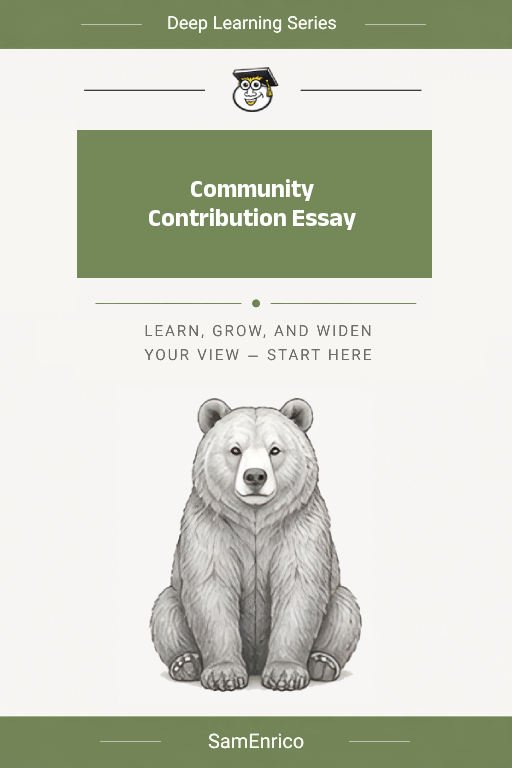
essaysCommunity GuideFuture Impact
Community Contribution Essay eBook
Write about how you'll add to campus life. Show ad
Write about how you'll add to campus life. Show admissions you're a future leader and collaborator.
Formats
Free sample
Chapter 1: The Invisible Backpack...–- Every student who applies to a competitive college carries an invisible backpack. Inside are their grades, test scores, and a list of extracurricular activities. Most admissions essays are written from this backpack—a recitation of achievements that admissions officers have already seen on the transcript and activities list. This chapter argues that the most memorable essays come from a different place entirely: not from what you have accumulated, but from what you have contributed. Before you can write about contribution, however, you must first understand what "community" actually means—and for most students, the word is dangerously vague.You have likely used the word "community" dozens of times in your life without ever defining it.
You have written "I care about my community" or "I want to give back to my community" on scholarship applications, in class discussions, and perhaps in drafts of your college essay. But if someone asked you to name the specific communities you belong to—to list them, describe their boundaries, and explain how you have shaped them—could you do it? Most students cannot. They default to abstractions: "my school community," "my local community," or worse, "the global community." These phrases are not communities. They are categories.
And you cannot write a compelling essay about contributing to a category.The problem is not that you lack community experience. The problem is that you have not learned to see the actual, messy, specific communities you already inhabit. This chapter will teach you to see them. It will give you a vocabulary for describing the different kinds of communities in your life, from the obvious (your soccer team) to the invisible (your Discord server). It will introduce a framework for understanding your role within each group.
And it will provide a hands-on exercise—Mapping Your Community DNA—that will generate the raw material for your entire essay. By the end of this chapter, you will never again write "my community" as if the word meant only one thing.The Abstraction Trap Every year, admissions officers read thousands of essays that begin with some version of this sentence: "My community has shaped who I am." The sentence is not wrong. It is simply empty. It tells the reader nothing specific about where you live, who you know, what problems you have faced, or what you have actually done. The word "community" functions as a placeholder, a verbal shrug.Consider the difference between these two statements:Vague: "I wanted to help my community, so I started volunteering."Specific: "In my apartment building, eighty-seven families share three laundry machines.
Every Sunday morning, the machines break, and neighbors fight over the repair schedule. I created a shared Google Calendar and taught my neighbors—none of whom spoke the same first language—how to reserve time using emoji icons."The first sentence could have been written by anyone. The second sentence could only have been written by someone who lives in that building, knows those neighbors, and noticed a specific, solvable problem. Admissions officers are not looking for good people. They are looking for specific people—individuals who see the world in fine-grained detail and act on what they see.The abstraction trap is seductive because it feels safe.
If you write "my community," you cannot be wrong. But you also cannot be memorable. Specificity is the antidote to abstraction. And specificity begins with naming the actual communities you belong to.The Four Types of Communities Communities come in many shapes, but most fall into one of four categories. Understanding these categories will help you identify groups you might otherwise overlook.Proximal communities are defined by physical proximity.
You belong to these communities simply because you are near other people: your family, your neighborhood, your dorm floor, your classroom seating row. Proximal communities are often invisible because they feel like background noise. But they are rich with contribution opportunities. The student who organized the laundry machine schedule was acting within a proximal community—her apartment building.Interest-based communities are defined by shared activities or passions. These include your soccer team, your debate club, your Dungeons & Dragons guild, your marching band, your chess team, your anime discussion forum, your robotics squad.
Interest-based communities are the ones students most readily identify because they appear on activities lists. But do not make the mistake of assuming that your interest-based community is only the official club. The six people who stay after robotics practice to watch You Tube videos about battle bots are also a community—a smaller, more intimate one.Identity-based communities are defined by shared characteristics or experiences. These include your faith youth group, your cultural heritage club, your first-generation student organization, your LGBTQ+ alliance, your neurodivergent study group. Identity-based communities are powerful because they often involve vulnerability.
People share parts of themselves that they hide elsewhere. Contributions in these communities—organizing a safe space, sharing resources, simply showing up consistently—carry weight precisely because the stakes are personal.Digital communities are defined by online spaces. These include your Discord server, your Reddit subforum moderation team, your study Tik Tok collective, your Twitch chat community, your collaborative fan translation group. Many students dismiss digital communities as not "real" enough for college essays. This is a mistake.
Admissions officers have read thousands of essays about soccer captains. They have read far fewer about the student who translated anime subtitles for a community of 10,000 fans. Digital communities are real communities. They have norms, hierarchies, conflicts, and contribution opportunities. Do not ignore them.As you read these four categories, you probably thought of several communities you belong to.
That is good. Now we need to push further. Because belonging to a community is not the same as contributing to it. The students who write memorable essays do not just show up. They shape.Your Role in the Community: Initiator, Glue, or Supporter Every community needs three kinds of people.
In Chapter 2, we will explore these roles in depth. For now, a brief introduction will help you complete this chapter's exercise.Initiators start new things. They notice a gap—a missing tradition, an unmet need, a silence—and they act. The student who created the laundry calendar is an initiator. So is the student who realized her school had no quiet space for overwhelmed students and convinced the librarian to open a study room during lunch.
Initiators do not need permission. They see a problem and build a solution.Glue builds relationships across disconnected people. Glue notices that the art students and the coding club never talk to each other, so they organize a collaborative project. Glue remembers names, introduces people at parties, and sends the follow-up email that turns an awkward meeting into a lasting friendship. Glue does not always start new things, but they make existing things work better.Supporters show up consistently and lift others without needing credit.
The supporter is not the team captain but the person who arrives early to set up and stays late to clean up. The supporter does not lead the food drive but donates every week and recruits two friends. The supporter sends the "great job today" text after a hard game. Supporters are…
This is the end of the free sample. Get the eBook to keep going. Buy now
About this book
Details
- Author
- Coffey Nannie
- Publisher
- SamEnrico
- Language
- English
- Genre
- essays, Community Guide, Future Impact
- Released
- 2026-05-28
- Pages (approx.)
- 127
- Available as
- eBook, Audiobook

Read better in the ZLOADR app
Your eBooks on your phone or tablet. Sign in with your SamEnrico account and start reading.
More by Coffey Nannie
 Meditation For Post Herpetic NeuralgiaCoffey Nannie$11.99
 Ice Cave VisualizationCoffey Nannie$11.99
 The Gratitude Forgiveness LinkCoffey Nannie$11.99
 SMART Recovery Self ManagementCoffey Nannie$11.99
 Toy Rotation and Declutter Time PlanCoffey Nannie$11.99
 Beware the Frostborn: The Trolls of DovreCoffey Nannie$11.99
 Procurement CoordinatorCoffey Nannie$11.99
 Understanding Night Blindness Skeletal Anomalies Unusual FaciesCoffey Nannie$17.99
 How to Start a Cake Mixture Business (Beginners Guide)Coffey Nannie$11.99
You may also like
 YouTube Video Essay DepthLeon Lala$11.99
 TOEFL Independent Essay GuideMintz Alex$11.99
 Music Theory Essay GuideWilkinson Maisha$11.99
 Expository Essay AI PromptsApplegate Dalia$11.99
 Exam Essay MemorizationMcgovern Johna$11.99
 Compare Contrast Essay PromptsOntiveros Marx$11.99
 College Application Essay GuideSisson Aimee$11.99College Application Essay GuideSisson Aimee$11.99
 The 100 Word Essay ChallengeAli Luciana$11.99
 Journalism Essay PromptsThatcher Williemae$11.99
 Finance Essay PromptsShrader Lamont$11.99
 Cause Effect Essay GPT GuideBland Jacelyn$11.99