
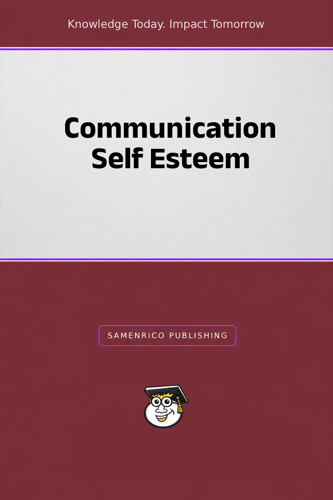
Non-FictionSelf-HelpCommunication
Communication Self Esteem eBook
Expresses needs without fear of rejection.
by Klein Brett
Expresses needs without fear of rejection.
Formats
Free sample
Chapter 1: The Approval Trap--–- Every time you silence a need, you pay a price. The invoice comes later—in resentment, exhaustion, or the quiet certainty that you matter less than the people around you. This chapter is about why you learned to pay that invoice in the first place, and why “being nice” might be the most expensive habit you ever developed.The Cost of a Silenced Need Let’s start with a question that might feel uncomfortable. Think back to the last time you wanted something—really wanted it—and said nothing. Perhaps you wanted help with a project at work but told yourself everyone else was too busy.
Perhaps you wanted your partner to listen instead of offering solutions, but you swallowed the request because “they’re trying their best.” Perhaps you wanted to say no to a favor that would drain your weekend, but the word “yes” left your mouth before you could stop it.Now ask yourself: what did that silence cost you?Not in some abstract, spiritual sense. What did it cost you in actual energy? In the hour you spent ruminating afterward? In the resentment that leaked out later in a sarcastic comment or a cold shoulder? In the quiet erosion of your belief that your needs matter?This book exists because the cost of silence is higher than most people realize.
And the invisible engine driving that silence is something psychologists call the approval trap—the desperate, exhausting, and ultimately impossible attempt to be liked by everyone, all the time, at your own expense.The Myth of the “Nice” Person We need to clear something up immediately. When I use the word “nice” in this chapter, I am not talking about genuine kindness, generosity, or thoughtfulness. Those are virtues. The world needs more of them.I am talking about performative niceness—the kind that comes from fear rather than choice. The kind that says “yes” while every cell in your body is screaming “no.” The kind that smiles at a joke that isn’t funny, laughs off a comment that stings, and pretends everything is fine when everything is very much not fine.Here is the uncomfortable truth that opens this entire book: For many people, “niceness” is not a personality trait.
It is a survival strategy.You learned somewhere along the way that being liked was the price of admission to relationships, to safety, to love. You learned that expressing a need—especially one that might inconvenience someone else—was risky. You learned that saying “no” could lead to withdrawal, anger, or abandonment. And so you adapted. You became agreeable.
You became low-maintenance. You became the person who never asks for anything.And you paid for that adaptation with your self-esteem.Approval Addiction: The Hidden Engine The term “addiction” gets thrown around loosely, but I want you to take it seriously here. An addiction has three core features: you crave the thing, you feel withdrawal without it, and you will sacrifice your own well-being to get it.Approval addiction works exactly the same way.When someone approves of you—when they smile, thank you, compliment you, or simply fail to criticize you—you get a small hit of neurochemical relief. Dopamine, oxytocin, a momentary sense of safety. When approval is absent—when someone seems disappointed, when they don’t respond, when you suspect they might be upset—you feel a low-grade panic.
The craving returns. And you will do whatever it takes to get that approval back, including abandoning your own needs.This is not weakness. This is wiring.Human beings are social mammals. For most of our evolutionary history, rejection from the tribe meant death. Literally.
You could not survive alone on the savannah. Your brain developed elaborate systems to detect disapproval and motivate you to seek reconnection. The problem is that those systems did not get the memo that you are no longer living in a small tribe where every relationship is a matter of life and death.So here you are, in the twenty-first century, with a Stone Age brain that interprets a colleague’s neutral facial expression as a mortal threat.The Approval Addiction Self-Assessment Before we go further, take two minutes to answer these questions honestly. There are no wrong answers, and no one will see your responses except you.When someone seems upset with you, do you immediately assume you did something wrong?Do you apologize for things that aren’t your fault—sometimes before anyone even complains?Have you ever said “yes” to something while already knowing you would resent it later?Do you spend significant time imagining how other people will react to your requests before you make them?Has a friend or partner ever told you, “You never ask for anything,” and you felt strangely proud of that?Do you feel anxious when someone doesn’t text back quickly?Do you change your opinion in conversation when you sense disagreement, even on minor topics?Have you ever stayed silent about a legitimate need because you didn’t want to be “difficult” or “needy”?If you answered yes to three or more of these, approval addiction is likely affecting your daily life. If you answered yes to six or more, it is very likely the primary barrier between you and the life you want.This is not a diagnosis.
It is an invitation to curiosity. The question is not whether you have this pattern—many people do. The question is what you want to do about it.Connection Versus Codependency: A Critical Distinction At this point, some readers may be thinking: “Wait. Isn’t it good to care about other people’s feelings? Isn’t that just being a decent human being?”Yes, absolutely.
And this is where we need to make one of the most important distinctions in the entire book.Connection is mutual, honest exchange where both people can express needs, set boundaries, and disagree without fear of abandonment. In a connected relationship, when you say “I need some time alone tonight,” the other person might feel disappointed, but they don’t punish you. When they say “I’m frustrated with how you handled that,” you can listen without collapsing. Connection is two whole people choosing to be together.Codependency is self-abandonment to maintain peace. In a codynamic relationship, you suppress your needs because you have learned that expressing them leads to conflict, withdrawal, or punishment.
You become a version of yourself designed to be easy to be around—but that version is not actually you. Codependency is one person disappearing so the other person feels comfortable.Here is the distinction that will matter across this entire book: Withdrawal from a safe person who is trying to connect with you is codependency. Withdrawal from an unsafe person who consistently violates your boundaries is self-protection.We will return to this distinction in Chapter 10, when we talk about difficult people. For now, simply hold onto this: not all withdrawal is the same. The difference is not in the behavior—it is in the relationship context and your reason for withdrawing.A woman named Sarah, a client I worked with early in my research, illustrated this perfectly.…
This is the end of the free sample. Get the eBook to keep going. Buy now
About this book
Details
- Author
- Klein Brett
- Publisher
- SamEnrico
- Language
- English
- Genre
- Non-Fiction, Self-Help, Communication
- Released
- 2026-06-09
- Pages (approx.)
- 132
- Available as
- eBook, Audiobook

Read better in the ZLOADR app
Your eBooks on your phone or tablet. Sign in with your SamEnrico account and start reading.
More by Klein Brett
 Legal Checklist For Business PlanKlein Brett$11.99
 Video Persuasion TechniquesKlein Brett$11.99
 The Full Splits ProgressionKlein Brett$11.99
 The Last Emperor of the Sun: Puyi’s Forgotten ReignKlein Brett$11.99
 How to Start a Bowling Center BusinessKlein Brett$11.99
 LinkedIn Recommendations GuideKlein Brett$12.99
 Medical DirectorKlein Brett$11.99
 Learn to Play the KudyapiKlein Brett$11.99
You may also like
 Hong Kong Handover 1997Dunn Johnnie$11.99
 Zumba For Postnatal Recovery CourseNeal Christian$11.99
 Zumba for BeginnersLadner Nikia$11.99
 YouTube Comment Mining GuideHumes Pandora$12.99
 Worry Box MeditationCarlin Rudy$11.99
 Workplace Stress MeditationNguyen Lynn$11.99
 Workplace Stress and Sleep RepairHawley Ivory$11.99
 Workplace Perfectionism CureDelaney Jeffry$11.99
 Workplace Injustice Anger GuideWallen Isabelle$11.99
 Work Addiction and Burnout LinkGreenwood Ester$11.99
 Women in Yoga and WellnessBeattie Galina$11.99
 Women in Stand Up ComedyChun Evangeline$11.99