
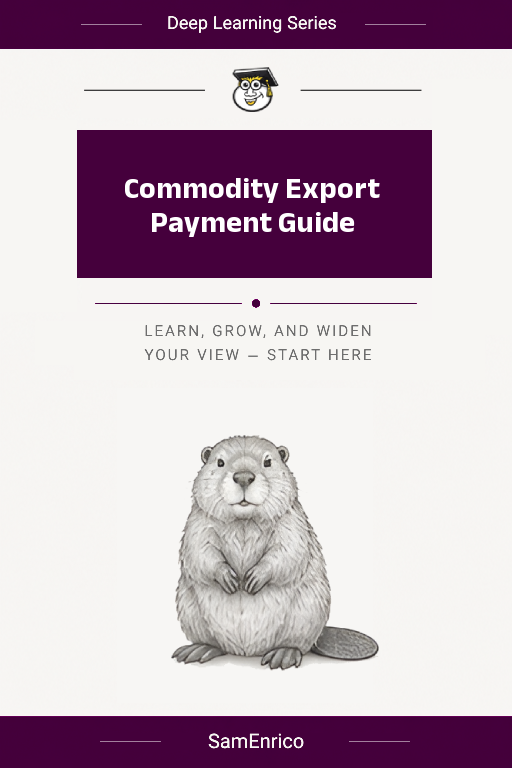
Commodity Export Payment Guide
Structure payment for coffee cocoa or mineral ship
by Marble Hoa
Structure payment for coffee cocoa or mineral shipments using warehouse receipts. Buyer pays against inspection certificate not physical delivery for cross border.
Formats
About this book
Free sample
Chapter 1: The 90-Day Nightmare--–- The humidity in Medellín had ruined three containers of Excelso grade coffee before they ever reached a ship. Not because of mold, not because of improper storage, but because the cooperative’s bank account was empty while their warehouse was full. They had 1.2millionininventorysittinginabondedwarehouse,perfectlypreserved,readytoship.Yettheycouldn’taffordthe1.2 million in inventory sitting in a bonded warehouse, perfectly preserved, ready to ship. Yet they couldn’t afford the 1.2millionininventorysittinginabondedwarehouse,perfectlypreserved,readytoship.Yettheycouldn’taffordthe40,000 trucking fee to move it to the port of Buenaventura. The buyer in Hamburg refused to pay until the Bill of Lading was issued – which would happen only after the goods were loaded onto a vessel.
And the vessel wouldn’t load until the trucking fee was paid. The cooperative was trapped in a paradox that haunts commodity exporters across every developing economy: they were asset-rich and cash-poor simultaneously, watching their wealth rot in storage while banks refused to lend against it.This is not an isolated story. It happens every day in coffee cooperatives across Colombia, Ethiopia, and Vietnam. In cocoa warehouses in Ghana and Côte d’Ivoire. In mineral stockpiles in the Democratic Republic of Congo and Peru.
The traditional payment model for cross-border commodity trade – ship first, get paid later – is fundamentally broken for anyone who isn’t a multinational trading house with a billion-dollar credit line. And the people who suffer most are the small-to-mid exporters who form the backbone of global commodity supply chains.The Cash Flow Gap That Starves Exporters Let’s understand the mechanics of the problem before we solve it. Under standard international trade practice – governed by the International Chamber of Commerce’s Uniform Customs and Practice for Documentary Credits (UCP 600) – the most common payment mechanism is a Letter of Credit (L/C) payable against presentation of a Bill of Lading (B/L). The B/L is a document issued by a shipping line that proves goods have been loaded onto a vessel. Only when that document is presented to the buyer’s bank does payment trigger.Here’s what that means in real days on the calendar…
This is the end of the free sample. Get the eBook to keep going. Buy now
Contents
- Chapter 1
- Chapter 2
- Chapter 3
- Chapter 4
- Chapter 5
- Chapter 6
- Chapter 7
- Chapter 8
- Chapter 9
- Chapter 10
- Chapter 11
- Chapter 12
Details
- Author
- Marble Hoa
- Publisher
- SamEnrico
- Language
- English
- Genre
- Non-Fiction, Business Brief, Commodity Finance
- Released
- 2026-06-01
- Pages (approx.)
- 139
- Available as
- eBook, Audiobook

Read better in the ZLOADR app
Your eBooks on your phone or tablet. Sign in with your SamEnrico account and start reading.
More by Marble Hoa
 Precision Medicine CapitalMarble Hoa$11.99
 Trigger Physical SensationsMarble Hoa$11.99
 SIBO Overlap ManagementMarble Hoa$11.99
 Postpartum Disability Leave GuideMarble Hoa$11.99
 Humor in Presentations GuideMarble Hoa$11.99
 Sarcopenia Thermal ImagingMarble Hoa$11.99
 Migraine Aura Management GuideMarble Hoa$11.99
 Co Parenting Anger ControlMarble Hoa$11.99
 Abbott Texas WheelchairMarble Hoa$11.99
 When the Sky Split: The Maori Birth of Te Rā and Te PōMarble Hoa$11.99
 Qubit's Gambit: The Race to Quantum SupremacyMarble Hoa$11.99
 Arjuna's Arrow: The Celestial Bowstring of the PandavaMarble Hoa$11.99