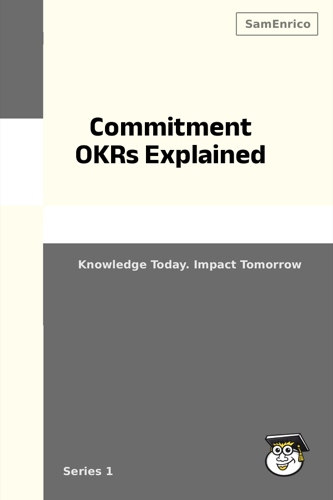
Commitment OKRs Explained eBook
Set must achieve goals with 100% confidence for ba
Set must achieve goals with 100% confidence for basic job duties.
Formats
Free sample
Chapter 1: The 70% Lie--–- The first time Sarah missed a payroll deadline, nobody panicked. It was a Tuesday in March, and the direct deposit files went out at 11:47 AM instead of the usual 10:00 AM. Forty-seven minutes late. Her manager sent a Slack message: "What happened?" Sarah explained that the banking portal had required a two-factor authentication that morning, and her backup code was in her other bag. Her manager nodded, said "Just fix it for next time," and moved on.The second time was worse.
It was July, and the discrepancy was $12,000. Twelve employees were overpaid. Six were underpaid. The company had to issue manual checks, and the VP of Finance had to personally call two furious employees who had rent payments bounce. Sarah's manager defended her in the leadership meeting: "She's usually solid.
Everyone makes mistakes." The VP nodded. But something shifted.The third time was a compliance filing. A state tax form was submitted three days late. The penalty was $4,700. The company paid it.
Nobody was fired.Eighteen months later, Sarah was let go. The official reason was "restructuring." Her final performance review had six OKRs rated at 0.7 or 0.8. "Meets expectations," the rubric said. But when she asked for an exit interview, the HR business partner was honest in a way most HR people never are. "Look," she said, leaning forward.
"You didn't have a single huge failure. But you had three small ones. The VP just lost trust. He couldn't articulate it, but he didn't sleep well knowing payroll was in your hands. It wasn't one thing.
It was death by a thousand 0.7s."Sarah's story is not exceptional. It is not a cautionary tale about incompetence. Sarah was a competent, conscientious professional who had worked in operations for eleven years. Her mistake was not a lack of skill. Her mistake was believing the performance management system she had been taught.She believed that 0.7 was a good score.
She believed that "stretch goals" applied to everything. She believed that missing a commitment by 30% was acceptable as long as you learned something.She was wrong. And if you are reading this book, you might be wrong too.The Most Dangerous Idea in Management Today There is an idea that has spread through corporate America like a benevolent virus. It started at Google in the early 2000s, incubated in the engineering culture that worshiped moonshots and celebrated failure as a badge of honor. The idea was simple: a "good" OKR score is 0.7.
Not 1.0. 0.7. Seventy percent.The logic was elegant. If you are hitting 100% of your goals, you are not stretching enough. You are sandbagging.
You are playing it safe. The perfect OKR score, according to this gospel, is 0.7—aggressive enough to push the team, realistic enough to be achievable, and humble enough to acknowledge that true innovation requires tolerance for failure.This idea was codified in the most influential OKR book of the past decade. It has been repeated in countless blog posts, Linked In articles, and management training seminars. It has been adopted by startups and Fortune 500 companies alike. It has become, for many professionals, an unquestioned article of faith.It is also, for the vast majority of workers, complete and dangerous nonsense.Let me be precise about what I am saying.
Google can afford the 0.7 rule. Google's core business—search advertising—generates hundreds of billions of dollars in annual revenue. Their moonshot projects, like self-driving cars and life sciences divisions, are funded by that revenue. If Waymo's autonomous vehicle team misses a stretch goal by 30%, nobody dies. If Google's search ads team misses a quarterly target by 30%, the company does not collapse.
The tolerance for failure is real because the consequences of failure are low.You are not Google.If you are an air traffic controller and you hit 70% of your separation standards, planes crash. If you are a payroll manager and you process 70% of checks correctly, people cannot pay rent. If you are a surgeon and you succeed 70% of the time, you lose your license. If you are a compliance officer and you file 70% of your regulatory documents on time, your company pays fines and your executive team goes to jail.These are not extreme examples. These are the daily realities of millions of professionals who work in operations, finance, healthcare, manufacturing, logistics, public safety, and regulated industries of every kind.
For these professionals, the 0.7 rule is not a philosophy of healthy ambition. It is a death sentence delivered in quarterly increments.The Quiet Crisis of Misclassified Commitments The damage of the 0.7 rule is not primarily about the scores themselves. The damage is about what the rule incentivizes employees to do with their OKRs.Here is what happens in organizations that celebrate the 0.7 rule: employees learn, consciously or unconsciously, to reclassify their must-win duties as "stretch goals." They take tasks that are legally, contractually, or ethically mandatory—payroll processing, safety checks, compliance filings, customer support SLAs—and they label them as aspirational. They do this not because they are lazy or deceitful. They do this because the performance management system has taught them that a 1.0 is suspicious and a 0.7 is celebrated.The result is a quiet crisis of operational integrity.
Across thousands of organizations, critical job duties are being treated as optional experiments. The language of "learning from failure" has been applied to situations where failure is not a learning opportunity but a catastrophe.I have interviewed dozens of professionals who have experienced this crisis firsthand. A nurse told me that her hospital classified "patient satisfaction scores" as a stretch goal—even though those scores directly impacted Medicare reimbursement and hospital funding. A manufacturing quality manager told me that his plant classified "defect rate reduction" as an aspirational OKR—even though a single defect could cause a product recall that would bankrupt the company. A software engineer told me that his team classified "system uptime" as a stretch goal—even though their service-level agreements with customers required 99.99% availability.In every case, the professionals knew the classification was wrong.
In every case, they were afraid to say so.The Asymmetry of Trust Why does this matter so much? Why is one 0.0 on a Commitment OKR worse than ten 1.0s on stretch goals?The answer lies in what I call the Asymmetry of Trust. This is a psychological and organizational principle that is almost never taught in management training but is universally understood by anyone who has ever been responsible for something important.Here is the math: trust is not additive. It is multiplicative, and it decays asymmetrically.Imagine you have a track record of delivering 1.0 on ten consecutive stretch goals. You have built a reputation as reliable, capable, and trustworthy.
Your manager has confidence in you. Your peers seek you out for difficult projects.Then you miss one Commitment OKR. Not a stretch goal—a commitment. Something that was supposed to be non-negotiable. Payroll is late.
A compliance filing is missed. A safety check is skipped.That single miss does not reduce your trust by 10%. It does not reduce your trust by 50%. It reduces your trust by something closer to 90%. Because the nature of a Commitment OKR is that it was supposed to be certain.
The entire point of the category was that failure was unacceptable. When you fail at something that was supposed to…
This is the end of the free sample. Get the eBook to keep going. Buy now
About this book
Details
- Author
- Seiler Stefani
- Publisher
- SamEnrico
- Language
- English
- Genre
- Non-Fiction, Business Brief, Execution
- Released
- 2026-06-10
- Pages (approx.)
- 141
- Available as
- eBook, Audiobook

Read better in the ZLOADR app
Your eBooks on your phone or tablet. Sign in with your SamEnrico account and start reading.
More by Seiler Stefani
 Intelligence Comparison In CouplesSeiler Stefani$11.99
 Witch Dream Symbolism HandbookSeiler Stefani$11.99
 US Commercial EV CreditSeiler Stefani$11.99
 Recovery Planning After Rehab DischargeSeiler Stefani$11.99
 Blood and Salt: The Forgotten War Over the Dead SeaSeiler Stefani$11.99
 Parson Russell Terrier BreedingSeiler Stefani$11.99
 Understanding Ichthyosis, Keratosis Follicularis Spinulosa DecalvansSeiler Stefani$17.99
 Ultimate Handbook Guide to Tongliao : (China) Travel GuideSeiler Stefani$11.99
 European Works Council ManualSeiler Stefani$12.99
 Parent Communication AutomationSeiler Stefani$12.99