
Non-FictionInformativeEducational
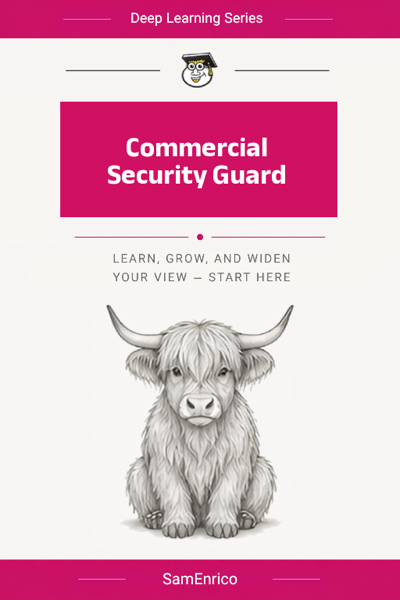
Commercial Security Guard eBook
A Coursebook on Commercial Security Guard
by Ricks Jong
A Coursebook on Commercial Security Guard
Formats
Free sample
Chapter 1: Beyond the Badge...--The first time Marcus Villanueva put on a security uniform, he felt foolish. The polyester shirt was two sizes too large, the trousers bunched at his ankles despite the cursory hem, and the badge—a cheap, gold-plated oval—sat crooked on his chest no matter how many times he adjusted it. He was twenty-two years old, freshly discharged from the military, and he had convinced himself that this was a stepping stone. A temporary embarrassment. A way to pay rent while he waited for something real.Three years later, Marcus had stopped waiting.
He had stopped feeling foolish, too. Not because the uniform had changed—it hadn't—but because he had learned something that no training manual had ever told him. The badge on his chest did not make him a cop. It did not give him special powers. It did not command respect automatically.But it did give him something else: a front-row seat to human nature.In his three years guarding a mid-sized corporate campus, Marcus had talked a suicidal employee down from a rooftop.
He had spotted a small fire that sprinklers missed, saving millions in server equipment. He had been screamed at, ignored, and once physically threatened by a vice president who had forgotten his access card. And on the slowest nights, when the parking lot was empty and the hallways echoed with nothing but the hum of fluorescent lights, he had filled page after page of his pocket notebook with observations about doors, locks, lighting, and people.Marcus was not a hero. He would tell you that himself. But he was a professional.Most people, including many who wear the uniform, do not understand what a commercial security guard actually does.
They think of the sleeping watchman, the bored rent-a-cop, the mall guard on a power trip. They think of a job that requires nothing more than a pulse and the ability to stay awake. This book exists to destroy that misconception.This chapter is the foundation. Before you learn about radios, report writing, legal authority, or defensive tactics, you must understand one thing: what you are and what you are not. Your entire career—your safety, your freedom, your professional reputation—depends on this distinction.The Evolution: From Watchman to Risk Manager One hundred years ago, the security guard was exactly what popular culture remembers: a night watchman.
He carried a flashlight, a heavy clock that he punched at designated stations to prove he was awake, and little else. His job was passive. He walked a route. He looked for fires, open doors, and intruders. If he found something wrong, he reported it to someone else—a manager, the police, the fire department—and his responsibility ended there.That guard still exists in certain settings.
Small warehouses, rural construction sites, and some residential buildings still use a model that has barely changed since the 1920s. But the commercial security guard of the twenty-first century operates in a vastly different world.The shift began in the 1970s and accelerated after September 11, 2001. As businesses became more complex, as liability lawsuits multiplied, as terrorism and workplace violence entered the mainstream consciousness, the role of the security guard transformed. No longer a passive observer, the modern guard is an active participant in risk management.What does that mean?Risk management, in the security context, is the process of identifying, assessing, and controlling threats to an organization's people, property, and operations. A security guard does not simply report a problem.
The guard prevents problems from occurring in the first place. The guard identifies vulnerabilities before they are exploited. The guard documents everything so that the organization can defend itself in court, collect insurance claims, and learn from near-misses.Consider the difference this way. The old watchman sees a door that is supposed to be locked but is standing open. He writes in his log: "3:15 AM, warehouse door B found open.
Closed and locked." The modern security guard sees the same door and asks a series of questions: Why was this door open? Was it left unsecured by an employee? Was the lock broken? Has this happened before? Is there a pattern?
The guard documents not only the fact of the open door but also the surrounding circumstances, notifies the appropriate supervisor, and—if necessary—recommends a physical inspection of the lock mechanism.The old watchman reacts. The modern guard analyzes.This evolution is not merely semantic. It has practical, legal, and financial implications that will echo throughout every chapter of this book. When you understand yourself as a risk manager rather than a watchman, you change how you walk, how you look, how you write, and how you think.Two Paths: Contract vs. Proprietary Security Before you go any further, you need to know which kind of security guard you are or will become.
The distinction between contract security and proprietary security shapes every aspect of your working life: your training, your chain of command, your loyalty obligations, and your career trajectory.Contract Security Contract security guards are employed by a security company—Allied Universal, Securitas, Garda World, and hundreds of smaller regional firms—and then assigned to work at a client's site. The guards are employees of the security company, not the business they protect. Their paychecks, benefits, uniforms, and training come from the security company.This model dominates the industry. Approximately seventy percent of all security guards in the United States work for contract security firms. The reasons are obvious to any business owner.
Hiring a contract firm shifts the burden of recruitment, training, background checks, insurance, and liability away from the client. If a guard makes a mistake, the client can demand a replacement from the security company. If a guard quits, the security company finds a replacement. The client simply pays a monthly invoice and receives a security presence.For the guard, contract security offers both advantages and disadvantages.The advantages include variety and opportunity. Contract guards often work at multiple sites over the course of their careers—office buildings, industrial plants, hospitals, schools, retail centers.
This variety builds experience quickly. Contract security companies are also large organizations with formal career pathways: guard to field supervisor to account manager to regional leadership.The disadvantages are significant. Contract guards are often paid less than their proprietary counterparts. Benefits are thinner. Training can be minimal because security companies compete on price, and cutting training costs is a quick way to lower bids.
Most critically, contract guards are always aware that they are guests. The client can terminate the contract, and the security company can reassign or lay off guards, with little notice. Job security in contract security is an illusion many learn too late.Proprietary Security Proprietary security guards—also called in-house security—are direct employees of the business they protect. A bank that hires its own guards, a hospital that maintains its own security department, a corporate campus with a uniformed team wearing the company logo: these are proprietary operations.In-house guards typically earn higher wages and receive better benefits than contract guards. They are part of the organization, not temporary visitors.
They build relationships with the same employees and managers day after day, year after year. The training is often more…
This is the end of the free sample. Get the eBook to keep going. Buy now
About this book
Details
- Author
- Ricks Jong
- Publisher
- SamEnrico
- Language
- English
- Genre
- Non-Fiction, Informative, Educational
- Released
- 2026-05-06
- Pages (approx.)
- 151
- Available as
- eBook, Audiobook

Read better in the ZLOADR app
Your eBooks on your phone or tablet. Sign in with your SamEnrico account and start reading.
More by Ricks Jong
 Eye Strain Headache GuideRicks Jong$11.99
 LibraryThing Collection StatusRicks Jong$11.99
 Legumes Insulin ResistanceRicks Jong$11.99
 Meth Skin Healing ProtocolRicks Jong$11.99
 Sole Heist: The Great Air Jordan Theft of 2001Ricks Jong$11.99
 Data Entry Automation with AIRicks Jong$12.99
 How to Become a Potato-chip SorterRicks Jong$11.99
 Learn to Play the MelodicaRicks Jong$11.99
You may also like
 Hong Kong Handover 1997Dunn Johnnie$11.99
 Zumba For Postnatal Recovery CourseNeal Christian$11.99
 Zumba for BeginnersLadner Nikia$11.99
 YouTube Comment Mining GuideHumes Pandora$12.99
 Worry Box MeditationCarlin Rudy$11.99
 Workplace Stress MeditationNguyen Lynn$11.99
 Workplace Stress and Sleep RepairHawley Ivory$11.99
 Workplace Perfectionism CureDelaney Jeffry$11.99
 Workplace Injustice Anger GuideWallen Isabelle$11.99
 Work Addiction and Burnout LinkGreenwood Ester$11.99
 Women in Yoga and WellnessBeattie Galina$11.99
 Women in Stand Up ComedyChun Evangeline$11.99