
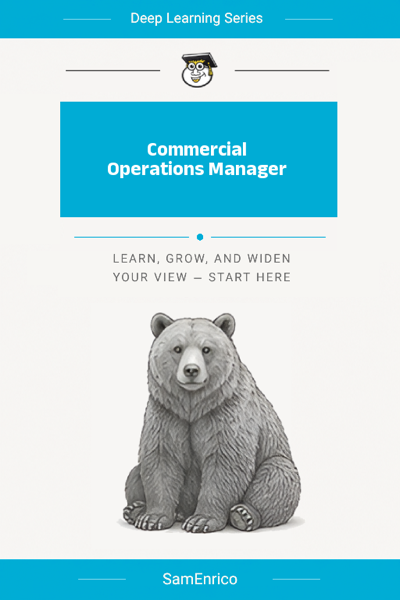
Non-FictionInformativeEducational
Commercial Operations Manager eBook
A Coursebook on Commercial Operations Manager
A Coursebook on Commercial Operations Manager
Formats
Free sample
Chapter 1: The Invisible Engine...--Imagine walking into a fast-growing technology company. The sales floor is electric—reps on headsets, whiteboards covered in deal names, managers huddling in glass conference rooms. The CEO is charismatic, the product is disruptive, and the investors are thrilled. Everyone believes the revenue growth is driven by brilliant salespeople closing brilliant deals.Now imagine walking into the back office. There, in a windowless room, sits a person staring at a spreadsheet that doesn't balance.
The CRM has three different spellings of the same customer. The lead routing script just sent a $2 million opportunity to a rep who specializes in small business. The VP of Sales is demanding a forecast, but no one knows which deals are real. This person—the Commercial Operations Manager—is about to have a very bad day.Here is the truth that most companies never admit: the hero sales rep is a myth. Charisma closes individual deals.
But systems close quarters. Processes scale revenue. And data predicts the future. The invisible engine that powers every high-growth company is not a person with a quota—it is the Commercial Operations function working silently behind the scenes.Yet most organizations treat Commercial Operations as an afterthought. They hire a "Sales Ops" person to clean up CRM data.
They ask a "Revenue Ops" manager to build reports. They expect a "Business Ops" analyst to fix the lead routing. These titles multiply, but the core problem remains: no one has defined what Commercial Operations actually is, how it differs from every other "ops" function, or why it matters more today than ever before.This chapter draws a hard line in the sand. Commercial Operations is not logistics. It is not supply chain management.
It is not manufacturing operations. Those functions optimize cost and efficiency. Commercial Operations optimizes revenue effectiveness—the ability of a company to turn a marketing lead into a paying customer faster, cheaper, and more predictably than the competition.If you are reading this book, you already suspect something is broken. Deals are slipping through cracks. Reps are drowning in admin.
Leadership is guessing instead of knowing. You have been handed the responsibility without the authority, the tools without the training, and the problems without the playbook.By the end of this chapter, you will understand exactly what Commercial Operations is, why your company desperately needs it, and how to diagnose whether your current ops team is a strategic asset or a glorified spreadsheet factory. More importantly, you will see yourself differently—not as a support function, but as the architect of the revenue engine.The Great Confusion: Why "Operations" Means Everything and Nothing Ask five executives what "operations" means, and you will receive six answers. To the supply chain director, operations is warehouses and trucks. To the manufacturing VP, it is assembly lines and quality control.
To the chief technology officer, it is server uptime and incident response. And to the chief revenue officer, it is... well, no one is quite sure.This ambiguity is not accidental. The word "operations" derives from the Latin operari, meaning "to work." But in modern business, every function has claimed a piece of the term. The result is a fragmented, confusing landscape where well-intentioned leaders create overlapping roles that compete rather than collaborate.Let us clarify the landscape before we build the house.Supply Chain Operations manages the flow of physical goods—raw materials to warehouses to customers.
Its primary metric is cost per unit delivered. Its tools are inventory management systems and logistics software. Its heroes are the people who ensure products arrive on time without destroying margins.Manufacturing Operations manages the transformation of inputs into outputs—assembly lines, quality assurance, plant utilization. Its primary metric is overall equipment effectiveness (OEE). Its tools are Lean, Six Sigma, and Kanban.
Its heroes are the engineers who squeeze efficiency from every machine.IT Operations manages the stability and security of technology infrastructure—servers, networks, databases, authentication. Its primary metric is uptime percentage. Its tools are monitoring dashboards and incident response playbooks. Its heroes are the system administrators who keep the lights on.Facilities Operations manages physical workspaces—cleaning, security, HVAC, parking. Its primary metric is occupant satisfaction.
Its tools are work order systems and vendor contracts. Its heroes are the building managers who ensure the coffee is hot and the toilets flush.Each of these functions is essential. Each has a clear mandate, measurable outcomes, and established best practices. But none of them is Commercial Operations.Commercial Operations sits at a different intersection entirely. It does not move boxes.
It does not run assembly lines. It does not reboot servers. Commercial Operations moves revenue—specifically, the revenue that flows from marketing's first touch to finance's final collection, passing through sales, customer success, and legal along the way.This distinction is not academic. When a company confuses Commercial Operations with general operations, it makes predictable mistakes. It hires a supply chain expert to fix lead routing.
It asks a manufacturing engineer to design territory allocation. It expects an IT project manager to build a sales forecasting model. The result is not just inefficiency—it is active harm to revenue growth.The Commercial Operations Manager is not a generalist who happens to work near sales. This is a specialized role requiring fluency in four distinct domains: process engineering, data science, change management, and financial analysis. Few people possess all four skills.
That is why this book exists.The Three Pillars of Commercial Operations To understand what Commercial Operations does, we must first understand what it builds. Every commercial operation rests on three foundational pillars: People, Process, and Platforms. Without all three, the structure collapses.Pillar One: People The first pillar is the most misunderstood. When executives hear "Commercial Operations People," they imagine the ops team itself—the analysts, the administrators, the report builders. But this is backwards.
The primary "people" in Commercial Operations are not the operators but the operated: sales representatives, sales development representatives, customer success managers, and the frontline teams who touch customers every day.Commercial Operations exists to enable these people, not to audit them. A sales rep should never wonder where their next lead comes from, how to log a meeting quickly, or whether their commission check will be accurate. The ops team builds the machine so that the frontline can focus on what humans do best: build relationships, understand needs, and close trust.This philosophical shift is profound. Most companies treat Commercial Operations as a policing function—checking whether reps filled out required fields, enforcing compliance with territory rules, auditing activity logs. But a policing mindset creates adversarial relationships.
Reps hide data. Ops creates more rules. The cycle spirals downward.The alternative is the enabling mindset. In this model, Commercial Operations asks a single question of every decision: "Does this make it easier or harder for a rep to sell?" A required field that blocks deal progression makes selling harder, so it should be eliminated or automated. A dashboard that shows a rep exactly which leads to call next makes selling easier, so it should be built immediately.This distinction between mandatory and optional data will appear throughout this book.
Some information is revenue-critical—deal value, close date, customer name—and must be captured accurately, even if it requires governance. Other information…
This is the end of the free sample. Get the eBook to keep going. Buy now
About this book
Details
- Author
- Shultz Jerica
- Publisher
- SamEnrico
- Language
- English
- Genre
- Non-Fiction, Informative, Educational
- Released
- 2026-05-11
- Pages (approx.)
- 159
- Available as
- eBook, Audiobook

Read better in the ZLOADR app
Your eBooks on your phone or tablet. Sign in with your SamEnrico account and start reading.
More by Shultz Jerica
 MFA Bypass Methods YearShultz Jerica$11.99
 Co occurring Mental Health OUDShultz Jerica$11.99
 Pivot to Full Time CreatorShultz Jerica$11.99
 Woyo Pottery StoriesShultz Jerica$11.99
 The Government Employee GuideShultz Jerica$11.99
 The Timbuktu Theorem: When African Mathematicians Rewrote the WorldShultz Jerica$11.99
 UK Sustainability Certifications GuideShultz Jerica$12.99
 Search Console Property VerificationShultz Jerica$12.99
 Understanding Precocious Puberty, Gonadotropin-dependentShultz Jerica$17.99
 How to Start a Chilli Growing Business (Beginners Guide)Shultz Jerica$11.99
You may also like
 Hong Kong Handover 1997Dunn Johnnie$11.99
 Zumba For Postnatal Recovery CourseNeal Christian$11.99
 Zumba for BeginnersLadner Nikia$11.99
 YouTube Comment Mining GuideHumes Pandora$12.99
 Worry Box MeditationCarlin Rudy$11.99
 Workplace Stress MeditationNguyen Lynn$11.99
 Workplace Stress and Sleep RepairHawley Ivory$11.99
 Workplace Perfectionism CureDelaney Jeffry$11.99
 Workplace Injustice Anger GuideWallen Isabelle$11.99
 Work Addiction and Burnout LinkGreenwood Ester$11.99
 Women in Yoga and WellnessBeattie Galina$11.99
 Women in Stand Up ComedyChun Evangeline$11.99