
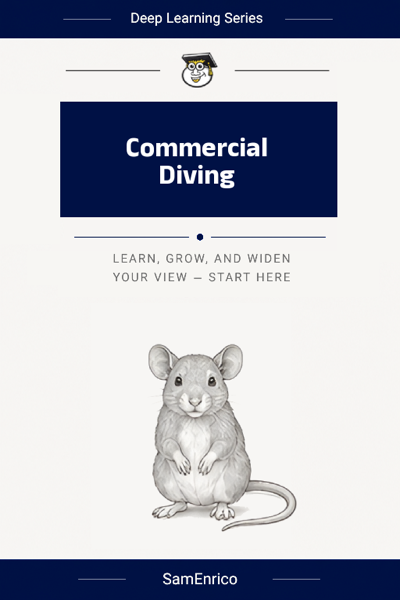
Non-FictionInformativeEducational
Commercial Diving eBook
A Coursebook on Commercial Diving
by Rose Luis
A Coursebook on Commercial Diving
Formats
Free sample
Chapter 1: The Hard Hat Difference...--The 911 call comes in at 10:47 AM on a Tuesday. The dispatcher writes the transcript in block capitals, the way they train you to do when someone is screaming.CALLER: He’s not answering! Oh God, he’s not answering!DISPATCHER: Sir, I need you to calm down. Who is not answering?CALLER: The diver! Tommy!
He’s on the bottom and his line went slack and he’s not answering the comms!DISPATCHER: How deep is the water, sir?CALLER: Ninety feet! He’s been down ninety feet for—I don’t know—ten minutes? Twelve? The umbilical just went slack and I pulled and there’s nothing on the end!DISPATCHER: Sir, do you have a standby diver?CALLER: (long pause) He’s on a smoke break.The transcript is real. The names have been changed, but the event happened.
The diver survived—barely. His umbilical had snagged on a submerged tree trunk, a snag his tender didn’t notice for ninety seconds because the tender was looking at his phone. By the time the standby diver suited up and went down, the diver had cut his own umbilical with a knife and was breathing from his bailout bottle, alone in zero visibility, trying to remember how to find the surface without a line.He made it. He quit diving the next week. He told an interviewer later: “I didn’t quit because I was scared.
I quit because I realized no one up there was paying attention.”That is the hard hat difference. Not the helmet. Not the depth. The difference is this: in recreational diving, you are responsible for yourself. In commercial diving, you are responsible for everything—and no one is responsible for you except the tender who might be looking at his phone.The Four Fatal Assumptions Every recreational diver who crosses over to commercial work brings four assumptions with them.
These assumptions are not just wrong. They are lethal.Assumption One: “My dive computer will keep me safe.”Your dive computer is a marvel of engineering. It tracks depth, time, nitrogen loading, ascent rate, and a dozen other variables. It beeps when you are doing something wrong. It clears you for another dive when your tissues have off-gassed enough.
It is, for the recreational diver, a reasonably reliable babysitter.Now throw it in the trash.Commercial diving does not use dive computers as primary instruments. The reasons are multiple. First, dive computers fail. Batteries die. Sensors foul.
Screens crack. In recreational diving, a computer failure means you abort the dive. In commercial diving, a computer failure means you switch to your pneumofathometer—a simple hose connected to a pressure gauge on the surface, no electronics, no batteries, no opinion. The pneumofathometer does not calculate your nitrogen loading. It does not track your ascent rate.
It tells you one thing: how deep you are, right now. Everything else is your responsibility.Second, dive computers are conservative. They are designed for recreational divers who might be tired, dehydrated, or hungover. Commercial diving uses tables—the U.S. Navy tables, IMCA tables, or company-specific tables—that are less forgiving because they assume a fit, rested, trained diver.
If you follow your dive computer on a commercial job, you will surface earlier than necessary, leaving money on the table. If you follow the tables, you will stay down longer, work harder, and come up with more bottom time logged. But if you make a mistake with the tables, the computer will not save you.Third—and this is the one that kills people—dive computers do not integrate with surface supplied diving. Your computer measures the pressure at your wrist. It has no idea what your umbilical is doing.
It cannot tell you that your gas supply is coming from a compressor with a cracked exhaust pipe. It cannot warn you that your tender has switched you to emergency gas. It is a passive observer, not an active participant. In commercial diving, the active participant is the team on the surface. You are just the end of the line.Assumption Two: “If something goes wrong, I can just go up.”In recreational diving, the solution to most problems is simple: ascend.
Out of air? Ascend. Lost your buddy? Ascend. Feeling narced?
Ascend. The surface is the ultimate safety net.In commercial diving, the surface is often the most dangerous place you can go.This is the first hard lesson of the hard hat world. A recreational diver who ascents from 100 feet without a safety stop might get bent. A commercial diver who ascents from 100 feet without following the decompression schedule will absolutely get bent—and might die from an arterial gas embolism before reaching the surface. The difference is bottom time.
Recreational divers rarely spend enough time at depth to saturate their tissues. Commercial divers stay down for hours. A recreational dive to 100 feet might last 20 minutes. A commercial dive to 100 feet might last three hours. The decompression obligation for three hours at 100 feet is measured in hours, not minutes.So when something goes wrong at 90 feet, you cannot just go up.
You have to solve the problem where you are, with the tools you have, while breathing from your bailout bottle if necessary, while your tender tries to figure out what went wrong. The surface is not a sanctuary. It is a destination you reach only after completing all the stops.Assumption Three: “I can hear what’s happening around me.”Sound travels four times faster in water than in air. This seems like it would be an advantage. It is not.Because sound travels faster underwater, your brain cannot localize the source.
A sound that arrives at your left ear 0.0001 seconds before your right ear gives your brain enough information to determine direction in air. Underwater, the difference is too small to detect. Every sound seems to come from everywhere at once. This is called the head shadow effect, and it means you cannot tell whether the noise you hear is your tender tapping on your helmet or a boat propeller about to cut your umbilical.Worse, commercial divers wear helmets that cover their entire head. The helmet is lined with communications speakers, but it also blocks ambient sound.
A recreational diver in a mask and wetsuit can hear a boat approaching. A commercial diver in a hard hat hears nothing except what comes through the comms. That is why surface supplied divers have a dedicated tender whose only job is to listen to the environment and warn the diver. The tender is the diver’s ears. If the tender is not paying attention, the diver is deaf.Assumption Four: “I am the most important person on this dive.”In recreational diving, you are.
The dive revolves around your experience, your comfort, your safety. The dive master is there to facilitate your enjoyment.In commercial diving, you are a tool. A very expensive, very fragile, very replaceable tool. The dive does not exist for your benefit. The dive exists to complete a task: weld a pipe, inspect a bridge, cut a cable, place a charge.
You are the means to that end. If you cannot complete the task, the supervisor will replace you. If you…
This is the end of the free sample. Get the eBook to keep going. Buy now
About this book
Details
- Author
- Rose Luis
- Publisher
- SamEnrico
- Language
- English
- Genre
- Non-Fiction, Informative, Educational
- Released
- 2026-06-02
- Pages (approx.)
- 142
- Available as
- eBook, Audiobook

Read better in the ZLOADR app
Your eBooks on your phone or tablet. Sign in with your SamEnrico account and start reading.
More by Rose Luis
 Libido Loss And HormonesRose Luis$11.99
 Stress Communication for CouplesRose Luis$11.99
 Networking for Non-Native English SpeakersRose Luis$11.99
 Asian American Mobile App BehaviorRose Luis$11.99
 The Silk Road Heist: Marco Polo’s Forbidden FortuneRose Luis$11.99
 How to Start a Hobby in Aircraft spottingRose Luis$11.99
 How to Produce Baseball and Softball Leg GuardsRose Luis$11.99
 US Contract to FTE Raise GuideRose Luis$12.99
You may also like
 Hong Kong Handover 1997Dunn Johnnie$11.99
 Zumba For Postnatal Recovery CourseNeal Christian$11.99
 Zumba for BeginnersLadner Nikia$11.99
 YouTube Comment Mining GuideHumes Pandora$12.99
 Worry Box MeditationCarlin Rudy$11.99
 Workplace Stress MeditationNguyen Lynn$11.99
 Workplace Stress and Sleep RepairHawley Ivory$11.99
 Workplace Perfectionism CureDelaney Jeffry$11.99
 Workplace Injustice Anger GuideWallen Isabelle$11.99
 Work Addiction and Burnout LinkGreenwood Ester$11.99
 Women in Yoga and WellnessBeattie Galina$11.99
 Women in Stand Up ComedyChun Evangeline$11.99