
Non-FictionHealth & WellnessMattress
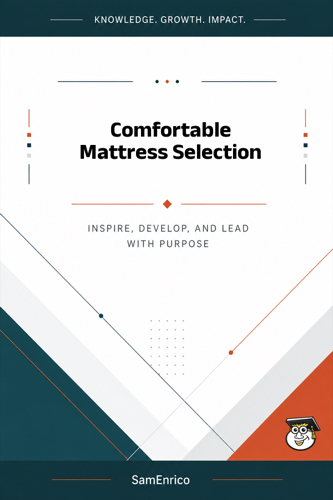
Comfortable Mattress Selection eBook
Replace mattress every 7 to 10 years for support.
Replace mattress every 7 to 10 years for support.
Formats
Free sample
Chapter 1: The Support Clock...--–- Every mattress is born with a death warrant. It arrives wrapped in plastic, smelling of factories and possibility, promising the best sleep of your life. And for a while, it delivers. But hidden beneath the quilted cover and the memory foam topper, a silent timer begins counting down the moment you lay down for the first time. This is the Support Clock, and it does not care about your warranty, your budget, or how expensive your mattress was.
It ticks with every toss, every turn, every night of the seven to ten years you are supposed to own it. Most people never hear it. They wake up with stiff backs, assume they slept wrong, and go about their day. They blame aging, stress, or the office chair. They do not blame the thing they spend one-third of their lives on.
That is a mistake, and it is an expensive one.The Support Clock is not a metaphor. It is a measurable, predictable decay curve that every mattress follows. Polyurethane foams lose their ability to spring back. Steel coils undergo metal creep, slowly compressing under repeated loads. Natural fibers like cotton and wool break down and mat.
Even the glue holding layers together dries out and cracks. The degradation is almost invisible from the outside because manufacturers know how to hide it. A mattress can look perfectly fine—no lumps, no visible sags, no torn fabric—and still be completely incapable of supporting your spine. This is the industry's dirty secret. They sell you comfort on the surface and durability that fails underneath.
And they count on you not knowing the difference.Let us start with the science of what actually happens inside a mattress over time. When you lie down, your body weight compresses the materials beneath you. In a new mattress, those materials rebound fully when you get up. This is called resilience, and it is the single most important property for longevity. But resilience is not permanent.
Every compression cycle causes microscopic damage to the cellular structure of foams and the crystalline lattice of metal springs. Think of it like bending a paperclip back and forth. The first fifty bends do nothing. The next fifty create a small weak spot. By bend two hundred, the metal snaps.
Your mattress undergoes the same process, just slower. Each night, you subject it to roughly three hundred to five hundred compression cycles as you shift positions. Over one year, that is over one hundred thousand cycles. Over seven years, nearly three-quarters of a million cycles. No material is immune to that kind of punishment.The biological cost of ignoring the Support Clock is staggering.
Research published in the Journal of Chiropractic Medicine found that sleeping on a mattress older than ten years correlates with a sixty percent higher incidence of chronic lower back pain compared to sleeping on a mattress aged five years or less. That is not a minor increase. That is the difference between waking up refreshed and waking up unable to tie your shoes without pain. The same study found a forty-five percent increase in morning stiffness, which participants described as taking over an hour to fully resolve. These are not subtle symptoms.
They are the body's way of screaming that something is wrong. But because the mattress looks fine, most people assume the problem is internal—their back is weak, their age is catching up, or they need a different pillow. They go to chiropractors, buy ergonomic chairs, and start stretching routines. They spend thousands of dollars treating the symptom while the cause rots beneath them.The spinal implications are particularly serious. Your spine is not a straight rod.
It has natural curves—a inward curve at the neck (lordosis), an outward curve at the upper back (kyphosis), and another inward curve at the lower back (lordosis). A proper mattress supports these curves, keeping the spine in neutral alignment. When a mattress sags, even by as little as half an inch, the lower back loses its support. The hips sink lower than the shoulders and feet, creating what sleep researchers call the "hammock effect." This hyperextends the lumbar spine, placing stress on the facet joints and the intervertebral discs. Over time, this accelerates disc degeneration, pinches nerves, and creates chronic pain patterns that become self-reinforcing.
Your muscles begin to compensate, tightening on one side and weakening on the other, creating a postural imbalance that persists even when you are awake. You are not just sleeping badly. You are actively damaging your spine every single night.The relationship between mattress age and sleep architecture is equally alarming. Sleep is not a single state. It cycles through four stages: N1 (light sleep), N2 (deeper light sleep), N3 (deep slow-wave sleep), and REM (rapid eye movement, where dreaming occurs).
Each cycle lasts about ninety minutes, and a healthy sleeper goes through four to six cycles per night. Deep sleep and REM sleep are the restorative phases. This is when your body repairs tissue, consolidates memory, clears metabolic waste from the brain, and regulates hormones. A sagging mattress disrupts these cycles by triggering micro-awakenings—brief arousals that last only a few seconds and that you do not consciously remember. You think you slept through the night, but your brain never entered deep sleep.
Researchers have measured this effect using polysomnography. Participants sleeping on seven-year-old mattresses spent twenty-three percent less time in deep sleep and nineteen percent less time in REM sleep compared to the same participants sleeping on new mattresses. The consequences are not trivial. Reduced REM sleep impairs memory consolidation and emotional regulation. Reduced deep sleep impairs physical recovery and immune function.
You are not just tired. You are cognitively and physically compromised.There is also the hidden burden of allergens. A mattress is a biological sponge. Over seven years, it absorbs sweat, skin oils, dead skin cells, and bodily fluids. The average person sheds roughly 1.5 pounds of dead skin per year.
Multiply that by seven years, and you have over ten pounds of skin cells embedded in your mattress. This is not merely disgusting; it is a food source. Dust mites—microscopic arachnids that thrive in warm, humid environments—colonize mattresses in staggering numbers. A typical queen-sized mattress at the seven-year mark contains between two million and ten million dust mites. Each mite produces roughly twenty fecal pellets per day.
Those pellets are small enough to become airborne when you move, and they contain powerful allergens that trigger inflammation in the airways. This is why so many people experience morning congestion, sneezing, and watery eyes that clear up within an hour of leaving the bedroom. They assume it is seasonal allergies or a cold. It is their mattress. The problem is so common that the American Academy of Allergy, Asthma, and Immunology specifically recommends replacing mattresses every seven to ten years as part of environmental control for allergic rhinitis and asthma.The "it looks fine" myth is the biggest obstacle to replacement.
Humans are visual creatures. We trust what we see more than what we feel. A mattress that appears flat and smooth must be fine, right? Wrong. The visible surface of a…
This is the end of the free sample. Get the eBook to keep going. Buy now
About this book
Details
- Author
- Hutto Georgina
- Publisher
- SamEnrico
- Language
- English
- Genre
- Non-Fiction, Health & Wellness, Mattress
- Released
- 2026-06-06
- Pages (approx.)
- 129
- Available as
- eBook, Audiobook

Read better in the ZLOADR app
Your eBooks on your phone or tablet. Sign in with your SamEnrico account and start reading.
More by Hutto Georgina
 The High Achiever Hydration HabitHutto Georgina$11.99
 Immigrant Rights Nonprofit Fraud HandbookHutto Georgina$11.99
 Blue Zone Forgiveness Practice GuideHutto Georgina$11.99
 Burnout Warning Signs HandbookHutto Georgina$11.99
 The Velvet Noose: The Enigma of Madame PopovaHutto Georgina$11.99
 Blood BondsHutto Georgina$11.99
 Founder Depression Meditation GuideHutto Georgina$12.99
 Mobile App CAC TacticsHutto Georgina$12.99
 Understanding Woods–leversha–Rogers SyndromeHutto Georgina$17.99
 How to Start a Basalt Mine Business (Beginners Guide)Hutto Georgina$11.99
You may also like
 Hong Kong Handover 1997Dunn Johnnie$11.99
 Zumba For Postnatal Recovery CourseNeal Christian$11.99
 Zumba for BeginnersLadner Nikia$11.99
 YouTube Comment Mining GuideHumes Pandora$12.99
 Worry Box MeditationCarlin Rudy$11.99
 Workplace Stress MeditationNguyen Lynn$11.99
 Workplace Stress and Sleep RepairHawley Ivory$11.99
 Workplace Perfectionism CureDelaney Jeffry$11.99
 Workplace Injustice Anger GuideWallen Isabelle$11.99
 Work Addiction and Burnout LinkGreenwood Ester$11.99
 Women in Yoga and WellnessBeattie Galina$11.99
 Women in Stand Up ComedyChun Evangeline$11.99