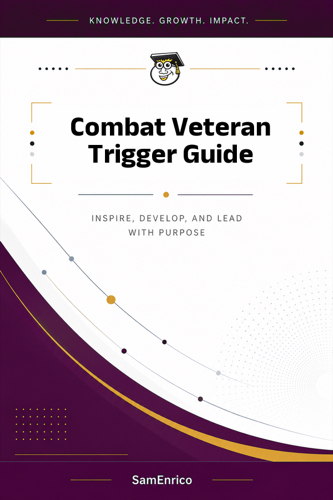
Combat Veteran Trigger Guide eBook
Manage hypervigilance, loud noise reactions, and c
by Best Debroah
Manage hypervigilance, loud noise reactions, and combat-related traumatic memories.
Formats
Free sample
Chapter 1: Welcome Home, Warrior--You have been home for months. Or years. Or decades. And something still does not feel right.The world looks different to you now. You notice things other people miss.
The way a car backfires and everyone else laughs while your heart pounds and your hand reaches for a weapon that is not there. The way a crowded restaurant feels like an ambush waiting to happen, so you position yourself with your back to the wall and a clear line of sight to every exit. The way you scan every room you enter, assessing threats, identifying cover, calculating escape routes. The way you cannot remember the last time you truly relaxed.These are not personality quirks. These are not signs that you are broken.
These are survival adaptations. Your brain and body learned to keep you alive in an environment where threats were real, constant, and deadly. The problem is that they have not figured out how to turn off now that you are home.This chapter is about understanding why you feel the way you do. Not as a clinical diagnosis, though that may apply. Not as a label to be ashamed of, though you may have been taught to feel that way.
But as a combat veteran trying to make sense of a world that no longer makes the same sense it used to. By the time you finish this chapter, you will have a name for what you are experiencing, a framework for understanding why it happened, and a clear picture of where this book will take you next.The War That Did Not End The tour ends. The long war does not. That is the reality of combat-related post-traumatic stress. You may have left the battlefield, but the battlefield did not leave you.
It lives in your nervous system, in the startle response that still fires at sudden noises, in the hypervigilance that makes relaxation feel like negligence, in the nightmares that visit you when you least expect them.Let us be clear about something from the very beginning. This is not a sign of weakness. It is not a moral failing. It is not evidence that you are somehow less than the warrior you once were. The opposite is true.
Your brain did exactly what it was supposed to do. The amygdala—your brain's alarm system—learned to detect threats with incredible speed and accuracy. That kept you alive. The hippocampus—your brain's memory center—encoded traumatic events with vivid intensity so you would never forget the danger. That also kept you alive.
The stress hormone system pumped adrenaline and cortisol through your body to prepare you for fight or flight. That kept you alive too.The problem is that the same adaptations that protected you in a combat zone can poison your life at home. The alarm that saved your life in Ramadi goes off when a car backfires in your hometown. The memory encoding that helped you learn from ambushes now replays those ambushes when you are trying to sleep. The stress hormones that gave you the edge in combat now leave you exhausted, irritable, and unable to rest.You are not broken.
You are not crazy. You are not weak. You are a combat veteran whose nervous system is still doing its job. It just needs help recalibrating.The Many Faces of Combat Trauma Combat trauma is not one thing. It is many things, and it shows up differently in different people.
Understanding the specific ways trauma affects you is the first step toward managing it. Let us walk through the most common symptoms.Hypervigilance is the most common and perhaps most exhausting symptom. Your threat detection system is stuck in overdrive. You scan constantly for danger. You notice changes in your environment that others miss—the subtle shift in someone's posture, the unexpected sound, the unfamiliar car on your street.
You cannot relax because relaxing feels unsafe. Relaxing means lowering your guard, and lowering your guard got people killed in combat. Your brain remembers.Startle reactions are the most visible symptom. A loud noise, a sudden movement, someone touching you from behind—your body reacts before your mind can catch up. You hit the deck.
You spin around ready to fight. Your heart pounds. Your breathing quickens. Your muscles tense. This is not a choice.
It is not something you can control by willpower alone. It is a reflex, wired into your nervous system at the deepest level. In combat, that reflex saved your life. At home, it causes embarrassment, shame, and avoidance of situations where loud noises might occur.Traumatic memories and flashbacks are the most distressing symptoms. You are going about your day—grocery shopping, driving, sitting at your desk—when something triggers a memory so vivid it feels like you are back there.
You smell the smells. You hear the sounds. You feel the fear. For a moment—or longer—you are not in your living room or your office. You are back on patrol.
The mission that went wrong. The IED that changed everything. The face you cannot forget. This is not imagination. This is your brain's memory system misfiring, treating a memory as if it is happening in the present.Avoidance and numbing are the most isolating symptoms.
You stop going places. You stop seeing people. You stop feeling things. The world becomes gray. You withdraw because interacting with others is exhausting.
Because you cannot explain what you are going through without sounding crazy. Because you do not want to burden anyone with your darkness. Because it is easier to be alone than to pretend to be okay. The problem is that avoidance feeds on itself. The more you withdraw, the harder it becomes to reach out.
The more you numb, the harder it becomes to feel anything at all—including joy, love, and connection.Anger and irritability are the most relationship-damaging symptoms. Your fuse is short. Small annoyances feel like personal attacks. Your spouse asks a simple question and you snap. Your child makes a normal amount of noise and you yell.
Your coworker offers help and you interpret it as criticism. Later, you feel guilty and ashamed. You apologize. You promise to do better. Then it happens again.
This is not because you are a bad person. It is because your nervous system is constantly on edge, ready to fight at the slightest provocation.Sleep problems and nightmares are the most physically damaging symptoms. You cannot fall asleep. Your mind races. You replay the day.
You worry about tomorrow. You scan for threats even in your bedroom. When you do fall asleep, you cannot stay asleep. You wake up at 2 AM, heart pounding, drenched in sweat, not sure where you are. When you finally get back to sleep, the nightmares come.
You relive the worst moments of your life. You wake up exhausted, more tired than when you went to bed. Your body never gets the rest it needs. And without rest, every other symptom gets worse.These symptoms do not appear in isolation. They feed on each other.
Hypervigilance makes it hard to sleep. Lack of sleep makes you more irritable. Irritability damages your relationships. Damaged relationships increase…
This is the end of the free sample. Get the eBook to keep going. Buy now
About this book
Details
- Author
- Best Debroah
- Publisher
- SamEnrico
- Language
- English
- Genre
- Non-Fiction, Self-Help, Military PTSD
- Released
- 2026-06-11
- Pages (approx.)
- 113
- Available as
- eBook, Audiobook

Read better in the ZLOADR app
Your eBooks on your phone or tablet. Sign in with your SamEnrico account and start reading.
More by Best Debroah
 Postpartum Milk Supply ConcernsBest Debroah$11.99
 Cloud Infrastructure SpendingBest Debroah$11.99
 Ego Strengthening Script TemplatesBest Debroah$11.99
 Sheppard Case DNA AdvancesBest Debroah$11.99
 Closing With Impact GuideBest Debroah$11.99
 Dreaming for Academic ResearchBest Debroah$11.99
 Alcohol Recovery for PartnersBest Debroah$11.99
 Task Completion Rate GuideBest Debroah$11.99
 The Icebound Pioneers: How Alpine Explorers Conquered the Arctic's Frozen PeaksBest Debroah$11.99
 Painkiller Profits: The Sackler Empire's Dark LegacyBest Debroah$11.99
 The Spice King of the Indian Ocean: The Rise of the Swahili Merchant PrincesBest Debroah$11.99
 CRS Points for GraduatesBest Debroah$12.99