
Non-FictionSelf-HelpCombat Trauma
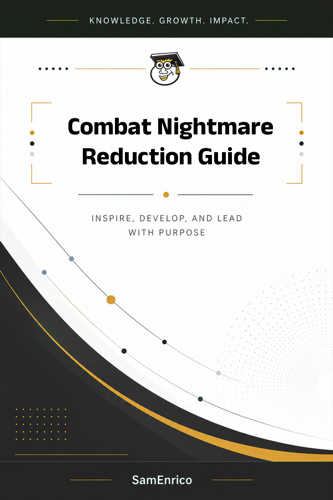
Combat Nightmare Reduction Guide eBook
Use military-tested dream rehearsal methods to dec
by Cousins Art
Use military-tested dream rehearsal methods to decrease frequency and intensity of battle dreams.
Formats
Free sample
Chapter 1: The 3 AM Enemy--You wake up with your heart slamming against your ribs, sheets soaked through, hands already curled into fists. For a moment—one terrible, disorienting moment—you don't know where you are. The bedroom is dark, but your brain is still inside the dream: the dust, the heat, the sound of metal tearing, the screaming. You reach for a weapon that isn't there. Beside you, your partner flinches away from your movement, having learned long ago not to touch you when you wake like this.
Neither of you says anything. You've both done this a hundred times before. You lie back down, but sleep will not return. The clock reads 3:17 AM. You know the rest of the night is a wash.
Tomorrow—today—you will be exhausted, irritable, and dangerous to be around. And tomorrow night, you will do it all over again.If any of this sounds familiar, this book is for you.This chapter establishes the fundamental difference between ordinary bad dreams and combat trauma nightmares. You will learn that combat nightmares are not random anxiety or a sign of weakness—they are your brain's learned survival response to extreme danger, a response that has become maladaptive because the danger is no longer present. We will explore the neurobiology of how combat changes your brain during REM sleep, the critical distinction between PTSD nightmares and other sleep disturbances like night terrors, and the vicious "Cycle of Hyperarousal" that turns your bed into a battlefield. By the end of this chapter, you will understand why you fight at night—and why that fighting is not a failure, but a survival instinct that has simply outlived its usefulness.The Dream That Is Not a Dream Let us begin with a fundamental distinction that most people never learn.
When a civilian says they had a nightmare, they usually mean something like this: they dreamed they were falling off a cliff, or showing up to work naked, or being chased by a shapeless monster. These dreams are unpleasant, often vivid, and can disrupt sleep. But they are not trauma nightmares. There is a qualitative difference that you already know in your bones.An ordinary bad dream is anxiety-based. It plays on universal fears—embarrassment, falling, being pursued.
It does not replay a specific event from your life. The emotions are diffuse: fear, yes, but also confusion, frustration, or shame. When you wake from an ordinary bad dream, you are relieved it was not real. Within minutes, the details fade. You might tell someone about it as a story, even laugh at the absurdity.A combat trauma nightmare is entirely different.
It is not anxiety-based—it is re-experiencing-based. Your brain is not generating a symbolic dream about fear; it is literally replaying a memory as if it is happening in the present moment. The dream is not a distorted version of combat. It is combat, complete with the smells, sounds, physical sensations, and emotional intensity of the original event. When you wake, you do not feel relief.
You feel as if you have just survived the event again. Your body is in full fight-or-flight mode: heart rate elevated, muscles tense, stress hormones flooding your system. The details do not fade. They stay with you all day, sometimes for days. And you would never, ever laugh about it.This distinction matters because the two types of dreams respond to different treatments.
Ordinary bad dreams might respond to stress reduction or better sleep hygiene. Combat trauma nightmares require a specific protocol targeting memory reconsolidation—exactly what this book provides. If you have tried general anxiety techniques for your nightmares and found them useless, now you know why. You were treating the wrong problem.A Critical Distinction: Nightmares vs. Night Terrors Before we go further, we must address a common point of confusion that has sent many veterans down the wrong treatment path.
Night terrors—also called sleep terrors—are a different condition entirely, and this book's protocol will not help you if that is what you are experiencing.A night terror typically occurs during non-REM sleep, usually in the first third of the night. The person sits up in bed, screams, thrashes, has a blank stare, and shows all the signs of extreme terror. Their heart rate can reach 160 beats per minute or more. Here is the crucial difference: when someone wakes from a night terror, they have no memory of a dream. They cannot tell you what they were afraid of.
There is no narrative, no replay of a combat memory. They are simply in a state of pure, inexplicable terror. Night terrors are more common in children but can persist into adulthood, particularly in veterans with traumatic brain injury or certain sleep disorders.A combat trauma nightmare, by contrast, occurs during REM sleep, usually in the second half of the night. The dreamer wakes with a complete, detailed memory of the dream content. There is a narrative: "I was back on Route Irish.
The lead vehicle hit an IED. I saw my best friend's face covered in blood." The terror has a story attached to it.Why does this distinction matter? Because if you have night terrors with no dream recall, Imagery Rehearsal Therapy—the core protocol of this book—cannot work. There is no dream imagery to rehearse. Night terrors require different interventions, including addressing underlying sleep disorders, medication adjustments, or specialized behavioral therapies.
If you read this description and realized you never remember a dream when you wake up screaming, put this book down and see a sleep specialist. For everyone else—for those of you who wake with the taste of dust and the sound of gunfire still in your ears—read on.The Neurobiology of the Nocturnal Battlefield To understand why you fight at night, you must first understand how combat changed your brain. This is not abstract neuroscience. This is the mechanical explanation for why your own mind has turned against you during sleep.The amygdala is a small, almond-shaped structure deep in your brain. Its job is threat detection.
When you are in danger, the amygdala sounds the alarm, triggering your sympathetic nervous system—the fight-or-flight response. In a healthy brain, the amygdala is balanced by the prefrontal cortex (your rational, decision-making center) and the hippocampus (which provides context: "This is a memory, not a current threat").Combat changes this balance. Repeated exposure to life-threatening events causes the amygdala to become hyperactive and hypersensitive. It starts sounding the alarm at lower and lower levels of threat. A car backfiring.
A slammed door. A certain smell. The amygdala does not know the difference between a real IED and a sound that merely resembles one. Its job is to keep you alive, and it has learned that in your world, the cost of missing a real threat is death. Better to sound a thousand false alarms than miss one real one.At the same time, combat exposure can impair hippocampal function.
The hippocampus is responsible for contextualizing memories—tagging them with information about time and place so your brain knows whether a memory belongs to the past or the present. When the hippocampus is not working properly, memories…
This is the end of the free sample. Get the eBook to keep going. Buy now
About this book
Details
- Author
- Cousins Art
- Publisher
- SamEnrico
- Language
- English
- Genre
- Non-Fiction, Self-Help, Combat Trauma
- Released
- 2026-06-10
- Pages (approx.)
- 136
- Available as
- eBook, Audiobook

Read better in the ZLOADR app
Your eBooks on your phone or tablet. Sign in with your SamEnrico account and start reading.
More by Cousins Art
 Napoleon's Irish Legion HandbookCousins Art$11.99
 The Aggressive Anxiety LinkCousins Art$11.99
 DBT For NumbnessCousins Art$11.99
 The Peg System Memory PalaceCousins Art$11.99
 The Velvet Quill: Sor Juana Inés de la Cruz and the Revolution of Colonial TheaterCousins Art$11.99
 General ApplicationCousins Art$11.99
 Coursework Research ProjectsCousins Art$12.99
 How to Start a Muslin Clipping Business (Beginners Guide)Cousins Art$11.99
 Understanding Syndrome X[disambiguation Needed]Cousins Art$17.99
You may also like
 Hong Kong Handover 1997Dunn Johnnie$11.99
 Zumba For Postnatal Recovery CourseNeal Christian$11.99
 Zumba for BeginnersLadner Nikia$11.99
 YouTube Comment Mining GuideHumes Pandora$12.99
 Worry Box MeditationCarlin Rudy$11.99
 Workplace Stress MeditationNguyen Lynn$11.99
 Workplace Stress and Sleep RepairHawley Ivory$11.99
 Workplace Perfectionism CureDelaney Jeffry$11.99
 Workplace Injustice Anger GuideWallen Isabelle$11.99
 Work Addiction and Burnout LinkGreenwood Ester$11.99
 Women in Yoga and WellnessBeattie Galina$11.99
 Women in Stand Up ComedyChun Evangeline$11.99