
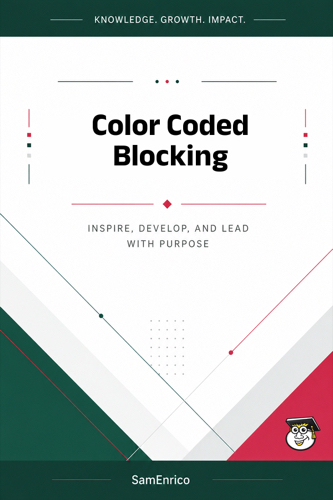
Color Coded Blocking Audiobook
Use calendar colors to distinguish work categories
by Wiese Aron
Use calendar colors to distinguish work categories at a glance.
Formats
Free sample
Chapter 1: The Three-Second Rule--–- Sarah had a perfectly organized calendar. Every meeting had a title. Every deadline had a color-coded flag. Every hour of her 50-hour workweek was accounted for in pristine black and white. And she was miserable.It was 2:47 PM on a Tuesday when the realization hit her.
She had just spent eleven seconds staring at her calendar, trying to figure out what she was supposed to be doing at 3:00 PM. Eleven seconds. Her mouse hovered over a block that read "Q3 Planning – review projections with David." She had written that block herself, just yesterday. But in the blur of four back-to-back meetings, two urgent Slack threads, and a client who had suddenly decided that "end of day" meant 2:00 PM, she had completely forgotten what "Q3 Planning" entailed. Was she presenting?
Was she reviewing? Was this a working session or a decision meeting?Eleven seconds of confusion. Then another fifteen seconds of context switching as she opened the meeting notes, re-read the agenda, and tried to recall her own mental state from yesterday. By the time she oriented herself, the 3:00 PM slot had arrived, and she was already behind.Sarah is not real. But her problem is.
And if you are reading this book, you have felt exactly what she felt: the slow, grinding inefficiency of a calendar that looks organized but functions like a locked filing cabinet.This chapter is about why that happens. It is about the hidden costs of monochromatic calendars, the cognitive science that explains why black-and-white scheduling is a form of self-sabotage, and the simple diagnostic that will tell you, in less than ten seconds, whether your current calendar is costing you hours of productive time every single week.But before we get to the science, let me ask you a question. Right now, without scrolling ahead or flipping pages, look at your calendar for tomorrow. The question is simple: What should you be doing at 10:00 AM?How many seconds did that take you? Did you know instantly, or did you have to read multiple entries?
Did the color of the block help you, or did you have to parse the text? Did you have to open the event details to remember what "sync" or "standup" or "review" actually meant?If the answer took you more than three seconds, this book is for you.The Three-Second Rule Let me define the central diagnostic of…
This is the end of the free sample. Get the Audiobook to keep going. Buy now
About this book
Details
- Author
- Wiese Aron
- Publisher
- SamEnrico
- Language
- English
- Genre
- Non-Fiction, Self-Help, Visual Organization
- Released
- 2026-06-09
- Pages (approx.)
- 153
- Available as
- eBook, Audiobook

Listen in the VoxFlicks app
Audiobooks and audio dramas wherever you go. Sign in with your SamEnrico account and press play.
More by Wiese Aron
 Cognitive Behavioral Therapy for Major Depressive DisorderWiese Aron$11.99
 Financial Resilience For Mental HealthWiese Aron$11.99
 Remote Work Communication OverloadWiese Aron$11.99
 Metta for Allergy ShotsWiese Aron$11.99
 Food Bank Creator StoryWiese Aron$11.99
 Success Without Burnout for Single ParentsWiese Aron$11.99
 Atlantic Slave Trade TriangleWiese Aron$11.99
 The Moscow Inferno: The Russian Mafia’s Fire Campaign of 1881Wiese Aron$11.99
 The Hollow Crown: How a Child King’s Betrayal Shaped a DynastyWiese Aron$11.99
 How to Produce Water Sport Board Storage RacksWiese Aron$11.99
 Service Providers Guide to Newspaper Clipping ServicesWiese Aron$11.99
 How to Produce Livestock HaltersWiese Aron$11.99