
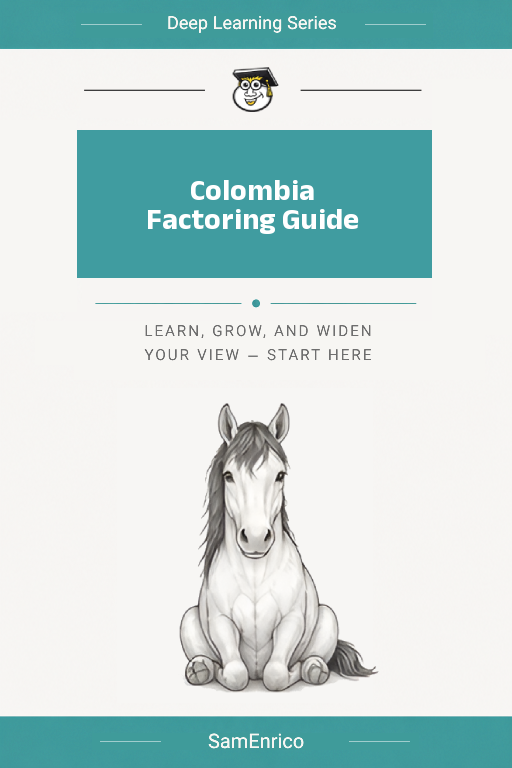
Non-FictionBusiness BriefTrust Structure
Colombia Factoring Guide
Use factoring fiduciario structure for Colombian i
Use factoring fiduciario structure for Colombian invoice finance. Trust holds receivables while factor provides advance protecting both parties.
Formats
About this book
Free sample
Chapter 1: The Million-Dollar Mistake--–- The call came on a Tuesday. Juan Carlos Ortega, owner of Textiles Finos SA in Medellín, had just finished a meeting with his largest buyer when his factoring account manager’s name appeared on his phone screen. He expected a routine update. Instead, he heard four words that would dismantle eighteen years of work: “The factor has filed.” Not the buyer. Not the debtor.
The factor itself—the company Juan had trusted to collect 500,000inverifiedinvoices—haddeclaredbankruptcyat9:47thatmorning.Thecourtfrozeeveryassetinthefactor’spossession,including Juan’smoney,whichhadbeencollectedfromhisbuyerthreedaysearlierandwassittinginthefactor’soperatingaccountwaitingforremittance.Eighteenmonthslater,afterlegalfeesconsumed500,000 in verified invoices—had declared bankruptcy at 9:47 that morning. The court froze every asset in the factor’s possession, including Juan’s money, which had been collected from his buyer three days earlier and was sitting in the factor’s operating account waiting for remittance. Eighteen months later, after legal fees consumed 500,000inverifiedinvoices—haddeclaredbankruptcyat9:47thatmorning.Thecourtfrozeeveryassetinthefactor’spossession,including Juan’smoney,whichhadbeencollectedfromhisbuyerthreedaysearlierandwassittinginthefactor’soperatingaccountwaitingforremittance.Eighteenmonthslater,afterlegalfeesconsumed47,000 and the court finally released the remaining $453,000, Juan’s business was gone. His suppliers had moved on. His buyer had found another manufacturer.
His equipment had been repossessed by a lender who wasn’t willing to wait for the court’s decision. Juan didn’t lose his company because his buyer failed to pay. His buyer paid in full, on time, every time. Juan lost his company because he used the wrong legal structure for invoice finance.This chapter reveals why that happens, how frequently it happens, and why the traditional factoring industry has every incentive to keep you from understanding the risk. By the end of this chapter, you will be able to identify the “Double Insolvency Trap” in any factoring arrangement, distinguish between factoring and descuento, understand the false security of con recurso versus sin recurso clauses, and recognize why your current factoring agreement likely leaves you exposed even if no one has ever defaulted before.
You will also complete a self-diagnostic quiz that will tell you, in less than five minutes, whether you are sitting in the Red Zone right now.The Story Behind the Statistics Juan’s story is not an aberration.…
This is the end of the free sample. Get the eBook to keep going. Buy now
Contents
- Chapter 1
- Chapter 2
- Chapter 3
- Chapter 4
- Chapter 5
- Chapter 6
- Chapter 7
- Chapter 8
- Chapter 9
- Chapter 10
- Chapter 11
- Chapter 12
Details
- Author
- Passmore Tamie
- Publisher
- SamEnrico
- Language
- English
- Genre
- Non-Fiction, Business Brief, Trust Structure
- Released
- 2026-05-27
- Pages (approx.)
- 160
- Available as
- eBook, Audiobook

Read better in the ZLOADR app
Your eBooks on your phone or tablet. Sign in with your SamEnrico account and start reading.
More by Passmore Tamie
 Postpartum Body EsteemPassmore Tamie$11.99
 Emotional Cheating Self EsteemPassmore Tamie$11.99
 Slide Deck AutomationPassmore Tamie$11.99
 Five Minute Dream Log GuidePassmore Tamie$11.99
 Strength Training For DancersPassmore Tamie$11.99
 Pet Food Recall DatabasePassmore Tamie$11.99Pet Food Recall DatabasePassmore Tamie$11.99
 Pearl Harbor SurvivorPassmore Tamie$11.99
 Serbian Manufacturing ResurgencePassmore Tamie$11.99
 Stacey Abrams VotingPassmore Tamie$11.99
 The Siege of Legation Quarter: China's Boxer Rebellion and the Birth of Modern Naval PowerPassmore Tamie$11.99
 The Oslo Vault Heist: A Million-Dollar Museum MysteryPassmore Tamie$11.99
You may also like
 Hong Kong Handover 1997Dunn Johnnie$11.99
 Zumba For Postnatal Recovery CourseNeal Christian$11.99
 Zumba for BeginnersLadner Nikia$11.99
 YouTube Comment Mining GuideHumes Pandora$12.99
 Worry Box MeditationCarlin Rudy$11.99
 Workplace Stress MeditationNguyen Lynn$11.99
 Workplace Stress and Sleep RepairHawley Ivory$11.99
 Workplace Perfectionism CureDelaney Jeffry$11.99
 Workplace Injustice Anger GuideWallen Isabelle$11.99
 Work Addiction and Burnout LinkGreenwood Ester$11.99
 Women in Yoga and WellnessBeattie Galina$11.99
 Women in Stand Up ComedyChun Evangeline$11.99