
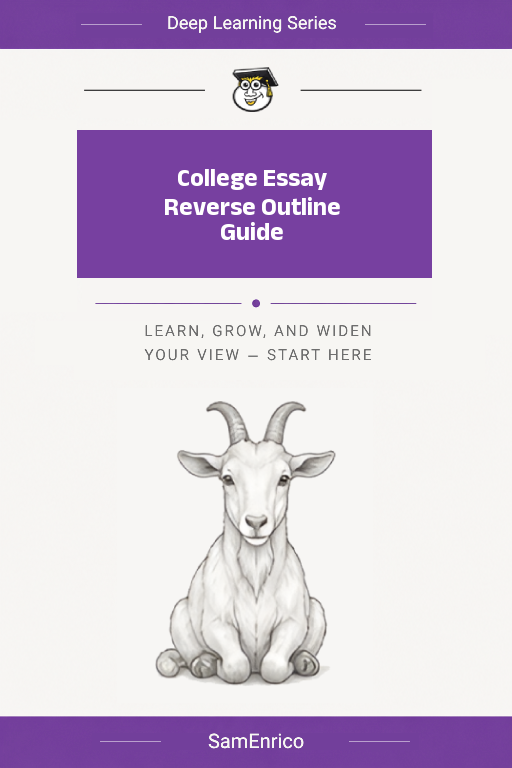
essaysStudent's ShortcutStructure
College Essay Reverse Outline Guide
Check your essay's logic, pacing, and structure by
Check your essay's logic, pacing, and structure by building an outline after writing.
Formats
About this book
Free sample
Chapter 1: The Xerox Fallacy--Every year, a quarter of a million college essays arrive at admissions offices with the same invisible defect. The students who wrote them are brilliant, accomplished, and genuinely interesting. Their grades are excellent. Their recommendations are glowing. But their essays feel wrong in a way that no one can quite name.The problem is not the writing.
The problem is the outline.Specifically, the problem is that most students believe they must write an outline before they start drafting. They sit down with a blank page, force themselves to produce a neat, linear list of Roman numerals (I, II, III) and capital letters (A, B, C), and then spend the next several weeks trying to stuff their messy, surprising, human story into that artificial container. When the story refuses to fit, they assume something is wrong with the story. So they cut. They trim.
They rearrange. They betray their own best sentences to serve a blueprint that was never accurate in the first place.This is what I call the Xerox Fallacy: the mistaken belief that a pre-writing outline is an accurate map of your eventual destination. A Xerox machine copies exactly what you feed it. An outline, by contrast, is a prediction—and predictions about creative work are almost always wrong.This book exists to help you unlearn that fallacy.The Map Is Not the Territory In 1931, the Polish-American philosopher Alfred Korzybski made a now-famous observation: "The map is not the territory." What he meant was that any representation of reality—a map, a diagram, an outline—is necessarily a simplification. It leaves things out.
It makes choices about what matters and what doesn't. And crucially, no matter how detailed the map becomes, it can never fully capture the lived, messy, chaotic reality of the territory itself.Your pre-writing outline is a map. Your actual draft is the territory.Here is what happens when you confuse the two. You begin with a reasonable plan: Paragraph 1 will introduce my love of robotics. Paragraph 2 will describe the competition I lost.
Paragraph 3 will explain how my grandfather's advice helped me try again. Paragraph 4 will conclude with what I learned…
This is the end of the free sample. Get the eBook to keep going. Buy now
Contents
- Chapter 1
- Chapter 2
- Chapter 3
- Chapter 4
- Chapter 5
- Chapter 6
- Chapter 7
- Chapter 8
- Chapter 9
- Chapter 10
- Chapter 11
- Chapter 12
Details
- Author
- Paxton Samara
- Publisher
- SamEnrico
- Language
- English
- Genre
- essays, Student's Shortcut, Structure
- Released
- 2026-06-01
- Pages (approx.)
- 139
- Available as
- eBook, Audiobook

Read better in the ZLOADR app
Your eBooks on your phone or tablet. Sign in with your SamEnrico account and start reading.
More by Paxton Samara
 Hinton V Alabama Supreme CourtPaxton Samara$11.99
 High Earner Benefit ReductionPaxton Samara$11.99
 Monster Dream Soothing GuidePaxton Samara$11.99
 Reconstruction of Overkill HomicidesPaxton Samara$11.99
 Pomodoro for PilotsPaxton Samara$11.99
 Peg System For AstronomyPaxton Samara$11.99
 Abolition Act 1807 ImpactPaxton Samara$11.99
 Voice Recording Dream JournalPaxton Samara$11.99
 The Gallipoli Gambit: Churchill's Failed Masterstroke (1915)Paxton Samara$11.99
 Galahad's Last Vigil: The Knight Who Refused the GrailPaxton Samara$11.99
 Cucumber & Gherkin: Harvesting Guide For Small Pickles & Large SlicersPaxton Samara$11.99
 Research Proposal Archival Research PrimerPaxton Samara$12.99
You may also like
 YouTube Video Essay DepthLeon Lala$11.99
 TOEFL Independent Essay GuideMintz Alex$11.99
 Music Theory Essay GuideWilkinson Maisha$11.99
 Expository Essay AI PromptsApplegate Dalia$11.99
 Exam Essay MemorizationMcgovern Johna$11.99
 Compare Contrast Essay PromptsOntiveros Marx$11.99
 College Application Essay GuideSisson Aimee$11.99College Application Essay GuideSisson Aimee$11.99
 The 100 Word Essay ChallengeAli Luciana$11.99
 Journalism Essay PromptsThatcher Williemae$11.99
 Finance Essay PromptsShrader Lamont$11.99
 Cause Effect Essay GPT GuideBland Jacelyn$11.99