
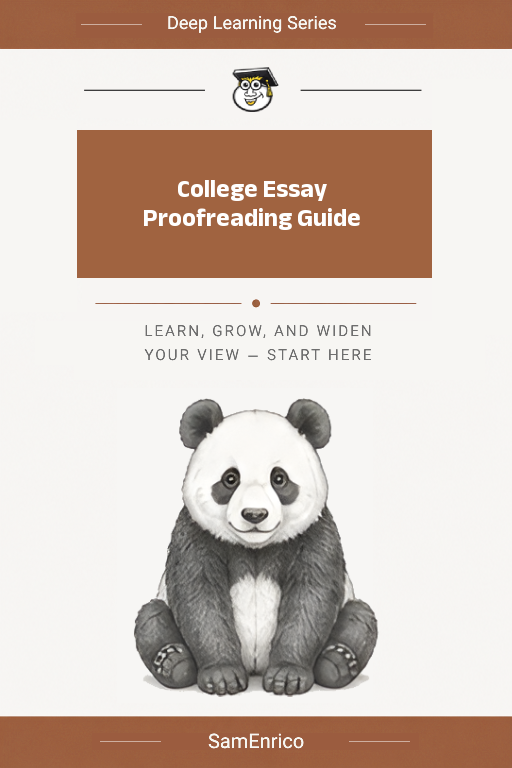
essaysStudent's ShortcutProofreading
College Essay Proofreading Guide eBook
Catch grammar errors, typos, and awkward phrasing
Catch grammar errors, typos, and awkward phrasing with a systematic proofreading protocol.
Formats
Free sample
Chapter 1: Seeing Your Own Words––You have already read your college essay at least a dozen times.You wrote it. You revised it. You read it aloud to your bathroom mirror at 11:47 PM, and you thought, This is it. This is the one.Then you sent it to your best friend, your mom, and that one kid from English class who gets A’s. They all said the same thing: “Looks good to me!”But somewhere in your gut, you feel it.A quiet, nagging suspicion that something is wrong.
A comma that might not belong. A sentence that seemed fine at 2 AM but now reads like a foreign language. A word you have stared at so long it no longer looks like a real word.You are not imagining things.You are experiencing one of the most frustrating, universal, and completely avoidable problems in all of writing: familiarity blindness.This chapter is not about grammar rules. It is not about commas or semicolons or the difference between “affect” and “effect.” (Those come later.) This chapter is about something more fundamental, and more urgent.This chapter is about why you cannot catch your own mistakes—and how to fix that before you change a single word.The Curse of the Familiar Let us start with a simple experiment.Read the following sentence once, normally:Paris in the the spring is beautiful.You probably missed the double “the.” Almost everyone does on the first read.Now read it again, slowly.There it is. “The the.” A typo so obvious that you would mock anyone who made it.
Yet your own brain airbrushed it out of existence.That is familiarity blindness in action.Your brain is not a camera. It does not record words like a scanner captures images. Instead, your brain predicts. It guesses. It takes shortcuts.
When you have already read a sentence five times, your brain stops processing each letter and starts processing meaning. It fills in the gaps. It corrects errors automatically. It shows you what you intended to write, not what you actually wrote.This is a miracle for conversation. It is a disaster for proofreading.Here is the cruel truth that no one tells you in high school English: You cannot trust your own eyes when you look at your own writing.Not because you are careless.
Not because you are a bad writer. But because your brain is doing exactly what it evolved to do—take shortcuts, recognize patterns, and ignore irrelevant details.When you proofread your own essay immediately after writing it, you are not proofreading. You are re-reading. And re-reading is not the same as proofreading.Why Spellcheck and Grammarly Cannot Save You You might be thinking: Fine, but I have technology. I run everything through Grammarly.
Isn’t that enough?No. And here is why.Spellcheckers catch misspelled words. They do not catch correctly spelled wrong words. Write “form” instead of “from”? Spellcheck smiles and moves on.
Write “their” instead of “there”? Spellcheck sees a real word and says nothing.Grammarly is more sophisticated, but it has three fatal weaknesses.First, Grammarly misses errors that are context-dependent. It cannot tell that you meant “public” instead of “pubic” because both are real words. It cannot tell that you meant “college” instead of “collage” because both are spelled correctly.Second, Grammarly makes bad suggestions. It loves cutting passive voice even when passive voice is correct.
It loves replacing specific words with generic ones. It will happily turn “The experiment yielded unexpected results” into “The experiment got results”—which is worse.Third, and most importantly, Grammarly does not understand your voice. It does not know that you are trying to sound like a thoughtful seventeen-year-old, not a corporate annual report. It will flag your most authentic sentences as “too informal” and suggest robotic alternatives.The tools are helpful. But they are not proofreading.
They are the equivalent of a calculator: useful for basic math, useless for checking your logic.You need a system.Introducing the Three-Pass Protocol (But Just the Philosophy for Now)This entire book builds toward a single method: the Systematic Proofreading Protocol, or SPP.The SPP has three passes.Pass 1: Grammar – You check for subject-verb agreement, pronoun errors, misplaced modifiers, and punctuation mistakes.Pass 2: Typos – You hunt for homophones, missing words, doubled words, and capitalization errors.Pass 3: Flow – You read aloud to catch awkward phrasing, clunky sentences, and structural problems.But before you can run any of these passes, you need to prepare your brain.You cannot just sit down at your laptop, open the document, and start proofreading. That is like trying to run a marathon without stretching. Your brain is still in “writing mode” or “reading mode.” It is still seeing what it expects to see.You need to break familiarity blindness.The rest of this chapter gives you four concrete, science-backed techniques to do exactly that. Use any of them. Use all of them.
But use at least one before you touch a single comma in your essay.Technique 1: The Print-and-Pen Method Here is the cheapest, most effective proofreading tool in existence: a printed copy of your essay and a red pen.Why does printing work when screens fail?On a screen, your eyes move differently. You scroll. You skim. Your brain treats the text as temporary, fluid, something to be consumed quickly. On paper, the text is fixed.
You cannot scroll past a mistake. You cannot change the font size to make errors disappear. The words are just there, immovable, staring back at you.Additionally, paper introduces haptic feedback—the physical sensation of holding the pages, turning them, moving a pen across the page. This engages different parts of your brain than screen reading. Studies have shown that people catch significantly more errors on paper than on screens, even when they take the same amount of time.How to do it:Print your essay double-spaced in a plain font like Times New Roman or Garamond.
Double spacing gives you room to write corrections.Use a red pen. Not black. Not blue. Red creates visual contrast and signals “error” to your brain.Hold the pen in your hand. Do not put it down.
Your job is to mark every single thing that looks wrong, even if you are not sure.Read each word aloud—quietly, to yourself, moving your lips. This slows you down and forces your brain to process each word individually.When to use this technique: Always. Even if you also use digital tools, always do a print pass. It will catch errors that nothing else will.Technique 2: The Reverse Read (Two Versions, One Goal)You have probably heard the advice “read your essay backward.” But that advice is usually given without explanation, and it is often misunderstood.There are actually two different reverse reading techniques. Both work.
Both disrupt familiarity blindness. But they catch different kinds of errors.Version A: Word-by-word reverse reading Start with the last word of your essay. Read it. Then the second-to-last word. Then the third-to-last.
Continue until you reach the first word.This technique destroys sentence structure. You are not reading for meaning. You are reading each word in isolation. That is…
This is the end of the free sample. Get the eBook to keep going. Buy now
About this book
Details
- Author
- Jacoby Shanel
- Publisher
- SamEnrico
- Language
- English
- Genre
- essays, Student's Shortcut, Proofreading
- Released
- 2026-06-01
- Pages (approx.)
- 114
- Available as
- eBook, Audiobook

Read better in the ZLOADR app
Your eBooks on your phone or tablet. Sign in with your SamEnrico account and start reading.
More by Jacoby Shanel
 Imposter Promotion GuideJacoby Shanel$11.99
 Crime Scene Reconstruction SoftwareJacoby Shanel$11.99
 Bladder Before HypnosisJacoby Shanel$11.99
 Widowed Parent Child GuideJacoby Shanel$11.99
 Shelter Access for Disabled HomelessJacoby Shanel$11.99
 Peg System For Periodic TableJacoby Shanel$11.99
 Janet Jackson Control after FameJacoby Shanel$11.99
 Pomodoro for ManagersJacoby Shanel$11.99
 The Condottieri Gambit: How a Mercenary Army Could Have Changed the Italian WarsJacoby Shanel$11.99
 The Master Thief of the Louvre: How a WWII Spy Stole Europe’s Art TreasuresJacoby Shanel$11.99
 How to Produce Drawing and Painting KitsJacoby Shanel$11.99
 Citronella: Grass Harvesting For Oil DistillationJacoby Shanel$11.99
You may also like
 YouTube Video Essay DepthLeon Lala$11.99
 TOEFL Independent Essay GuideMintz Alex$11.99
 Music Theory Essay GuideWilkinson Maisha$11.99
 Expository Essay AI PromptsApplegate Dalia$11.99
 Exam Essay MemorizationMcgovern Johna$11.99
 Compare Contrast Essay PromptsOntiveros Marx$11.99
 College Application Essay GuideSisson Aimee$11.99College Application Essay GuideSisson Aimee$11.99
 The 100 Word Essay ChallengeAli Luciana$11.99
 Journalism Essay PromptsThatcher Williemae$11.99
 Finance Essay PromptsShrader Lamont$11.99
 Cause Effect Essay GPT GuideBland Jacelyn$11.99