
essaysStudent's ShortcutRevision
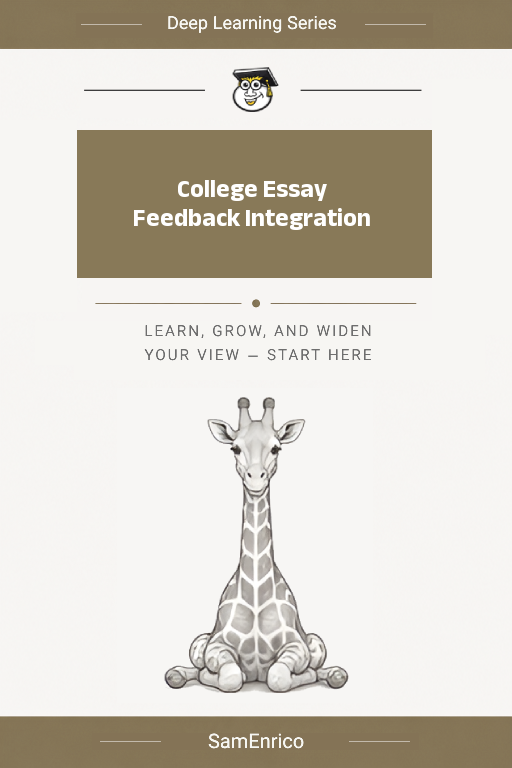
College Essay Feedback Integration eBook
Process input from teachers, counselors, and peers
by Falls Trina
Process input from teachers, counselors, and peers without losing your authentic voice.
Formats
Free sample
Chapter 1: The Help Trap--–- Every year, thousands of talented students sit down to write the most important 650 words of their lives. They pour their hearts onto the page. They dig up memories they haven't touched in years. They find a truth, a story, a piece of themselves that finally feels real. And then they make a catastrophic mistake.They ask for help.Not because asking for help is wrong.
It isn't. The catastrophe is not the asking. The catastrophe is what happens next. The student sends their raw, vulnerable, deeply personal draft to three people: a parent who loves them, an English teacher who wants them to succeed, and a peer who has also written an essay. Within forty-eight hours, the Google Doc looks like a crime scene.
Yellow highlights everywhere. Comments in the margins. Suggested deletions. Phrases like "this doesn't flow" and "consider rephrasing" and "maybe choose a different example." The student reads through the comments, each one reasonable on its own, each one offered with genuine goodwill, and something inside them deflates.They try to make everyone happy. They take Mom's line edit on paragraph two.
They accept the teacher's suggestion to move the anecdote from the end to the beginning. They incorporate the peer's idea to add a joke at the top. They delete the sentence their counselor called "risky." They add a transition their tutor said was missing. They change "awesome" to "remarkable" because someone told them college essays should sound more mature.When they are finished, they have an essay that is grammatically perfect, structurally sound, and utterly dead. No one who reads it could guess who wrote it.
It sounds like a committee wrote it, because a committee did. The student has built a Frankenstein's monster—a draft assembled from other people's parts, with no single heartbeat driving the whole.This chapter is about why that happens, why it keeps happening, and why the standard model of "more feedback equals a better essay" is the single most destructive lie in the college admissions process. By the end of this chapter, you will understand the difference between feedback that helps and feedback that harms. You will learn why the people who love you most often give the worst advice. And you will begin building the filter that will save your essay from the committee.The Two Kinds of Feedback (And Why Confusing Them Destroys Essays)Every piece of feedback falls into one of two categories.
They are not the same. They are not interchangeable. And the single fastest way to ruin a personal essay is to treat them as if they are.Academic Feedback is designed for research papers, lab reports, and five-paragraph essays. Its goals are correctness, clarity, and conformity to a standard. Academic feedback asks: Is your thesis statement clear?
Did you cite your sources correctly? Is your argument logical? Does your conclusion restate your introduction? This kind of feedback is essential for schoolwork. It is also almost entirely useless—and often actively harmful—when applied to a personal narrative essay.Narrative Feedback is designed for stories, memoirs, and personal essays.
Its goals are voice, emotional arc, authenticity, and reader engagement. Narrative feedback asks: Do I believe you? Do I care about what happens next? Does this sound like a real person talking? Am I moved?
This kind of feedback is difficult to give and even harder to receive because it is subjective. There is no rubric for "does this sound like you."Here is the problem. Most of the people giving you feedback on your college essay are experts in academic feedback. They are teachers, tutors, and counselors who have spent their careers grading research papers. They know how to spot a weak thesis.
They know how to correct a comma splice. They know how to demand textual evidence. They are brilliant at what they do. But a personal essay is not a research paper. Applying academic feedback to a narrative essay is like using a hammer to tune a piano.
The tool is fine. The application is wrong.When your English teacher tells you to "add more evidence," they are giving you academic feedback. But a personal essay does not need evidence. It needs truth. When your tutor tells you to "strengthen your topic sentences," they are giving you academic feedback.
But a personal essay does not need topic sentences. It needs a voice. When your parent tells you to "sound more professional," they are giving you academic feedback. But a personal essay does not need professionalism. It needs humanity.The student who cannot distinguish between these two kinds of feedback will accept both as equally valid.
They will cut their voice to make room for evidence. They will replace their rhythm with topic sentences. They will trade their humanity for professionalism. And they will submit an essay that an admissions officer will read in forty-five seconds and forget in sixty.The Frankenstein Essay: How Good Intentions Create Monsters The metaphor of Frankenstein's monster is not hyperbole. It is the most accurate description of what happens to essays that receive too much unfiltered feedback.Consider the anatomy of a Frankenstein essay.
The opening paragraph comes from a parent who thought the original started too slowly. The second paragraph has been restructured by a counselor who wanted a clearer thesis. The third paragraph contains a joke added by a peer who said the essay was "too serious." The fourth paragraph has been rewritten by a tutor who thought the language was too informal. The conclusion has been revised by a teacher who wanted the ending to "mirror the beginning" because that is what good academic essays do.Every individual edit makes sense in isolation. The parent was right that the original opening was meandering.
The counselor was right that the essay needed direction. The peer was right that humor can be disarming. The tutor was right that some phrases were too casual. The teacher was right that repetition can create closure. Each piece of advice is reasonable.
Each comes from a place of care. And together, they create something that sounds like no one.The tragedy of the Frankenstein essay is that it is often technically perfect. The grammar is flawless. The structure is logical. The transitions are smooth.
The vocabulary is sophisticated. It is the kind of essay that would earn an A in an English class. And it is the kind of essay that will not get a student into a competitive college.Why? Because admissions officers are not grading for grammar. They are not looking for logical transitions.
They are not impressed by big words. They are reading hundreds of essays per week, and they are looking for one thing: a human being worth getting to know. The Frankenstein essay hides the human being behind a wall of other people's edits. It is polished, professional, and perfectly forgettable.The Paradox of Revision: Why Love Is a Terrible Editor Here is a truth that will save you years of frustration if you internalize it now: The people who love you most often give the worst advice about your writing.This is not because they are stupid or malicious. It is because…
This is the end of the free sample. Get the eBook to keep going. Buy now
About this book
Details
- Author
- Falls Trina
- Publisher
- SamEnrico
- Language
- English
- Genre
- essays, Student's Shortcut, Revision
- Released
- 2026-05-29
- Pages (approx.)
- 120
- Available as
- eBook, Audiobook

Read better in the ZLOADR app
Your eBooks on your phone or tablet. Sign in with your SamEnrico account and start reading.
More by Falls Trina
 Estate Settlement for WidowsFalls Trina$11.99
 Reconstruction of Drowning DeathsFalls Trina$11.99
 Memory Palace For Music NotesFalls Trina$11.99
 Imposter Networking GuideFalls Trina$11.99
 Inaccessible Medical Equipment FightFalls Trina$11.99
 The Jackson 5 to MichaelFalls Trina$11.99
 Pomodoro for StudentsFalls Trina$11.99
 Hydration Before Hypnosis ListeningFalls Trina$11.99
 The Fall and Rise of the Taepyeongyang Tigers: A Baseball Miracle in the Shadow of WarFalls Trina$11.99
 The Alchemist’s Secret: Paracelsus and the Birth of Modern MedicineFalls Trina$11.99
 How to Become a Host/hostessFalls Trina$11.99
 Citron: Harvesting EtrogFalls Trina$11.99
You may also like
 YouTube Video Essay DepthLeon Lala$11.99
 TOEFL Independent Essay GuideMintz Alex$11.99
 Music Theory Essay GuideWilkinson Maisha$11.99
 Expository Essay AI PromptsApplegate Dalia$11.99
 Exam Essay MemorizationMcgovern Johna$11.99
 Compare Contrast Essay PromptsOntiveros Marx$11.99
 College Application Essay GuideSisson Aimee$11.99College Application Essay GuideSisson Aimee$11.99
 The 100 Word Essay ChallengeAli Luciana$11.99
 Journalism Essay PromptsThatcher Williemae$11.99
 Finance Essay PromptsShrader Lamont$11.99
 Cause Effect Essay GPT GuideBland Jacelyn$11.99