
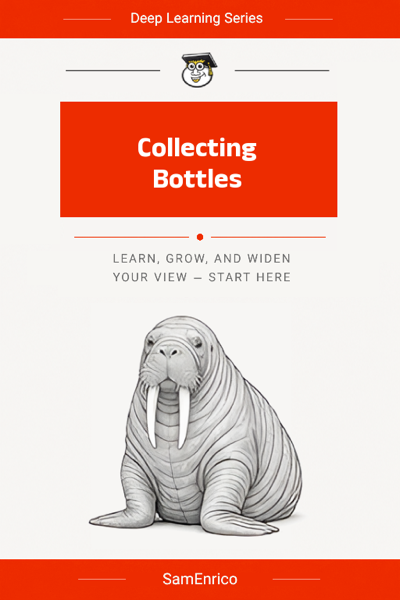
Non-FictionInformativeEducational
Collecting Bottles Audiobook
A Coursebook on Collecting Bottles
A Coursebook on Collecting Bottles
Formats
Free sample
Chapter 1: The Accidental Treasure--–- On a crisp October morning in 2012, a construction worker named Frank Stevens swung his backhoe into an abandoned lot behind a derelict pharmacy in Alexandria, Virginia. He was clearing space for a new parking garage. Instead, he unearthed a privy—an old outhouse pit—that had been sealed since 1895. Inside, buried under seven feet of packed earth and rusted tin cans, lay forty-seven glass bottles. Most were broken.
But nine were intact. Among them was a squat, cobalt blue bottle embossed with the words “Dr. J. Hostetter’s Stomach Bitters.” Frank, who collected vintage beer cans as a casual hobby, nearly threw it back into the hole. It was small, dirty, and looked like something from a old apothecary shelf.
He cleaned it with dish soap that night and posted a photo on a collectors’ forum. Within hours, he received seven private messages. The highest offer: $8,500. Frank had never heard of Hostetter’s Bitters. He had no idea that the bottle’s deep蓝色, its applied lip, and its faint pontil scar meant it was made in 1865.
He simply dug where he was told to dig. That bottle now sits in a museum collection. Frank still works construction. But he never passes an old lot without looking down.This chapter is about why you should, too. It reframes old bottles as historical artifacts rather than mere trash.
It explains why bottles abandoned in dumps, privies, construction sites, and riverbeds can be valuable—both monetarily and culturally. It lays the foundation for everything that follows: the history, the dating methods, the valuation, and the ethics of collecting. By the end of this chapter, you will never look at a discarded glass container the same way again.The Trash Paradox Every bottle you have ever thrown away is a potential artifact. That sounds absurd. But consider this: archaeologists divide human history into eras based on what we threw away.
The Stone Age, the Bronze Age, the Iron Age—all named for discarded materials. Glass is no different. Before 1905, bottles were made by hand, one at a time, by skilled glassblowers. Each one carries the fingerprint of its maker: a slightly uneven lip, a seam that does not quite align, a tiny bubble trapped in the glass. After 1905, automatic bottle machines produced identical containers by the millions.
The difference between a hand-blown bottle and a machine-made one is the difference between a handwritten letter and a spam…
This is the end of the free sample. Get the Audiobook to keep going. Buy now
About this book
Details
- Author
- Pullen Whitney
- Publisher
- SamEnrico
- Language
- English
- Genre
- Non-Fiction, Informative, Educational
- Released
- 2026-05-06
- Pages (approx.)
- 129
- Available as
- eBook, Audiobook

Listen in the VoxFlicks app
Audiobooks and audio dramas wherever you go. Sign in with your SamEnrico account and press play.
More by Pullen Whitney
 Hypnotic Visualization MasteryPullen Whitney$11.99
 Acupuncture Fertility EnhancementPullen Whitney$11.99
 The Breath Journal MethodPullen Whitney$11.99
 Facebook Anniversary Comparison CyclePullen Whitney$11.99
 Protecting Your Energy GuidePullen Whitney$11.99
 The Last Tape: The Untold Story of Tupac’s Lost RecordingsPullen Whitney$11.99
 Frozen Hearts: The Secret Love Letters of Willem Barentsz and the Icebound ExpeditionPullen Whitney$11.99
 Wirestock Mobile GuidePullen Whitney$12.99
 AI No Code App BuilderPullen Whitney$12.99
 Understanding Dwarfism SyndesmodysplasicPullen Whitney$17.99
You may also like
 Hong Kong Handover 1997Dunn Johnnie$11.99
 Zumba For Postnatal Recovery CourseNeal Christian$11.99
 Zumba for BeginnersLadner Nikia$11.99
 YouTube Comment Mining GuideHumes Pandora$12.99
 Worry Box MeditationCarlin Rudy$11.99
 Workplace Stress MeditationNguyen Lynn$11.99
 Workplace Stress and Sleep RepairHawley Ivory$11.99
 Workplace Perfectionism CureDelaney Jeffry$11.99
 Workplace Injustice Anger GuideWallen Isabelle$11.99
 Work Addiction and Burnout LinkGreenwood Ester$11.99
 Women in Yoga and WellnessBeattie Galina$11.99
 Women in Stand Up ComedyChun Evangeline$11.99