
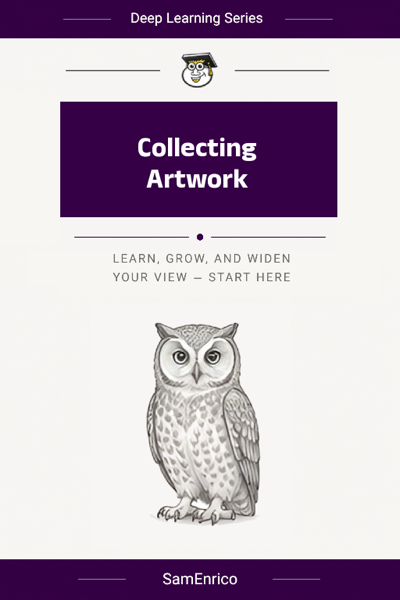
Non-FictionInformativeEducational
Collecting Artwork eBook
A Coursebook on Collecting Artwork
by Yount Renea
A Coursebook on Collecting Artwork
Formats
Free sample
Chapter 1: The Mirror Test--–- Before you spend a single dollar on art, before you step into a single gallery, before you open a single auction catalogue, you must answer one question that most collectors spend their entire careers avoiding: Why are you really doing this?The answer seems obvious. You love art. You want to live with beautiful things. You have some disposable income and a blank wall. But here is the uncomfortable truth that gallery owners whisper to each other behind closed doors: most people who buy art are not collectors.
They are acquirers. And acquirers almost never build anything of lasting value.The difference between an acquirer and a collector is not wealth, taste, or connections. It is intentionality. An acquirer buys art the way a shopping addict buys handbags—for the dopamine hit, the status signal, or simply to fill emptiness. A collector buys art the way a novelist writes a book—each purchase is a sentence, each body of work a chapter, and the entire collection a story with a beginning, a middle, and (ideally) a legacy.This chapter is going to hurt a little.
It is designed to. Because before you can build anything worth building, you need to look in the mirror and confront the ugliest possible version of your motivations. Only then can you strip away the ego, the insecurity, and the cultural baggage that turns most collections into expensive wallpaper.The Five Reasons People Buy Art (And Only Three of Them Work)Every art purchase is driven by one or more of five core motivations. None is inherently evil. But each comes with a distinct set of psychological traps.
And only three of these motivations, when properly channeled, lead to a sustainable, satisfying collection.Motivation One: Status Status collecting is the oldest motivation in the book. The Medicis collected art to signal power. The Rockefellers collected art to signal cultural legitimacy. Your neighbor who bought a Damien Hirst spot painting because "everyone at the country club has one" is operating from the exact same impulse.Status collecting is not wrong. It is simply limited.
The status collector buys art that is recognizable, expensive, and socially legible. They want the painting that other wealthy people will immediately identify as valuable. This means they buy blue-chip artists, heavily marketed names, and works that have appeared in Artforum or on the walls of a mega-gallery.The trap of status collecting is that it outsources your taste to the market. You never develop an eye because you never need to. You simply follow the consensus of people richer than you.
The result is a collection that impresses strangers at dinner parties but bores you to tears in private.Motivation Two: Legacy Legacy collectors are building for a future they will not see. They collect with an eye toward museums, archives, and heirs. Every purchase is measured against the question: Will this matter in fifty years?This motivation produces serious collections—the kind that end up in institutions. But it also produces paralysis. The legacy collector can become so obsessed with historical significance that they never buy anything.
They spend years researching, fretting, and waiting for "perfect" opportunities that rarely arrive.The trap of legacy collecting is that it mistakes the future for the present. You are not building a museum. You are building a life. If you never enjoy the art you own because you are too busy worrying about where it will end up after you die, you have lost the plot.Motivation Three: Visual Pleasure Visual pleasure is the purest motivation. You buy art because looking at it makes you feel something—joy, curiosity, awe, even discomfort.
You do not care what the artist's auction record is. You do not care if your neighbor recognizes the name. You care only about the daily experience of living with the work.This is the motivation that every book, every gallery, every well-meaning advisor tells you to follow. "Buy what you love" is practically a commandment in the art world.But here is the problem that no one tells you: love without literacy is blind. Visual pleasure, on its own, is just an emotion.
And emotions change. The painting that made your heart sing at the art fair may feel boring and sentimental after eighteen months on your living room wall. The sculpture that seemed so provocative may age into cliché.The trap of visual pleasure is that it mistakes feeling for understanding. Until you know why you love something—until you can articulate the formal qualities, historical references, and intellectual questions that the artwork raises—your love is just a weather pattern. It will shift.Motivation Four: Investment Investment collecting treats art as an asset class.
You buy works that you believe will appreciate in value, and you sell them when the price is right. This is not immoral. Art has been an investment vehicle for centuries. But it is fundamentally different from collecting.The pure investment collector does not care about the art. They care about the spread between purchase price and sale price.
They buy with an exit strategy already in mind. They track auction records, monitor market trends, and treat galleries the way a hedge fund manager treats stockbrokers.The trap of investment collecting is that it reduces art to arithmetic. You will miss the best works because they do not fit your financial model. You will sell too early because you hit your target return. You will never experience the deep, irrational pleasure of owning something simply because it speaks to you.But here is the nuance that most books ignore: investment awareness is not the same as investment motivation.
Every collector should understand pricing, valuation, and market dynamics. That is just financial literacy. The problem begins when financial return becomes the only reason you buy.Motivation Five: Patronage Patronage is the motivation of the supporter. You buy art because you want to enable artists to keep making it. You care about the ecosystem—the small galleries, the artist-run centers, the emerging voices that might otherwise disappear.Patronage produces generous collections.
Patronage collectors attend graduate thesis shows. They buy from unknown artists. They take risks that market-driven collectors would never touch.The trap of patronage is that it can become charity rather than collecting. Buying work you do not genuinely love, simply to support the artist, is noble but unsustainable. Your walls will fill with well-intentioned acquisitions that you secretly resent.
And the artist will eventually sense your lack of genuine enthusiasm.The Collector's Motivation Matrix Now comes the hard work. Below is a tool called the Collector's Motivation Matrix. It is designed to help you identify which motivations dominate your buying decisions—and which are sabotaging you.Take out a piece of paper. For each of the five motivations, rate yourself on a scale of 1 to 10, where 1 means "this never drives me" and 10 means "this is my primary driver."Motivation Your Score (1-10)Status___Legacy___Visual Pleasure___Investment___Patronage___Now look at your top two scores. These are your dominant motivations.
They will shape everything—how much risk you tolerate, which galleries you frequent, how you respond to price, and whether you…
This is the end of the free sample. Get the eBook to keep going. Buy now
About this book
Details
- Author
- Yount Renea
- Publisher
- SamEnrico
- Language
- English
- Genre
- Non-Fiction, Informative, Educational
- Released
- 2026-05-09
- Pages (approx.)
- 143
- Available as
- eBook, Audiobook

Read better in the ZLOADR app
Your eBooks on your phone or tablet. Sign in with your SamEnrico account and start reading.
More by Yount Renea
 Metta for Enemies ListYount Renea$11.99
 Twelve Step Anniversary CelebrationsYount Renea$11.99
 The Walton Buffett DiscountYount Renea$11.99
 Growth Hormone and LongevityYount Renea$11.99
 Glastonbury 2017: The Festival That Defied the Rain and Made HistoryYount Renea$11.99
 Franchise Co-Branding GuideYount Renea$12.99
 How to Produce Bowling PinsYount Renea$11.99
 How to Become a Pasting-machine OffbearerYount Renea$11.99
You may also like
 Hong Kong Handover 1997Dunn Johnnie$11.99
 Zumba For Postnatal Recovery CourseNeal Christian$11.99
 Zumba for BeginnersLadner Nikia$11.99
 YouTube Comment Mining GuideHumes Pandora$12.99
 Worry Box MeditationCarlin Rudy$11.99
 Workplace Stress MeditationNguyen Lynn$11.99
 Workplace Stress and Sleep RepairHawley Ivory$11.99
 Workplace Perfectionism CureDelaney Jeffry$11.99
 Workplace Injustice Anger GuideWallen Isabelle$11.99
 Work Addiction and Burnout LinkGreenwood Ester$11.99
 Women in Yoga and WellnessBeattie Galina$11.99
 Women in Stand Up ComedyChun Evangeline$11.99