
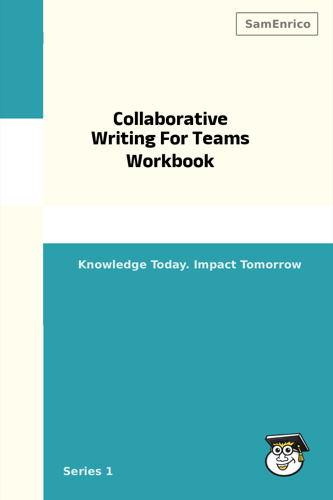
Non-FictionSelf-HelpCollaborative Writing
Collaborative Writing For Teams Workbook eBook
Manages shared documents, version control, and gro
by Ryan Isabel
Manages shared documents, version control, and group authorship for creative writing projects.
Formats
Free sample
Chapter 1: The Pre-Written Agreement...--Most teams fail before they write a single word. Not because they lack talent, not because they miss deadlines, and certainly not because they don’t care. They fail because they never answered two simple questions before opening a shared document: What does “done” sound like? and Who decides when we disagree?If those questions sound obvious, so does “look both ways before crossing the street.” And yet, thousands of collaborative writing projects derail every day—not in the writing, but in the assumptions people made about the writing. The academic team that submits a journal article with three different citation styles because each author assumed their own was “standard.” The screenplay duo that breaks up over a single line of dialogue because they never agreed on who had final cut.
The marketing team that spends four hours debating an Oxford comma while the structural holes in their campaign go unnoticed.This chapter introduces the Team Charter—a living document signed by all members before the project begins. The Team Charter is not legally binding, but it is psychologically binding. It forces conversations that most teams avoid until it is too late. By the end of this chapter, your team will have a written, signed agreement covering voice, authority, credit, and conflict resolution. You will never again hear the words “I thought you were handling that” or “Wait, who has final say?” You will have a Pre-Written Agreement that makes every subsequent chapter of this workbook possible.The Silence That Kills Collaboration Before we build the solution, let us sit with the problem for a moment.
Most teams do not actively sabotage themselves. They simply assume. They assume everyone hears the same “voice” when they read a draft. They assume the quiet person agrees with the loud one. They assume credit will sort itself out at the end.
These assumptions are the silent killers of collaborative writing.The Assumption of Shared Voice. Every writer has an internal rhythm, vocabulary, and tolerance for abstraction. When six people write six paragraphs without agreeing on tone, the result is not a unified document. It is a literary chimera—what one of my clients famously called “Frankenstein prose.” One paragraph is academic and dense. The next is casual and breezy.
The third is poetic and vague. Each paragraph is fine in isolation. Together, they are unreadable.The Assumption of Shared Authority. Teams often assume that “collaboration” means everyone has equal say on everything. This is noble, and it is also a recipe for gridlock.
Creative writing—unlike data entry or assembly line work—does not benefit from design by committee. Without a clear decision-making hierarchy, teams spend hours arguing over trivial word choices while ignoring structural problems. The psychologist C. Northcote Parkinson called this “bikeshedding”: spending disproportionate time on easy, visible issues (like the color of a bike shed) while neglecting complex, invisible ones (like the structural integrity of the nuclear reactor). In collaborative writing, bikeshedding looks like two hours debating a single comma while the plot has a hole you could drive a truck through.The Assumption of Shared Credit.
Perhaps the most painful assumption is that credit will work itself out. It will not. The end of a collaborative project is the worst possible time to ask “Who did what?” Memories are foggy. Contributions blur together. Quiet but essential work (fact-checking, formatting, structural editing) is invisible compared to flashy writing.
The result is resentment, broken relationships, and—in academic and professional contexts—formal disputes that can derail publication or employment.The Team Charter kills all three assumptions dead.Core Component 1: The Voice Audit The Voice Audit is the first and most important exercise in this workbook. It takes twenty minutes and will save you twenty hours of rewriting. Here is how it works.Step One: Individual Writing (5 minutes). Every team member writes a single paragraph on the same topic. The topic does not matter.
Choose something neutral but specific: “Describe the ideal user experience for our product” or “Summarize the protagonist’s motivation in Act One.” The key is that everyone writes on exactly the same prompt.Step Two: Anonymous Reading (5 minutes). Collect the paragraphs. Remove the authors’ names. Distribute them to the team without attribution. Each person reads all the paragraphs and notes three things for each: the sentence length, the vocabulary level (simple, moderate, complex), and the tone (formal, neutral, casual, poetic, humorous).Step Three: Negotiation (10 minutes).
Now the team answers five questions as a group:Sentence length: What is our target average sentence length? (Short sentences under 15 words feel urgent. Long sentences over 25 words feel academic or meditative. Mixed lengths feel natural but require intentional variation.)Vocabulary level: What reading level are we targeting? (Use the Flesch-Kincaid scale or simply decide: “No jargon,” “Technical terms defined at first use,” or “Assume expert audience.”)Tone: Describe our target tone in three adjectives.
(Examples: “Authoritative but accessible,” “Warm and conversational,” “Dry and precise,” “Playful and irreverent.”)Grammar non-negotiables: Make three specific grammar decisions. (Examples: “Oxford comma required,” “No semicolons,” “Active voice only except when passive is necessary for emphasis.”)The “Frankenstein test”: After negotiating, reread the anonymous paragraphs. Which ones would be rejected under the new rules? Discuss openly. This is not about blaming the author.
It is about calibrating the team’s shared ear.The Output. The Voice Audit produces a one-page Voice Card that lives in your shared drive and is taped to the wall of every writing session. The Voice Card might look like this:Project: Dragon Novella Target sentence length: 15–20 words average, with variation for emphasis Vocabulary level: Grade 8–10. No jargon without definition.Tone: Urgent, sensory, close third-person Grammar non-negotiables: Oxford comma. No passive voice in action scenes.
Dialogue tags limited to “said” and “asked.”Rejected examples (from our audit): [Attach 1-2 anonymized paragraphs that violate the rules]The Voice Card is not a straightjacket. It is a calibration tool. When a sentence breaks the rules, the team can ask: “Is this a deliberate exception or a drift?” Deliberate exceptions are fine. Drift is how Frankenstein prose is born.Core Component 2: The Lead Author and the Integrator The Voice Audit aligns what you write. The next component aligns who decides.
The Team Charter establishes two distinct roles: the Lead Author and the Integrator. Most teams collapse these roles into one person. Sometimes that is correct. Sometimes it is a mistake. The decision depends on project size and structure.The Lead Author.
The Lead Author writes most of the draft. They are the primary creative voice. They hold Level 2 authority (as defined in the Edit Authority Hierarchy below), meaning they have final decision power only after disputes have been escalated. The Lead Author is not a dictator. They are a tiebreaker.
On a typical project, the Lead Author writes 40–60 percent of the words and makes final calls on fewer than 5 percent of contested decisions.The Integrator. The Integrator weaves together contributions from multiple team members. They do not necessarily write original content. Instead, they take drafts from several authors and merge them into a single, coherent document. The Integrator is responsible for resolving transitional gaps, detecting contradictions, and ensuring that the final document…
This is the end of the free sample. Get the eBook to keep going. Buy now
About this book
Details
- Author
- Ryan Isabel
- Publisher
- SamEnrico
- Language
- English
- Genre
- Non-Fiction, Self-Help, Collaborative Writing
- Released
- 2026-06-07
- Pages (approx.)
- 143
- Available as
- eBook, Audiobook

Read better in the ZLOADR app
Your eBooks on your phone or tablet. Sign in with your SamEnrico account and start reading.
More by Ryan Isabel
 Iraqi Professional ExodusRyan Isabel$11.99
 Gambling Self ExclusionRyan Isabel$11.99
 Bodyweight Workout Log BookRyan Isabel$11.99
 Parental Anger Trigger AwarenessRyan Isabel$11.99
 Velvet & Vandalism: The Unseen Masterpieces of Banksy’s UndergroundRyan Isabel$11.99
 The Whispering Sands: Unearthing Oman's Prehistoric GiantsRyan Isabel$11.99
 Raspite MiningRyan Isabel$11.99
 GIMP Free Photoshop KillerRyan Isabel$12.99
 Financial Services AcquirersRyan Isabel$12.99
 Understanding Chromosome 6, Partial Trisomy 6qRyan Isabel$17.99
 How to Start a Farm Management Service BusinessRyan Isabel$11.99
You may also like
 Hong Kong Handover 1997Dunn Johnnie$11.99
 Zumba For Postnatal Recovery CourseNeal Christian$11.99
 Zumba for BeginnersLadner Nikia$11.99
 YouTube Comment Mining GuideHumes Pandora$12.99
 Worry Box MeditationCarlin Rudy$11.99
 Workplace Stress MeditationNguyen Lynn$11.99
 Workplace Stress and Sleep RepairHawley Ivory$11.99
 Workplace Perfectionism CureDelaney Jeffry$11.99
 Workplace Injustice Anger GuideWallen Isabelle$11.99
 Work Addiction and Burnout LinkGreenwood Ester$11.99
 Women in Yoga and WellnessBeattie Galina$11.99
 Women in Stand Up ComedyChun Evangeline$11.99