
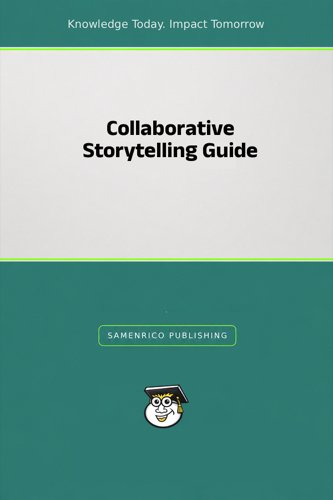
Non-FictionSelf-HelpStorytelling
Collaborative Storytelling Guide eBook
Build narratives together for creative insights.
Build narratives together for creative insights.
Formats
Free sample
Chapter 1: The Conductor's Baton...--The image is burned into our cultural imagination: a solitary figure hunched over a desk, coffee growing cold, the midnight oil burning, wrestling alone with demons of doubt and inspiration. The novelist in a remote cabin. The screenwriter typing furiously in a darkened room. The genius inventor scribbling equations no one else can understand. We have been sold this myth for centuries—the lone author, the solitary genius, the brilliant misfit who creates in isolation and delivers their masterpiece to a grateful world.It is, almost entirely, a lie.Not because individual talent doesn't exist.
It does. Not because hard work and discipline aren't required. They absolutely are. But because the most innovative, the most resonant, the most enduring stories of our era have never emerged from a vacuum. They emerge from friction.
From collision. From the messy, unpredictable, transformative space where multiple minds refuse to see the world the same way and are willing to fight about it—productively.This book is built on a provocative proposition: the most innovative ideas of the twenty-first century will not come from a lone genius in a room, but from the friction and fusion of shared narratives. This guide moves beyond "brainstorming"—that tired, overused word that usually means people taking turns saying things while someone writes nothing down—to provide a system for co-constructing stories that unlock hidden insights, build empathy, and generate breakthrough solutions.But before we get to the systems, the workflows, the tools, and the techniques, we must first dismantle the mythology that prevents most teams from ever attempting genuine collaboration in the first place. Because the fear is real. You have felt it.
I have felt it. The fear that collaboration means compromise. That sharing your story means diluting your vision. That bringing other voices into the creative process will result in a muddled, committee-designed disaster.That fear is understandable. It is also wrong.The Myth of the Solitary Genius Let us examine this myth more closely.
Where did it come from? The Romantic era of the eighteenth and nineteenth centuries gave us the archetype of the artist as tortured outsider—Byron, Shelley, Van Gogh—figures who seemed to create despite society, not because of it. This cultural narrative was reinforced by the publishing industry's marketing of authors as brands, by Hollywood's celebration of the auteur director, and by our own natural desire to simplify complex systems into heroic origin stories.But the historical record tells a different story. Shakespeare borrowed plots, collaborated on plays, and wrote for a troupe of actors whose strengths shaped his characters. Mozart studied Bach, incorporated folk melodies, and refined his work through public performance.
Mary Shelley's Frankenstein emerged from a ghost story competition among friends—Lord Byron, John Polidori, and Percy Shelley—during a rainy summer in Geneva. The novel was literally co-constructed in a collaborative storytelling session gone viral before the internet existed to make such things possible.Even the most celebrated "solitary" geniuses of the modern era relied on invisible collaborators. Steve Jobs did not build the first Macintosh alone; he curated and constrained the work of engineers whose names are lost to history. J.K. Rowling, often held up as the archetypal solo success story, benefited enormously from editors, beta readers, her agent, and a publishing ecosystem that shaped and refined her work.
Toni Morrison, while writing Beloved, shared drafts with a small circle of trusted readers whose feedback changed the novel's structure.The point is not to diminish individual achievement. The point is to recognize that what looks like solitary creation from the outside is almost always a network of influences, constraints, collaborations, and responses—some acknowledged, many invisible. Every story is already collaborative at the moment of reading; the only question is whether the collaboration is intentional or accidental.Narrative Co-Construction: A New Framework This insight brings us to the central theoretical framework of this book: Narrative Co-Construction. The term comes from communication theory and literary studies, specifically the work of scholars who noticed that meaning is not a package delivered from author to audience. Rather, meaning is built in the space between them.Think of it this way.
When you read a novel, you are not a passive recipient. You are bringing your own experiences, your cultural context, your mood on that particular Tuesday evening, your memories of other stories you have read. All of these factors shape what the story means to you. The author may have intended one thing, but you are co-constructing something else. This is not a failure of communication; it is the fundamental nature of narrative.Now imagine making that process intentional.
Imagine gathering a team—of writers, of designers, of product managers, of engineers, of stakeholders—not to merely "share ideas" but to actively co-construct a shared narrative in real time. Imagine the insights that could emerge when multiple perspectives are forced to negotiate, to build, to say "Yes, and..." instead of "No, but..." Imagine the breakthroughs waiting in the friction between a marketer's obsession with clarity and a designer's love of ambiguity, between an engineer's need for logic and a storyteller's hunger for emotion.That is Narrative Co-Construction. And it is the single most underutilized tool in creative problem-solving today.The Writer as Conductor, Not Dictator If we are abandoning the myth of the solitary genius, we need a new metaphor for the role of the lead storyteller. The old metaphor was the dictator: the author who controls every detail, who tolerates no deviation from their vision, who views collaborators as threats rather than resources. This model produces stories, yes.
But it rarely produces breakthroughs. And it almost never produces the kind of collective ownership and engagement that turns a story into a movement.The better metaphor is the conductor.A conductor does not play every instrument. They do not write every note. They do not, in fact, produce any sound at all. Yet everyone in the orchestra looks to them.
Why? Because the conductor sets the tempo, cues the entrances, balances the dynamics, and holds the vision for how all the individual parts fit together into a whole that is greater than any single instrument could produce.The conductor's genius is not in playing the violin or the trumpet. It is in creating the conditions for the violin and trumpet to play their best. It is in hearing the symphony before a single note is played and then guiding seventy individual artists toward that shared destination.This is your role in collaborative storytelling. You are not surrendering control; you are trading the exhausting illusion of total control for the more powerful reality of orchestrated influence.
You set the nuclear elements—the non-negotiable facts that define the story world. You establish the canonicity scale that tells the team how "true" any given contribution is. You facilitate the Critique Contract that separates generation from editing. You protect the container, manage the energy, and handle other people's contributions with respect.But you do not play every note. And that is precisely why the result will be better than anything you could have created alone.The Endless Story: Finite Shapes, Infinite Combinations One of the most common fears about collaborative…
This is the end of the free sample. Get the eBook to keep going. Buy now
About this book
Details
- Author
- Linares Jazmine
- Publisher
- SamEnrico
- Language
- English
- Genre
- Non-Fiction, Self-Help, Storytelling
- Released
- 2026-06-10
- Pages (approx.)
- 123
- Available as
- eBook, Audiobook

Read better in the ZLOADR app
Your eBooks on your phone or tablet. Sign in with your SamEnrico account and start reading.
More by Linares Jazmine
 Parental Anger Safety PlanLinares Jazmine$11.99
 Conversation Starters for PharmaciesLinares Jazmine$11.99
 Toes to Crown Body ScanLinares Jazmine$11.99
 Leaning Forward InterestLinares Jazmine$11.99
 Self Hypnosis for Bursitis PainLinares Jazmine$11.99
 Self Esteem for EntrepreneursLinares Jazmine$11.99
 Design Thinking for HRLinares Jazmine$11.99
 The Devil’s Apprentices: The Bloody Boys of Victorian LondonLinares Jazmine$11.99
 The Ice Queen of Vancouver: How a Suburban Mom Built a Meth EmpireLinares Jazmine$11.99
 How to Produce Coffee Servers and Tea PotsLinares Jazmine$11.99
 Yellow Buckeye HarvestingLinares Jazmine$11.99
 A Collector's Handbook to the Steyr 50Linares Jazmine$11.99
You may also like
 Hong Kong Handover 1997Dunn Johnnie$11.99
 Zumba For Postnatal Recovery CourseNeal Christian$11.99
 Zumba for BeginnersLadner Nikia$11.99
 YouTube Comment Mining GuideHumes Pandora$12.99
 Worry Box MeditationCarlin Rudy$11.99
 Workplace Stress MeditationNguyen Lynn$11.99
 Workplace Stress and Sleep RepairHawley Ivory$11.99
 Workplace Perfectionism CureDelaney Jeffry$11.99
 Workplace Injustice Anger GuideWallen Isabelle$11.99
 Work Addiction and Burnout LinkGreenwood Ester$11.99
 Women in Yoga and WellnessBeattie Galina$11.99
 Women in Stand Up ComedyChun Evangeline$11.99