
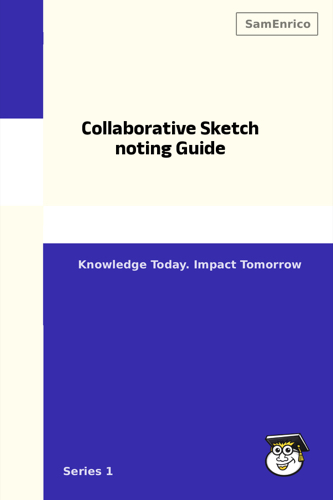
Collaborative Sketch noting Guide eBook
Uses group drawing and visual recording to capture
by Myrick Carry
Uses group drawing and visual recording to capture and generate ideas together.
Formats
Free sample
Chapter 1: The Permission Paradox--Most adults believe they stopped drawing because they weren't good at it. This is precisely backwards. You aren't good at drawing because you stopped.Pick up a pen. Any pen. Now look at the person sitting closest to you—or imagine a colleague if you are reading this alone.
In the next five seconds, draw that person's face. No erasers. No second guesses. No apologizing in advance. Go.What happened?
Did your hand freeze halfway to the page? Did you draw two circles for eyes, a line for a mouth, and perhaps a few frantic scratches for hair? Did you immediately feel the need to say "I know, it's terrible" before anyone could even look at what you had drawn?Here is the secret that no art teacher ever told you and that no well-meaning colleague has ever admitted: that stick figure you just drew is not a failure. It is evidence. It proves that you already possess the only skill you need for collaborative sketchnoting: the ability to translate a three-dimensional human being into a two-dimensional symbol using nothing but a pen and the astonishing pattern-matching machine inside your skull.
That translation—from reality to representation, from person to marks on paper—is not art. It is thinking made visible.And thinking made visible changes everything about how groups work together.The Funeral of the Verbal Meeting Imagine a meeting. Not an unusual meeting. Not a catastrophically bad meeting. Just an ordinary Tuesday morning meeting of the sort that happens ten thousand times every hour in offices around the world.Seven people sit around a table.
A projector glows blue. Someone—let us call her Priya—has prepared a slide deck with fourteen slides. She begins with slide one: "Q3 Revenue Strategy Alignment." She talks for three minutes while the others perform what researchers call "civil attention"—the eyes are pointed at the speaker, but the brain is anywhere else. Three people check email under the table. One person takes notes on a laptop, but the notes are actually a grocery list and a to-do list for later.
Two people stare at Priya with what looks like focus but is actually a mild dissociative state brought on by fluorescent lighting and the third meeting of the day.Priya finishes slide four. She asks, "Thoughts?"The silence lasts four seconds. Four seconds does not sound like a long time, but in a conference room with seven people who would rather be anywhere else, four seconds is an eternity. People shift in their chairs. Someone's phone buzzes.
A throat is cleared.Finally, James speaks. James is the loudest person in the room, though not necessarily the smartest. He speaks for seven minutes about something tangentially related to slide four. He uses the word "synergy" three times. He references a competitor's strategy that he read about in a newsletter.
He is confident, which is mistaken for competence. Three people nod because nodding is easier than disagreeing and because nodding makes the meeting end faster.Mei has a genuinely good idea. She has been thinking about it since slide two. It is specific, actionable, and would save the team approximately twelve hours of work per week. But Mei is an introvert.
She was raised in a culture where interrupting is rude. She has been waiting for a gap in the conversation for six minutes, but James has not taken a breath long enough for her to insert herself. By the time James finishes, Mei has lost the thread of her own idea. She tells herself she will bring it up later. She never does.The meeting ends fifty-three minutes later.
The group has made exactly three decisions, all of which were obvious before the meeting started. One of the decisions directly contradicts a decision made in last week's meeting, but no one remembers last week's meeting because the minutes were never read. Priya sends out meeting notes. Sixteen people receive them. Four people open the email.
One person reads past the subject line.This scene is not an exaggeration. According to a 2023 study published in the Harvard Business Review, 67 percent of professionals report that meetings actively prevent them from completing their actual work. The same study found that the average senior manager spends nearly two full workdays per week in meetings—not working on meetings, but physically sitting in them—and that 71 percent of those meetings are rated as unproductive by the attendees themselves.Let us do the math. If the average professional works forty-five years, and if they spend ten hours per week in unproductive meetings, that is nearly six full years of their career spent sitting in rooms watching slides and waiting for James to stop talking. Six years.
Of their one precious life.Why do we tolerate this?Because we have no alternative. Verbal communication is the default. It is what we learned in school, what we practice every day, and what every tool in our workplace is designed to support. Email, Slack, Zoom, Teams, Power Point, Google Docs—all of them are built on the assumption that words, spoken or written, are the primary unit of business communication.But words are terrible for groups. They are terrible not because words are bad—words are miraculous—but because the physics of conversation works against group cognition.Here is the problem: speech is linear.
One word follows another follows another. By the time the fifth person speaks, the first person's idea has already begun to decay in the short-term memory of everyone else. By the time the eighth person speaks, the third person's brilliant insight is gone entirely, replaced by the urgent need to use the restroom or the creeping awareness that you forgot to reply to your boss's email from yesterday.Human working memory can hold approximately four chunks of information at once. A seven-person meeting generates far more than four chunks of information. Most of those chunks are lost forever.
The meeting becomes a shared exercise in forgetting, punctuated by brief moments of assertive speaking.Drawing changes the physics.Drawing as Externalized Cognition When you draw an idea—even a crude, childlike drawing of a stick figure holding a dollar sign—that idea becomes physical. It exists outside of anyone's head. It can be pointed at, argued with, moved, combined, split apart, and improved. It has a location on a page or a wall. It can be seen by eight people simultaneously, each of whom can process the image in less than one-tenth of a second—approximately sixty thousand times faster than reading the equivalent sentence of text.This is not a metaphor.
This is cognitive science. Psychologists call it "externalized cognition"—the practice of offloading mental work onto the physical environment. When you write a to-do list, you are externalizing cognition. When you use a calculator, you are externalizing cognition. When you draw a diagram to explain a complex system, you are externalizing cognition.
The physical artifact does the remembering so your brain does not have to.Collaborative sketchnoting is externalized cognition for groups. The wall of sticky notes becomes the group's shared memory. The mural becomes the group's shared model of the problem. The drawings…
This is the end of the free sample. Get the eBook to keep going. Buy now
About this book
Details
- Author
- Myrick Carry
- Publisher
- SamEnrico
- Language
- English
- Genre
- Non-Fiction, Self-Help, Visual Facilitation
- Released
- 2026-06-10
- Pages (approx.)
- 152
- Available as
- eBook, Audiobook

Read better in the ZLOADR app
Your eBooks on your phone or tablet. Sign in with your SamEnrico account and start reading.
More by Myrick Carry
 Immediate Feedback Loop FlowMyrick Carry$11.99
 Nap for Entrepreneurs GuideMyrick Carry$11.99
 Circadian Hormone Reset PlanMyrick Carry$11.99
 OKR For Sleep GoalsMyrick Carry$11.99
 Self Hypnosis for Morning AnxietyMyrick Carry$11.99
 Acupuncture for Stress ReliefMyrick Carry$11.99
 Ashiatsu Barefoot MassageMyrick Carry$11.99
 Shōwa Steel Storm: The Rise of Japan's Carrier FleetMyrick Carry$11.99
 Cannae: Hannibal's Perfect Trap (216 BC)Myrick Carry$11.99
 How to Produce a DefoggerMyrick Carry$11.99
 Polish Project Management GuideMyrick Carry$12.99
 One Page Marketing Handbook for ContractorsMyrick Carry$12.99