
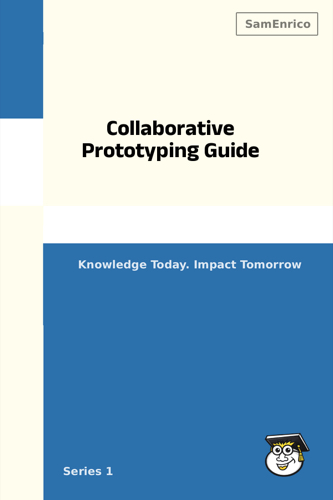
Collaborative Prototyping Guide eBook
Build rough physical or digital models together to
Build rough physical or digital models together to test ideas quickly.
Formats
Free sample
Chapter 1: The $187,000 Mistake...--–- Sarah Chen had been staring at the same pixel-perfect button for three hours. It was 11:47 PM on a Tuesday, and she was alone in the fintech startup’s open-plan office, adjusting the drop shadow on a trading dashboard that she already knew, deep in her gut, was destined to fail.She had known it for six weeks. Actually, she had known it on day two of the eight-week prototyping marathon, when the user research had come back with a clear, unambiguous signal: retail investors did not want a real-time options visualizer. They wanted simpler statements, faster deposits, and a mobile view that didn’t truncate their account balances. But the Vice President of Product, Marcus Villanueva, had fallen in love with the visualizer.
It looked impressive in board meetings. It made the product seem “enterprise-grade.” And now, fifty-seven days and one hundred eighty-seven thousand dollars later, Sarah was adjusting a drop shadow on a coffin.The Perfectionism Tax The numbers were brutal, and Sarah had run them enough times to memorize them. The team had six people: Marcus (VP, $180k annualized), Sarah (senior product designer, $120k annualized), two back-end engineers ($150k each), one front-end engineer ($130k), and a part-time product manager ($100k). The fully loaded cost of the team, including benefits and overhead, was approximately $23,000 per week. Times eight weeks.
That was $184,000 in salaries alone, plus the opportunity cost of not building the features users had actually requested. The final tally: $187,000 for a prototype that not a single user wanted.The Perfectionism Tax formula was simple, and Sarah had scrawled it on a sticky note that she kept hidden in her drawer: (Days Delayed × Team Salary) + (Opportunity Cost of Wrong Direction) = Perfectionism Tax. But the formula missed the human cost. Marcus had stopped speaking to Sarah after she gently suggested, at week three, that they might want to test a low-fidelity paper version first. “We’re not an agency,” he had said, his voice tight.
“We don’t do crayons.” So they had skipped the crayons. They had gone straight to high-fidelity Figma files with interactive components, micro-animations, and a custom icon set that Sarah had spent forty hours polishing. The result was beautiful. It was also useless.The day of reckoning came on a Wednesday. The team had recruited eight retail investors through a user testing service.
Sarah set up the conference room with a one-way mirror, a tripod for the camera, and a fresh notebook. The first participant, a fifty-two-year-old accountant named Diane, sat down, looked at the dashboard, and said nothing for forty-five seconds. Then she asked, “Why would I ever need this?” Sarah’s stomach dropped. The second participant, a thirty-four-year-old software engineer, said, “This is overwhelming. I liked the old one better.” The third participant didn’t even complete the task.
He clicked twice, sighed, and said, “Can I just see my balance? I don’t understand what I’m looking at.”Marcus was watching from behind the mirror. Sarah could see his reflection: arms crossed, jaw tight, the slow shake of his head. After the fifth user, he walked out. He was fired two weeks later, and Sarah started updating her resume that same night.
But before she left, she took a photo of the sticky note with the Perfectionism Tax formula. She still has it on her phone, three years later, as a reminder of the most expensive lesson she ever learned: polished prototypes kill collaboration, and perfection is the enemy of learning.The Paradox of Perfection This book exists because Sarah’s story is not an exception. It is the rule. Across industries—software, medical devices, consumer goods, automotive, even architecture—teams are wasting millions of dollars on prototypes that are too polished, too late, and too precious to change. The central paradox is this: the more finished a prototype looks, the less useful it becomes for collaboration.
When a model appears complete, human psychology takes over. People stop suggesting radical changes. They stop asking “what if.” Instead, they offer tiny tweaks: “Can you make that blue?” “What if the button were two pixels to the left?” “I think the font should be bolder.” These micro-suggestions feel like progress, but they are actually a form of procrastination—a way to avoid the hard work of questioning the underlying assumptions.The research backs this up. A 2019 study from the Design Science Lab at Stanford University gave two groups of product teams the same problem to solve. One group was instructed to build a “rough and ready” prototype using cardboard, tape, and markers.
The other group was instructed to build a “high-fidelity” prototype using digital tools. Both groups had the same amount of time. The results were stark: the low-fidelity group generated 4.7 times more substantive design changes during critique sessions. They also produced prototypes that were 62% more likely to succeed in user testing. Why?
Because the cardboard group treated their prototypes as questions. The high-fidelity group treated theirs as answers.This is what I call the Glue vs. Steel Rule. Physical materials like cardboard, tape, clay, foam core, and Lego are “glue.” They are soft, forgiving, and easy to modify. When you hand someone a cardboard prototype, they instinctively know it is temporary.
They will bend it, break it, and suggest wild modifications because the material itself signals impermanence. Digital prototypes—especially polished ones in Figma, Sketch, or Adobe XD—are “steel.” They are rigid, intimidating, and psychologically expensive to change. When you show someone a high-fidelity digital mockup, they assume you have already invested hundreds of hours. They hesitate to ask for major changes because they do not want to hurt your feelings or waste your time. The result is a cascade of tiny, safe suggestions that preserve the status quo.
The prototype becomes a monument, not a tool for learning.Why Your Brain Loves Polished Prototypes (And Why That Is Dangerous)There is a neurological reason why teams fall into the perfection trap. It is called the IKEA Effect, a cognitive bias first identified by researchers at Harvard, Yale, and Duke University. The IKEA Effect describes the tendency for people to overvalue things they have partially created themselves. In the original study, participants who assembled their own IKEA furniture rated it as more valuable than identical pre-assembled furniture—even when their assembly was clumsy and imperfect. The effort invested created an emotional attachment that distorted their judgment.Now apply this to prototyping.
When a designer or engineer spends three weeks building a high-fidelity prototype, they become emotionally attached to it. The hundreds of micro-decisions—the color choices, the alignment, the animation curves, the icon placement—become a part of their identity. When someone suggests a radical change, it feels like a personal attack. The brain’s amygdala activates a threat response. Defensiveness rises.
Collaboration dies.The solution is counterintuitive: build ugly on purpose. If a prototype is rough, unfinished, and slightly embarrassing, the IKEA Effect works in reverse. No one becomes attached to a cardboard box with googly eyes. When a prototype is obviously temporary, the emotional stakes drop to zero. Junior team members feel safe critiquing senior executives because “it’s just cardboard.” Senior executives feel free to…
This is the end of the free sample. Get the eBook to keep going. Buy now
About this book
Details
- Author
- Finch Caitlyn
- Publisher
- SamEnrico
- Language
- English
- Genre
- Non-Fiction, Self-Help, Prototyping
- Released
- 2026-06-09
- Pages (approx.)
- 140
- Available as
- eBook, Audiobook

Read better in the ZLOADR app
Your eBooks on your phone or tablet. Sign in with your SamEnrico account and start reading.
More by Finch Caitlyn
 The Individual Contributor OKRFinch Caitlyn$11.99
 The Money and Mental HealthFinch Caitlyn$11.99
 First Generation Growth MindsetFinch Caitlyn$11.99
 Warehouse Automation OutlookFinch Caitlyn$11.99
 Delegation for Graphic DesignersFinch Caitlyn$11.99
 Corporate Creativity CourseFinch Caitlyn$11.99
 Mindfulness for First RespondersFinch Caitlyn$11.99
 Quetzalcoatl's Serpent Song: The Feathered Serpent's Rise and FallFinch Caitlyn$11.99
 The Confession of the Cursed: How a Victim Exposed a Serial Killer in 1930s RomaniaFinch Caitlyn$11.99
 Soybean Hay: Forage SoyFinch Caitlyn$11.99
 Mailchimp Product RecommendationFinch Caitlyn$12.99
 US Vendor Credit Building BlueprintFinch Caitlyn$12.99
You may also like
 Prototype Rapid CreationBuckingham Shayne$11.99
 Collaborative Prototyping Sessions CourseKellogg Luci$11.99
 Play Doh Prototyping GuidePringle Shantelle$11.99
 The Non Artist Prototyping GuidePatten Adela$11.99
 Idea Prototyping GuideOverton Barabara$11.99
 Prototyping for Non MakersEllison Eden$11.99
 Rapid Prototyping GuideSaxton Sharita$11.99
 Collaborative Prototyping LabToney Willow$11.99
 Prototyping for Problem SolversBeebe Chet$11.99