
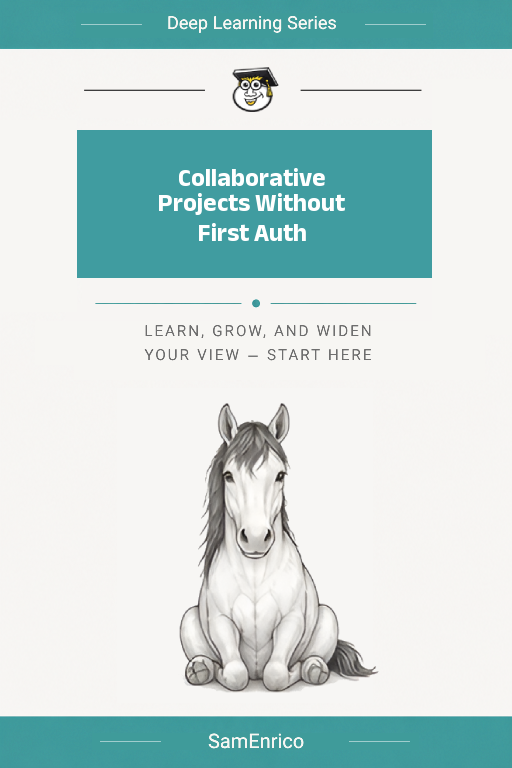
Non-FictionStudent's ShortcutCollaboration Strategy
Collaborative Projects Without First Auth Audiobook
Describe teamwork on multi-author projects, contri
Describe teamwork on multi-author projects, contributions to ongoing studies, and role in larger research initiatives.
Formats
Free sample
Chapter 1: The Tyranny of the Byline--–- The first time Maria saw her name buried in position seven on a twelve-author paper, she told herself it didn’t matter. She had designed the experiment. She had written the original draft of the methods section. She had personally cleaned every outlier from the dataset—three weeks of work that she would never get back. But when the paper appeared in a top-tier journal, the first author was the postdoc who had joined six months into the project and contributed the final figure.
The last author was the principal investigator who had secured the grant but had not touched a single data point. Maria was somewhere in the middle, a ghost in the byline. Her department’s tenure committee would scan the author list, see position seven, and assume she had done something peripheral—maybe a few edits, maybe a single analysis. They would never know that without her work, the paper would not exist.Maria’s story is not unusual. It is not even remarkable.
It is the quiet, grinding reality of modern collaboration.The Collapse of the Lone Genius Myth For most of the history of written knowledge, the single author was the default. In the seventeenth century, a scientific letter or a philosophical treatise carried one name—the thinker, the writer, the sole authority. Isaac Newton published alone. Charles Darwin published alone. Jane Austen published alone.
The lone genius was not just a romantic ideal; it was a practical necessity. Collaboration was rare, slow, and geographically constrained. You could not easily co-author a paper with someone in another country when letters took weeks to arrive and copying a manuscript by hand took days.That world is gone.Today, the average research paper in the life sciences has between six and ten authors. In high-energy physics, it is not unusual to see one hundred, five hundred, or even one thousand co-authors. The 2015 discovery of gravitational waves was credited to over one thousand scientists from more than one hundred institutions.
The Human Genome Project listed hundreds of contributors. In medicine, large clinical trials routinely name twenty, thirty, or forty authors. Even outside academia, the same shift has occurred. Commercial anthologies routinely feature eight, twelve, or fifty co-authors. Open-source software projects list hundreds of contributors.
The era of the lone creator is over. We are all collaborators now.But the tools we use to credit collaboration…
This is the end of the free sample. Get the Audiobook to keep going. Buy now
About this book
Details
- Author
- Mayhew Leandra
- Publisher
- SamEnrico
- Language
- English
- Genre
- Non-Fiction, Student's Shortcut, Collaboration Strategy
- Released
- 2026-05-29
- Pages (approx.)
- 122
- Available as
- eBook, Audiobook

Listen in the VoxFlicks app
Audiobooks and audio dramas wherever you go. Sign in with your SamEnrico account and press play.
More by Mayhew Leandra
 Mirroring And Rapport Building GuideMayhew Leandra$11.99
 Calming Aggressive People TechniquesMayhew Leandra$11.99
 Marketing Creativity GuideMayhew Leandra$11.99
 OCD Journaling Prompts WorkbookMayhew Leandra$11.99
 Survey Redundant Question DetectionMayhew Leandra$11.99
 The Silk Road Conspiracy: Rome’s Forgotten Trade WarsMayhew Leandra$11.99
 Echoes of the Deep: The AI That Decoded the Titanic’s Final MomentsMayhew Leandra$11.99
 Understanding Camptomelic SyndromeMayhew Leandra$17.99
 How to Start a Fancy Leather Goods Business (Beginners Guide)Mayhew Leandra$11.99
 Portuguese Master Degree GuideMayhew Leandra$12.99
 Construction General ManagerMayhew Leandra$11.99
You may also like
 Hong Kong Handover 1997Dunn Johnnie$11.99
 Zumba For Postnatal Recovery CourseNeal Christian$11.99
 Zumba for BeginnersLadner Nikia$11.99
 YouTube Comment Mining GuideHumes Pandora$12.99
 Worry Box MeditationCarlin Rudy$11.99
 Workplace Stress MeditationNguyen Lynn$11.99
 Workplace Stress and Sleep RepairHawley Ivory$11.99
 Workplace Perfectionism CureDelaney Jeffry$11.99
 Workplace Injustice Anger GuideWallen Isabelle$11.99
 Work Addiction and Burnout LinkGreenwood Ester$11.99
 Women in Yoga and WellnessBeattie Galina$11.99
 Women in Stand Up ComedyChun Evangeline$11.99