
Non-FictionSelf-HelpLeadership
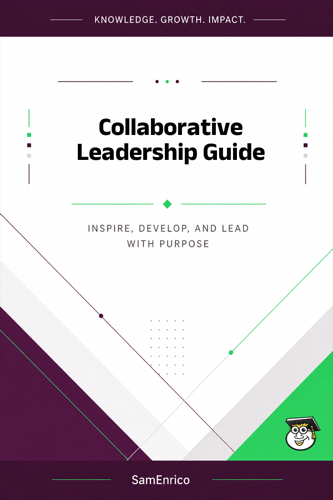
Collaborative Leadership Guide eBook
Facilitate group creativity without dominating.
by Flagg Sammie
Facilitate group creativity without dominating.
Formats
Free sample
Chapter 1: The Domination Log--–- You are about to make a quiet but profound mistake. It will happen within your next three meetings, probably within the next hour, and you will not notice it. The people around you will notice it, but most of them will not tell you. They will comply, they will withdraw, and they will quietly decide that their creative energy is not welcome here. And because you are a well-intentioned leader who genuinely wants the best ideas to surface, you will walk away from that meeting convinced that you have done your job well.This gap between intention and impact is the most dangerous blind spot in collaborative leadership.
The overwhelming majority of leaders who dominate creative conversations do not see themselves as dominators. They see themselves as contributors. They see themselves as problem-solvers. They see themselves as the person in the room with the most experience, the clearest vision, or simply the least tolerance for ambiguity. When asked, they will say with complete sincerity that they value diverse perspectives, that they want everyone to speak up, that they believe in the collective genius of the team.
And they will be telling the truth. But their behavior tells a different story.The marshmallow challenge, introduced in the opening of this book, revealed this gap in stark relief. The business school graduates who lost to kindergarteners did not lose because they lacked intelligence or good intentions. They lost because they were trained, by every promotion and every performance review and every cultural signal they had ever received, to add value by talking. When the timer started, they immediately began asserting opinions, proposing plans, and jockeying for status.
The kindergarteners, by contrast, had not yet learned that talking was the primary way to prove their worth. They simply started building, adjusted based on what they saw, and let the marshmallow—the objective evidence—guide their next move. They were not trying to dominate. They were trying to build. And because no one was trying to dominate, everyone contributed.This chapter exists to solve one specific problem: the gap between your intention to facilitate collaborative creativity and your actual impact on the group's creative output.
The solution is a simple, uncomfortable, and remarkably effective practice called the Domination Log. Before we get there, we need to understand the neuroscience of why dominance kills creativity, the cultural stories that have trained us to dominate without realizing it, and the subtle behaviors that mark the difference between leading and dominating.The Neuroscience of Threat Let us begin with what happens inside the human brain when a leader dominates a conversation. The research is not ambiguous. When a person in a position of perceived authority speaks first, interrupts, criticizes early ideas, or asserts an opinion before others have had a chance to form their own, the brains of everyone else in the room undergo a measurable shift. The amygdala, an ancient structure responsible for detecting threats, activates as though the group were facing a physical predator.
Blood flow redirects away from the prefrontal cortex—the region responsible for creativity, complex problem-solving, and long-term planning—and toward the parts of the brain that manage survival behaviors. The group becomes, in a very real neurological sense, dumber.This is not a metaphor. Functional MRI studies have shown that when individuals perceive themselves to be in a low-power position relative to a dominant speaker, their cognitive flexibility decreases by as much as thirty percent. Their working memory capacity narrows. Their ability to generate novel associations between disparate ideas—the very engine of creativity—is significantly impaired.
The group does not become less creative because they have fewer good ideas. They become less creative because their brains have been biochemically reconfigured to prioritize self-protection over exploration.Amy Edmondson, the Harvard researcher who coined the term "psychological safety," has spent decades studying this phenomenon in organizations. Her work shows that in teams where members feel psychologically safe—where they believe that speaking up with a question, a concern, or a half-formed idea will not result in punishment or humiliation—performance on complex, creative tasks is dramatically higher. In teams where psychological safety is low, performance on routine tasks may remain acceptable, but performance on any task requiring innovation collapses. The reason is simple: creativity requires vulnerability.
You cannot be creative and self-protective at the same time.The tragedy is that most leaders who destroy psychological safety have no idea they are doing it. They believe they are creating a high-performance environment. They believe their interruptions are efficient. They believe their early criticism is saving time. They do not see the flinch, the quiet withdrawal, the carefully neutral expression that masks a decision to stop contributing.
And because no one tells them—because everyone is now in threat-response mode and the last thing a threatened person does is criticize the threat—the leader continues, and the group continues to shrink.The Domination Log begins by making the invisible visible. For one week, you are going to track every single time you engage in one of three specific behaviors: speaking first in a meeting, interrupting another person, or offering an unsolicited solution. You are not trying to change these behaviors yet. You are simply trying to see them. Most leaders who complete this exercise for the first time are shocked by the frequency of their own dominance behaviors.
They did not know. Now they will.The Cultural Stories That Trained You to Dominate You did not wake up one morning and decide to become a dominator. You were trained. The cultural stories about leadership that saturate business schools, management books, performance review criteria, and even children's movies have all reinforced the same basic narrative: leaders talk, leaders have answers, leaders set the direction, and everyone else follows. The "great man" theory of leadership is not just a historical artifact; it is a daily, unexamined operating system running in the background of most organizations.Consider the language of leadership.
We talk about "command and control." We talk about "driving results." We talk about "setting a vision" and "getting buy-in." These are not neutral phrases. They imply a directional flow from top to bottom, from leader to follower, from talker to listener. They imply that the leader's primary job is to produce content and the team's primary job is to receive it. Even the metaphor of "buy-in" is telling: the leader has already decided where to go, and the team's role is to purchase that direction, to sign on the dotted line. No one has ever bought into a surprise.
The deal is already done.The alternative metaphor introduced in this book is the Silent Conductor, and it is useful to pause here and understand why it challenges these deep cultural stories. An orchestra conductor does not play an instrument. The conductor cannot produce a single note of music. Every sound comes from the musicians. And yet the conductor is essential.
The conductor shapes the tempo, the dynamics, the entrance and exit of each section. The conductor hears what no single musician can hear: the whole. The conductor's power is not in talking but in listening, not in producing but in…
This is the end of the free sample. Get the eBook to keep going. Buy now
About this book
Details
- Author
- Flagg Sammie
- Publisher
- SamEnrico
- Language
- English
- Genre
- Non-Fiction, Self-Help, Leadership
- Released
- 2026-06-07
- Pages (approx.)
- 151
- Available as
- eBook, Audiobook

Read better in the ZLOADR app
Your eBooks on your phone or tablet. Sign in with your SamEnrico account and start reading.
More by Flagg Sammie
 Avoiding Overwork RemotelyFlagg Sammie$11.99
 Blinking Frequency SignalsFlagg Sammie$11.99
 Arranged Marriage Fear ChildhoodFlagg Sammie$11.99
 Parenting Special Needs AngerFlagg Sammie$11.99
 Dream Shadow Figure LogFlagg Sammie$11.99
 Small Talk for International TravelFlagg Sammie$11.99
 Preventive Master GuideFlagg Sammie$11.99
 The Silent Protest: The Untold Story of the 1968 Olympic Black Power SaluteFlagg Sammie$11.99The Silent Protest: The Untold Story of the 1968 Olympic Black Power SaluteFlagg Sammie$11.99
 The Cursed Caskets of Cape Town: Wine Fraud and the Phantom of the VineyardsFlagg Sammie$11.99
 A Collector's Handbook to the Standard FifteenFlagg Sammie$11.99
 User Experience DesignerFlagg Sammie$11.99
You may also like
 Hong Kong Handover 1997Dunn Johnnie$11.99
 Zumba For Postnatal Recovery CourseNeal Christian$11.99
 Zumba for BeginnersLadner Nikia$11.99
 YouTube Comment Mining GuideHumes Pandora$12.99
 Worry Box MeditationCarlin Rudy$11.99
 Workplace Stress MeditationNguyen Lynn$11.99
 Workplace Stress and Sleep RepairHawley Ivory$11.99
 Workplace Perfectionism CureDelaney Jeffry$11.99
 Workplace Injustice Anger GuideWallen Isabelle$11.99
 Work Addiction and Burnout LinkGreenwood Ester$11.99
 Women in Yoga and WellnessBeattie Galina$11.99
 Women in Stand Up ComedyChun Evangeline$11.99