
Non-FictionSelf-HelpAddiction Medicine
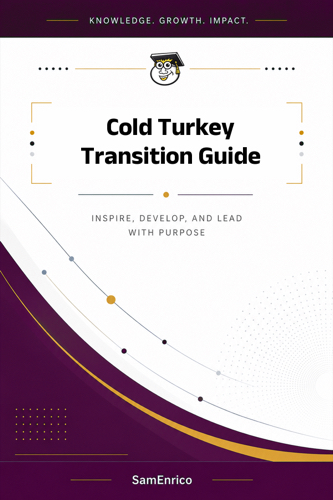
Cold Turkey Transition Guide eBook
Master the abrupt cessation method with withdrawal
Master the abrupt cessation method with withdrawal management schedules and motivational milestone tracking.
Formats
Free sample
Chapter 1: The Zero-Day Pledge--You have been lied to, but not by anyone who meant you harm.The lie is everywhere in recovery culture, whispered in twelve-step basements and shouted from addiction treatment center billboards. It appears in the careful language of well-meaning doctors and in the tearful confessions of people who have tried to quit a hundred times and failed. The lie sounds like wisdom. It sounds like kindness. It sounds like this:"Slow and steady wins the race.
Taper. Reduce gradually. Give your body time to adjust. Cold turkey is too hard. Cold turkey is dangerous.
Cold turkey is for people with more willpower than you have. Do not attempt it. You will fail."This book exists because that lie has killed more recovery attempts than relapse ever did.Not the lie about safety—to be clear, there are substances and dosages for which abrupt cessation can kill you, and we covered those in Chapter 0 with the unflinching honesty that this topic demands. If you are reading this chapter, you have either passed the safety screen or you have ignored it, in which case stop now and go back. The red flags for alcohol, benzodiazepines, and barbiturates are not negotiable.
Seizures do not care about your motivation.But for the rest of you—the nicotine users, the cannabis users, the behavioral addiction strugglers, the short-term medication users, the people whose substance of choice is legal, accessible, and slowly dismantling their lives—the lie about tapering has done incalculable damage.Here is the truth that the recovery industry does not want you to hear: for many people and many substances, abrupt cessation produces higher long-term abstinence rates than gradual tapering. The science supports this. The psychology supports this. And the lived experience of millions of former smokers, former cannabis users, and former behavioral addicts supports this.The problem is that no one has ever given you a manual for cold turkey. Until now.The Prison of "Just One Less"Imagine a man standing at the edge of a swimming pool.
The water is cold. He knows he needs to get in, but he has been told that the only safe way is to lower himself inch by inch, one degree of discomfort at a time. So he dips a toe. He shivers. He pulls it back out.
He waits. He dips the same toe again. He tells himself he is making progress. An hour later, he is still standing on the edge, his toe wrinkled, his body dry, his courage exhausted.This is the tapering trap.Tapering sounds rational. Reduce your dose by ten percent each week.
Step down gradually. Let your brain adjust slowly. What could be more sensible?What the tapering advocates do not tell you is that for a significant subset of the human population—perhaps a third, perhaps half—the slow reduction never reaches zero. The reason is not weakness. The reason is neurobiology combined with personality psychology.Here is what happens when you taper.You start with motivation.
You measure your doses. You feel virtuous. You cut back by that first ten percent, and the withdrawal is noticeable but manageable. You feel proud. You survived a reduction.
You are in control.Then the second week comes. You cut another ten percent. Now you are at eighty percent of your original dose. The withdrawal is more noticeable. You are sleeping worse.
You are more irritable. But you persist.By the third or fourth week, something shifts. You are now at seventy percent of your original dose. You have been in a state of mild, continuous withdrawal for nearly a month. You are exhausted.
Your motivation is fraying. And here is the cruel math: you are still using. You have not quit. You have simply learned to tolerate a lower dose while experiencing almost all the discomfort of abstinence, stretched out over weeks or months.This is not recovery. This is a hostage negotiation with your own addiction.The tapering model assumes that humans are rational calculators of long-term benefit.
It assumes that we can endure indefinite discomfort for a distant reward. It assumes that every person's psychology responds identically to gradual dose reduction.These assumptions are false.For the person with an all-or-nothing personality—and if you are reading a book about cold turkey, that is likely you—tapering is not a path to freedom. It is a treadmill that never stops. You are constantly negotiating with yourself. Should you cut today?
You had a bad day at work, maybe skip the reduction this week. You are traveling, maybe wait until you are home. You have a social event, maybe just this once you stay at the previous dose.The taper that was supposed to take eight weeks stretches to eight months. Then it stops altogether. Then you are back at your original dose, convinced that you are incapable of quitting, because the only method you were told to use failed you.It did not fail you because you are weak.
It failed you because it was the wrong tool for your brain.The Neurochemistry of the Abrupt Stop To understand why cold turkey works for certain people and certain substances, you need to understand what happens inside your skull when you stop using.Every substance that generates dependence works on one of a handful of neurotransmitter systems. Alcohol and benzodiazepines enhance GABA, the brain's primary inhibitory neurotransmitter. Opioids bind to mu receptors, flooding the brain with artificial endorphins. Nicotine stimulates nicotinic acetylcholine receptors, triggering a cascade of dopamine release. Cannabis activates CB1 receptors, which modulate dopamine and GABA indirectly.
Stimulants like cocaine and amphetamines directly flood the synapse with dopamine, norepinephrine, and serotonin.When you use a substance repeatedly, your brain adapts. It is not trying to punish you. It is trying to maintain balance, a process called homeostasis. If you are constantly flooding your synapses with dopamine, your brain will reduce the number of dopamine receptors—downregulation—so that the signal does not become overwhelming. If you are constantly enhancing GABA, your brain will reduce its own GABA production and increase excitatory neurotransmitters to compensate.This adaptation is the biological basis of tolerance.
You need more of the substance to get the same effect because your brain has moved the goalposts.When you stop using abruptly, your brain is caught off guard. It has been operating under the assumption that the substance would continue to arrive. Now, suddenly, it does not. The receptors that were suppressed spring back to life. The compensatory mechanisms that your brain built to fight the substance are now operating without opposition.This is withdrawal.Here is the key insight that tapering advocates miss: withdrawal is not a punishment.
It is a sign that your brain is healing. The intensity of withdrawal is directly proportional to the speed of neurochemical recalibration. The faster the recalibration, the more intense the symptoms—and the faster you return to baseline.When you taper slowly, your brain adapts at roughly the same rate that you reduce your dose. You never experience intense withdrawal because you never create a sudden imbalance. But you also never experience a complete reset.
Your brain simply adjusts to a new, lower dose. You have not healed. You have just moved to a different…
This is the end of the free sample. Get the eBook to keep going. Buy now
About this book
Details
- Author
- Cheek Palmira
- Publisher
- SamEnrico
- Language
- English
- Genre
- Non-Fiction, Self-Help, Addiction Medicine
- Released
- 2026-06-08
- Pages (approx.)
- 131
- Available as
- eBook, Audiobook

Read better in the ZLOADR app
Your eBooks on your phone or tablet. Sign in with your SamEnrico account and start reading.
More by Cheek Palmira
 Face Association TechniqueCheek Palmira$11.99
 Self Esteem for RedheadsCheek Palmira$11.99
 Faith Lost and FoundCheek Palmira$11.99
 Mendeleev Siberian ChildhoodCheek Palmira$11.99
 Divorce Loneliness GuideCheek Palmira$11.99
 Biotech Capital StrategyCheek Palmira$11.99
 Dementia Sensory EngagementCheek Palmira$11.99
 The Silk Code: How a 19th-Century Spy Outwitted the East India CompanyCheek Palmira$11.99
 The Forge of the Iron Horse: How the Celts Shaped America's RailsCheek Palmira$11.99
 How to Setup and Launch a Vip EventCheek Palmira$11.99
 How to Produce Sex ToysCheek Palmira$11.99
 GST Registration Penalties IndiaCheek Palmira$12.99
You may also like
 Hong Kong Handover 1997Dunn Johnnie$11.99
 Zumba For Postnatal Recovery CourseNeal Christian$11.99
 Zumba for BeginnersLadner Nikia$11.99
 YouTube Comment Mining GuideHumes Pandora$12.99
 Worry Box MeditationCarlin Rudy$11.99
 Workplace Stress MeditationNguyen Lynn$11.99
 Workplace Stress and Sleep RepairHawley Ivory$11.99
 Workplace Perfectionism CureDelaney Jeffry$11.99
 Workplace Injustice Anger GuideWallen Isabelle$11.99
 Work Addiction and Burnout LinkGreenwood Ester$11.99
 Women in Yoga and WellnessBeattie Galina$11.99
 Women in Stand Up ComedyChun Evangeline$11.99