
Non-FictionSelf-HelpCold Outreach
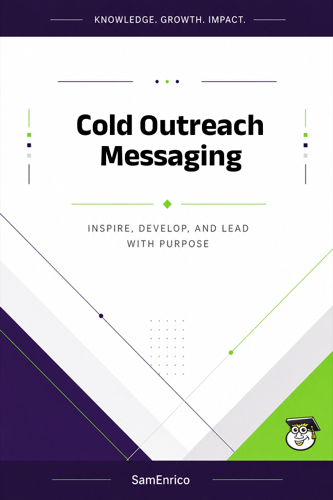
Cold Outreach Messaging eBook
Write effective emails to strangers who matter.
Write effective emails to strangers who matter.
Formats
Free sample
Chapter 1: The Machine Learning Mindset--The single biggest reason your cold emails go unanswered is not bad writing, a weak subject line, or the wrong template. It is that you quit too early and change tactics too often.You send ten emails. No one replies. So you rewrite your template. You send twenty more.
One person says "not interested." You decide cold email doesn't work. You abandon the channel entirely and buy a list of leads from a data broker. That list is terrible. You blame the tool. You switch CRMs.
You hire a consultant. Six months later, you have sent exactly zero effective emails, spent thousands of dollars, and learned nothing.This is not a strategy problem. This is a mindset problem.Every successful cold outreach professional I have ever met treats their work like a machine learning model. They do not judge success by individual replies or rejections. They judge success by patterns that emerge only after hundreds of data points.
They do not change their approach after every failure. They commit to a hypothesis, execute it consistently, and let the data tell them what works.This chapter will completely rewire how you think about cold outreach. You will learn why volume is not the enemy of personalization but its partner, why thirty days of consistency matters more than thirty clever templates, and how to define your target so narrowly that your email feels like a gift instead of an interruption.The Gambler's Fallacy of Cold Outreach Most sellers operate under a hidden logical error that destroys their results before they begin. They believe that each email is an independent event. If email number one fails, email number two must be different.
If email number ten fails, the entire approach must be wrong.This is the gambler's fallacy applied to sales. A roulette wheel does not remember that it landed on black three times in a row. Your prospect does not remember that the last nine people ignored you. Each email is a fresh test of a single hypothesis: does this person have this problem at this moment?The problem is that sellers do not behave like gamblers. Gamblers understand variance.
They know that a roulette wheel will hit red roughly half the time over ten thousand spins, even if it hits black ten times in a row. Sellers, by contrast, see three rejections and declare the game rigged.Let me show you the math that changed how I think about outreach.If your email generates a 3% positive reply rate which is solidly average for B2B cold email, you will receive zero replies from your first ten emails roughly seventy-four percent of the time. That is not a sign of failure. That is basic probability. If you send one hundred emails, you will receive at least one positive reply ninety-five percent of the time.
But here is the catch: you have to send all one hundred emails using the exact same approach. The moment you change your subject line, your template, or your target persona halfway through, you invalidate the test. You no longer know whether the approach failed or whether you failed to execute it.This is why the most successful outbound teams I have worked with do something that looks insane to outsiders. They send the same email to five hundred people. They do not change a single word.
They accept that the first fifty replies might all be negative or nonexistent. And then, around email one hundred fifty, something shifts. The replies start coming. Not because they got lucky, but because they finally reached enough people who had the problem at the right time.Volume is not a substitute for quality. Volume is the only way to find the quality.The Thirty Day Execution Rule Jeb Blount, author of Fanatical Prospecting, popularized a concept that has become the foundation of every elite outbound organization I know.
He calls it the Thirty Day Rule. The rule is simple: you cannot judge any outreach strategy until you have executed it consistently for thirty days.Not twenty days. Not fifteen days. Thirty days.Here is why thirty days works. Most sales cycles, even for simple products, have a natural rhythm.
Prospects check email less frequently on Fridays. They are distracted on Mondays. They go on vacation. They have quarterly planning meetings. A two week test might accidentally land entirely during a slow period.
A thirty day test captures at least two full business cycles, giving you a representative sample.But there is a critical distinction that most people miss. The thirty days must be execution days, not setup days. Too many sellers count the week they spent warming up their domain, the three days they spent building their lead list, and the weekend they spent tweaking their templates as part of the thirty day test. Those days do not count.Here is the rule as I teach it to every team I have ever built. Day one of your thirty day execution sprint begins only after three things are true.
First, your infrastructure is fully configured including secondary domain, authentication records, and deliverability warmed up as described in Chapter 11. Second, you have a lead list of at least one thousand people who match a single, clearly defined persona. Third, you have chosen exactly one email template and one follow up sequence that you will not change for any reason for thirty days.Once those three conditions are met, you start the clock. For thirty days, you send the same number of emails every day. You use the same subject line.
You use the same body copy. You follow up on the same schedule. You do not A/B test. You do not tweak. You do not ask for feedback from colleagues.
You simply execute.This feels wrong. It feels like leaving money on the table. It feels like you could be doing better if you just made one small adjustment. That feeling is the enemy. That feeling is why most sellers fail.
They optimize before they have data. They change variables before they understand the baseline.After thirty days, you will have sent roughly fifteen hundred emails if you are sending fifty per day. You will have received somewhere between forty five and one hundred twenty replies depending on your industry. You will have enough data to know one thing with certainty: whether your core hypothesis about problem, persona, and value proposition is correct.If your reply rate is below one percent after thirty days of consistent execution, your hypothesis is wrong. The problem is not your subject line.
The problem is that you are emailing the wrong people about the wrong thing. Change your persona or change your problem statement. Then run another thirty day sprint.If your reply rate is above three percent, your hypothesis is correct. Now you can start optimizing. But you cannot optimize until you have a baseline.
The thirty day rule gives you that baseline.The One Persona, One Position Principle Most cold emails fail before they are written because the sender does not know who they are talking to. They use generic language like "decision maker" or "stakeholder" or "leader." They address…
This is the end of the free sample. Get the eBook to keep going. Buy now
About this book
Details
- Author
- Beckett Mardell
- Publisher
- SamEnrico
- Language
- English
- Genre
- Non-Fiction, Self-Help, Cold Outreach
- Released
- 2026-06-06
- Pages (approx.)
- 136
- Available as
- eBook, Audiobook

Read better in the ZLOADR app
Your eBooks on your phone or tablet. Sign in with your SamEnrico account and start reading.
More by Beckett Mardell
 Social Media Comparison AffirmationsBeckett Mardell$11.99
 Twelve Step Programs For Incarcerated Individuals HandbookBeckett Mardell$11.99
 Pet Support Group GuideBeckett Mardell$11.99
 Stress Night Sweats GuideBeckett Mardell$11.99
 Fantasy Sports AddictionBeckett Mardell$11.99
 Trader Floor Stress GuideBeckett Mardell$11.99
 Car Emergency KitBeckett Mardell$11.99
 The Architects of the Sky: The Lost Pyramids of MeroëBeckett Mardell$11.99
 The Moonlit Dance of the TenguBeckett Mardell$11.99
 How to Start a Convalescent Home (private Sector Providing Medical Care) Business (Beginners Guide)Beckett Mardell$11.99
 Growing ApocynumBeckett Mardell$11.99
 Pop Up Space Rental PlaybookBeckett Mardell$12.99
You may also like
 Hong Kong Handover 1997Dunn Johnnie$11.99
 Zumba For Postnatal Recovery CourseNeal Christian$11.99
 Zumba for BeginnersLadner Nikia$11.99
 YouTube Comment Mining GuideHumes Pandora$12.99
 Worry Box MeditationCarlin Rudy$11.99
 Workplace Stress MeditationNguyen Lynn$11.99
 Workplace Stress and Sleep RepairHawley Ivory$11.99
 Workplace Perfectionism CureDelaney Jeffry$11.99
 Workplace Injustice Anger GuideWallen Isabelle$11.99
 Work Addiction and Burnout LinkGreenwood Ester$11.99
 Women in Yoga and WellnessBeattie Galina$11.99
 Women in Stand Up ComedyChun Evangeline$11.99