
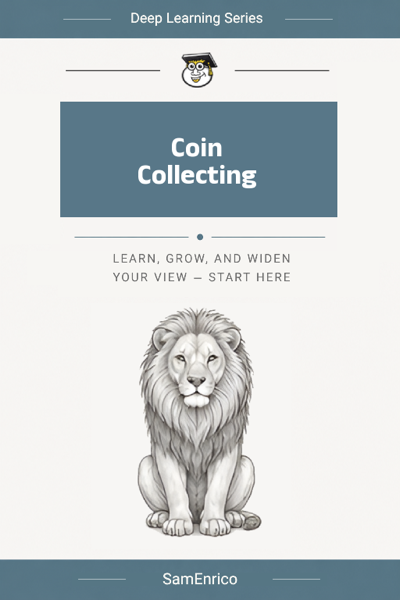
Non-FictionInformativeEducational
Coin Collecting eBook
A Coursebook on Coin Collecting
A Coursebook on Coin Collecting
Formats
Free sample
Chapter 1: The Hidden Metal...--Imagine holding a small, greasy disc of copper that your grandfather carried through a war. Now imagine that same disc, after a professional assessment, is worth forty thousand dollars. That is not a fantasy. That is the reality of a 1943 bronze Lincoln cent—a coin that should never have existed, minted by accident during World War II when the US Mint briefly switched to steel. Fewer than twenty are known.
One sold for 372,000.Another,foundinalunchbox,fetchedover372,000. Another, found in a lunchbox, fetched over 372,000.Another,foundinalunchbox,fetchedover200,000. The difference between pocket change and a down payment on a house is not luck. It is knowledge. This book exists to give you that knowledge.Coin collecting, or numismatics—from the Greek word nomisma, meaning "currency" or "what is accepted by custom"—is often dismissed as a quiet hobby for retired accountants.
That dismissal could not be more wrong. Coin collecting has been called the "Hobby of Kings" because emperors, popes, Renaissance bankers, and American presidents have pursued it with passion. King Farouk of Egypt owned one of the most valuable collections in history, including the 1933 Double Eagle that later sold for nearly $19 million. Franklin Delano Roosevelt, confined to a wheelchair, found solace and mental stimulation in building a world-class collection of naval and maritime coins. John J.
Ford, Jr., used coin dealing to amass a fortune and then donated millions to museums. But you do not need royal blood or a fortune to enter this world. You need curiosity, patience, and a willingness to see what others overlook.This chapter is not merely an introduction. It is a foundational argument for why you should invest your time, attention, and money into collecting coins. By the end of this chapter, you will understand the 2,600-year history of coinage, why coins are fundamentally different from any other collectible, and—most importantly—what kind of collector you want to become.
The remaining eleven chapters will teach you how to find, grade, store, value, and sell coins. But first, you must understand why.The Accidental Time Machine A coin is the only mass-produced object that carries explicit date, place of origin, political authority, and economic value on a single surface. A Roman denarius minted under Emperor Trajan in 107 AD tells you who ruled, what he looked like (or wanted to look like), what metals Rome controlled, and what a day’s wage was. A 1794 Flowing Hair dollar tells you that the fledgling United States needed to prove its economic sovereignty to Europe. A 1933 German 5-mark coin with a swastika tells you about propaganda, desperation, and the rise of fascism.
A 2020 American Innovation dollar with a privy mark tells you about modern minting technology and state pride.Historians call coins "primary documents" because they are not written about history; they are history. When a coin is struck, it captures a specific moment: the political leader in power, the technological limits of metallurgy, the artistic tastes of the era, and even the economic anxieties (debased silver during wars, for example). Unlike a book, which can be rewritten, or a building, which can be renovated, a coin is frozen in the exact moment of its creation.Consider the case of the "1913 Liberty Head nickel." Only five exist. Why? The US Mint officially stopped producing Liberty Head nickels in 1912 to replace them with the Buffalo nickel.
Yet somehow, five 1913-dated Liberty Heads appeared decades later, struck under mysterious circumstances—probably illegally by a mint employee. Those five nickels have been owned by kings, celebrities, and oligarchs. One sold in 2018 for $4.56 million. The coins are not valuable simply because they are rare. They are valuable because they embody a story of secrecy, scandal, and survival.
Every collector, whether they admit it or not, is a storyteller.The Top Ten Myths That Keep Beginners Poor Before you spend a single dollar on a coin, you must unlearn what popular culture has taught you. The following myths are the single greatest reason why beginners overpay, under-sell, and ultimately quit in frustration. Each myth is presented here with a brief correction. The detailed explanations appear in later chapters (noted in parentheses).Myth 1: "Old equals valuable."Reality: A Roman coin from 300 AD can cost 10becausemillionssurvive.A1909−SVDBLincolncentcancost10 because millions survive. A 1909-S VDB Lincoln cent can cost 10becausemillionssurvive.A1909−SVDBLincolncentcancost1,000 because only 484,000 were made.
Age without scarcity is worthless. See Chapter 6 for key dates and mintage figures.Myth 2: "Cleaning a coin increases its value."Reality: Abrasive cleaning (polish, baking soda, erasers) or acid-dipping destroys the original surface and patina, reducing value by 50-90%. This is the most destructive myth in numismatics. See Chapter 5 for the full preservation protocol and the only rare exception (distilled water rinse).Myth 3: "A coin's face value is its true value."Reality: A 1943 steel cent has a face value of one cent but sells for 0.50to0.50 to 0.50to10 depending on condition. A 1974 aluminum cent (never released) would be illegal to own but priceless.
Value is determined by rarity, condition, demand, and metal content—not what is stamped on the coin. See Chapter 6 for valuation frameworks.Myth 4: "You need a lot of money to start."Reality: The most valuable coin you will ever find might be in your pocket change today. Roll hunting—buying boxes of pennies from a bank—costs $25 and can yield wheat cents, errors, and even the occasional Indian Head cent. Many professional collectors began with pocket change. *See Chapter 3 for low-cost acquisition strategies.*Myth 5: "Grading is obvious—a nice coin is a nice coin."Reality: Two coins that look identical to a beginner can differ by a factor of 100x in price based on subtle differences in luster, strike, and surface marks.
Professional grading is a science, not a feeling. See Chapter 4 for the Sheldon Scale and the "Big Three" criteria.Myth 6: "Coins are a get-rich-quick investment."Reality: Over 20-year periods, rare coins have appreciated 5-8% annually on average, but with high volatility and illiquidity. Many modern Proof sets lose value. Coins are a hobby first; treat them as an investment only after five years of experience. See Chapter 8 for the investor vs.
collector distinction.Myth 7: "All mint errors are valuable."Reality: A minor off-center strike on a common coin is worth a few dollars. A dramatic off-center strike that shows the full date on a key-date coin can be worth thousands. Most errors are common curiosities, not treasures. See Chapter 6 for the error field guide.Myth 8: "You should only collect precious metals."Reality: Gold and silver bullion tracks commodity prices. Numismatic value is independent of melt value.
A copper penny (melt value
This is the end of the free sample. Get the eBook to keep going. Buy now
About this book
Details
- Author
- Masterson Ayako
- Publisher
- SamEnrico
- Language
- English
- Genre
- Non-Fiction, Informative, Educational
- Released
- 2026-05-04
- Pages (approx.)
- 149
- Available as
- eBook, Audiobook

Read better in the ZLOADR app
Your eBooks on your phone or tablet. Sign in with your SamEnrico account and start reading.
More by Masterson Ayako
 Food Shame Spiral InterruptMasterson Ayako$11.99
 Emotional Regulation CuesMasterson Ayako$11.99
 Vitamin D Receptor Growth HormoneMasterson Ayako$11.99
 Urban Struggle Childhood MemoirMasterson Ayako$11.99
 Arcade Game AddictionMasterson Ayako$11.99
 The Lab Work PressureMasterson Ayako$11.99
 Twelve Step for Veterans with PTSDMasterson Ayako$11.99
 Liver Disease Anticipatory GriefMasterson Ayako$11.99
 Caregiver and Spouse RelationshipMasterson Ayako$11.99
 The Oracle's Last Prophecy: The Curse of CassandraMasterson Ayako$11.99
 Kicks of the Colossus: How a Lost Sneaker Empire Rose from the AshesMasterson Ayako$11.99
 How to Start a Custom Tailored Outerwear for Men and Boys Business (Beginners Guide)Masterson Ayako$11.99
You may also like
 Hong Kong Handover 1997Dunn Johnnie$11.99
 Zumba For Postnatal Recovery CourseNeal Christian$11.99
 Zumba for BeginnersLadner Nikia$11.99
 YouTube Comment Mining GuideHumes Pandora$12.99
 Worry Box MeditationCarlin Rudy$11.99
 Workplace Stress MeditationNguyen Lynn$11.99
 Workplace Stress and Sleep RepairHawley Ivory$11.99
 Workplace Perfectionism CureDelaney Jeffry$11.99
 Workplace Injustice Anger GuideWallen Isabelle$11.99
 Work Addiction and Burnout LinkGreenwood Ester$11.99
 Women in Yoga and WellnessBeattie Galina$11.99
 Women in Stand Up ComedyChun Evangeline$11.99