
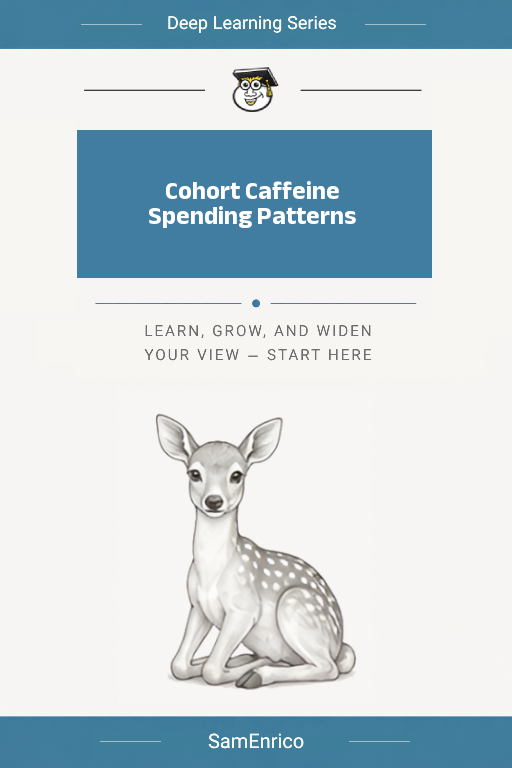
Non-FictionConsumer Mind ReportBeverage Economics
Cohort Caffeine Spending Patterns eBook
Track coffee shop, home brewing, and energy drink
by Ahmed Lynell
Track coffee shop, home brewing, and energy drink purchases across two generations from daily commuters to home-bound retirees.
Formats
Free sample
Chapter 1: The Two-Trillion-Sip Question--The average American office worker will, over the course of a forty-year career, spend approximately 4,160 hours commuting. That is the equivalent of 173 full days, or nearly six months of continuous sitting in traffic, standing on train platforms, or gripping the steering wheel at 7:47 AM while silently calculating whether running that yellow light is worth the ticket. And yet, when researchers ask these same commuters to describe their morning routine, they almost never mention the driving or the waiting or the crowded subway cars. Instead, they describe the coffee. They remember the precise temperature of the cup, the number of pumps of vanilla syrup, the ritual of placing the order without looking at the menu because they have memorized it months ago.
They remember the coffee because the coffee is not fuel. The coffee is the only part of the morning that feels chosen rather than imposed.This book is about that cup of coffee. But it is also about the seventeen other ways that Americans consume caffeine across a lifetime, and how those choices have diverged so dramatically between generations that we are no longer describing a single market or a single habit or a single relationship with stimulation. We are describing two entirely different universes of consumption, separated not by geography or income or even taste, but by the simple and unyielding fact of when someone was born.The thesis of this book is straightforward, though its implications are not: caffeine consumption patterns have fragmented so completely along generational lines that any analysis treating "coffee drinkers" or "energy drink users" as a single category is worse than incomplete. It is actively misleading.
A Baby Boomer drinking a cup of Folgers from a drip machine at 6:30 AM is not engaged in the same behavior as a Gen Z consumer ordering a cold brew with oat milk and two pumps of hazelnut at 2:30 PM as a productivity hack for the remaining three hours of the workday. The first is tradition. The second is performance. And the gap between them explains more about the future of retail, real estate, healthcare, and workplace design than any demographic trendline published in the last decade.The United States coffee market alone exceeds one hundred billion dollars annually. That figure includes beans ground in grocery stores, pods clicked into Keurig machines, lattes poured into ceramic cups at independent cafes, and cold brew sold in tall aluminum cans at highway rest stops.
It includes the morning stop at Starbucks and the office Keurig and the 15bagofsingle−origin Ethiopianyirgacheffepurchasedbysomeonewhoownsbothaburrgrinderandstrongopinionsaboutwatertemperature.Onehundredbilliondollarsisthekindofnumberthatbecomesabstractalmostimmediately.Itiseasiertounderstandasaseriesofsmallernumbers:the15 bag of single-origin Ethiopian yirgacheffe purchased by someone who owns both a burr grinder and strong opinions about water temperature. One hundred billion dollars is the kind of number that becomes abstract almost immediately. It is easier to understand as a series of smaller numbers: the 15bagofsingle−origin Ethiopianyirgacheffepurchasedbysomeonewhoownsbothaburrgrinderandstrongopinionsaboutwatertemperature.Onehundredbilliondollarsisthekindofnumberthatbecomesabstractalmostimmediately.Itiseasiertounderstandasaseriesofsmallernumbers:the5.83 that the average coffee shop visitor spends per transaction, the 210 milligrams of caffeine that the average American consumer ingests daily, the 37 percent of consumers who report brewing more coffee at home than they did one year ago because inflation has made the $6 latte feel like an indulgence rather than a right.But the most important number in this book is not one hundred billion or two hundred ten or thirty-seven percent. It is two. There are two distinct and increasingly incompatible models of caffeine consumption operating simultaneously in the American economy.
One is rooted in the twentieth century, in the era of the three-martini lunch and the newspaper at the breakfast table, in a time when coffee was a companion to conversation rather than a tool for optimization. The other is rooted in the twenty-first, in the age of biohacking and the quantified self and the relentless pressure to extract more output from every hour of the day. These two models are not merely different. They are, in many ways, opposites. And they are colliding in real time across every channel of the caffeine economy, from the drive-thru lane at Dutch Bros to the cold brew section at Whole Foods to the pharmacy shelf where energy shots sit alongside vitamin supplements.This book is an attempt to map that collision.
It draws on the most current data available from industry sources, academic research, and government surveys, including the Numerator Coffee Insights Report, the National Coffee Association's National Coffee Data Trends, the Technomic Beverage Navigator, the NIH Caffeine Intake data, the Citigroup International Survey of price-driven behavioral change, the Harvard T.H. Chan School of Public Health study on coffee and healthy aging, the TD Securities Coffee Metaverse Model, and population-level intake statistics from Caffeine Informer and Kantar. These sources are cited throughout the book, but the methodology is worth stating upfront: this book treats age not as a static demographic variable to be controlled for, but as a dynamic driver of behavior that interacts with life stage, economic pressure, health status, and social context. The top ten books on caffeine consumption have consistently missed this interaction. They treat a sixty-five-year-old retiree and a thirty-five-year-old parent of two as different points on the same consumption curve, when in fact they are playing entirely different games with entirely different rules.The evidence for this divergence is everywhere, once you learn to see it.
Consider the simplest possible caffeine metric: past-day consumption. Among adults aged sixty and older, 73 percent consumed coffee in the past day. That is the highest participation rate of any age group. Among adults under forty-five, participation is lower, but their caffeine intake from energy drinks, cold brew, and ready-to-drink products has grown at nearly three times the rate of traditional coffee. The older group is drinking more coffee, but the younger group is drinking more caffeine from a wider array of sources.
Neither trend is more or less real than the other. They are simply different.Or consider the economics of home brewing versus coffee shop purchases. The cost-per-cup calculation is brutal: a home-brewed cup of ground coffee costs approximately thirty cents, while a coffee shop latte averages five dollars. A rational economic actor would brew at home every day and invest the savings. But humans are not rational economic actors, and caffeine is not a rational economic product.
The same thirty-something professional who meticulously tracks their 401(k) contributions and compares car insurance rates every six months will nonetheless spend $1,500 per year on coffee shop beverages without a moment of regret. This is not irrational. It is social, habitual, and psychological. The coffee shop provides something that home brewing cannot: a third place between work and home, a backdrop for social connection, a ritual that signals identity and taste and belonging. The calculus changes entirely when we stop asking "what is cheapest" and start asking "what is meaningful."The divergence deepens when we examine specific channels of consumption.
Energy drinks, once dismissed as a teenage fad, have become a staple of the middle-aged caffeine portfolio. Gen X consumers, now in their forties and fifties, have quietly become the fastest-growing segment of the energy drink market. They are not drinking Monster because they want to stay up late playing video games. They are drinking Monster because they need to get through…
This is the end of the free sample. Get the eBook to keep going. Buy now
About this book
Details
- Author
- Ahmed Lynell
- Publisher
- SamEnrico
- Language
- English
- Genre
- Non-Fiction, Consumer Mind Report, Beverage Economics
- Released
- 2026-06-01
- Pages (approx.)
- 152
- Available as
- eBook, Audiobook

Read better in the ZLOADR app
Your eBooks on your phone or tablet. Sign in with your SamEnrico account and start reading.
More by Ahmed Lynell
 Red Light Mindfulness PracticeAhmed Lynell$11.99
 Quit Smoking Accountability GuideAhmed Lynell$11.99
 Candida Overgrowth TreatmentAhmed Lynell$11.99
 Daily Review for Project ManagersAhmed Lynell$11.99
 Cleopatra Cultural Diplomacy with RomeAhmed Lynell$11.99
 The Double Life of Anna AndersonAhmed Lynell$11.99
 The Last Telegram: How a Single Message Ended a WarAhmed Lynell$11.99
 Incident ManagerAhmed Lynell$11.99
 10 Ways to Use Chopped Tomatoes (Recipe Book)Ahmed Lynell$11.99
 Payment Provider Selection GuideAhmed Lynell$12.99
 Understanding Bassoe SyndromeAhmed Lynell$17.99
You may also like
 Hong Kong Handover 1997Dunn Johnnie$11.99
 Zumba For Postnatal Recovery CourseNeal Christian$11.99
 Zumba for BeginnersLadner Nikia$11.99
 YouTube Comment Mining GuideHumes Pandora$12.99
 Worry Box MeditationCarlin Rudy$11.99
 Workplace Stress MeditationNguyen Lynn$11.99
 Workplace Stress and Sleep RepairHawley Ivory$11.99
 Workplace Perfectionism CureDelaney Jeffry$11.99
 Workplace Injustice Anger GuideWallen Isabelle$11.99
 Work Addiction and Burnout LinkGreenwood Ester$11.99
 Women in Yoga and WellnessBeattie Galina$11.99
 Women in Stand Up ComedyChun Evangeline$11.99