
Non-FictionSelf-HelpBrain Training
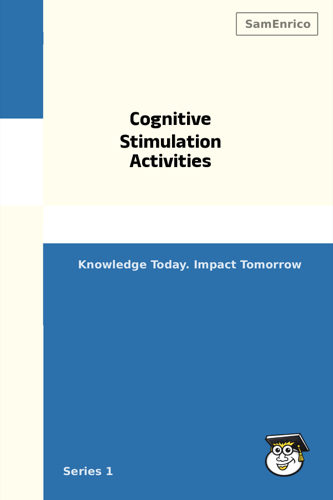
Cognitive Stimulation Activities eBook
Keep your mind sharp with puzzles, learning, and s
Keep your mind sharp with puzzles, learning, and social engagement using this guide.
Formats
Free sample
Chapter 1: The Seven Pillars––You are about to forget something. Not because you are old, not because you are distracted, and certainly not because your brain is broken. You are about to forget something for the same reason your heart beats without your permission and your lungs breathe while you sleep: because your brain is doing exactly what evolution designed it to do.The human brain is not a hard drive. It is not a filing cabinet, a photographic album, or a supercomputer that reliably stores every memory like a perfect recording. If it were any of those things, you would remember every license plate you have ever seen, every song lyric from every car ride, and every single item on every grocery list you have ever written.
And you would be utterly miserable. A brain that remembered everything would be paralyzed by information, unable to separate the signal from the noise, unable to decide which of ten thousand memories mattered in this exact moment.Instead, your brain is a prediction engine. It evolved to keep you alive on the savanna, not to help you remember where you left your reading glasses. It prioritizes threats, rewards, and social information over trivia. And it changes constantly—reshaping itself with every experience, every thought, and every moment of rest.
That capacity for change is called neuroplasticity, and it is the single most important concept in this entire book.Let me say that again, more directly: your brain is physically different tomorrow than it is today. The neurons in your head are not fixed in place like bricks in a wall. They are more like a garden—growing new connections, pruning away unused pathways, and strengthening the routes you travel most often. Every time you learn a new fact, solve a new puzzle, or have a meaningful conversation, you are literally digging new grooves in your neural landscape. And every time you let those grooves sit unused, they grow over like an abandoned footpath.This is the science behind every activity in this book.
When I ask you to memorize a shopping list using a memory palace, you are not doing a parlor trick. You are forcing your hippocampus—the seahorse-shaped structure deep in your brain that acts as the gatekeeper of memory—to build new synaptic connections. When I ask you to solve a logic grid puzzle, you are not just passing time. You are strengthening the myelin sheaths around the axons in your prefrontal cortex, which speeds up neural transmission and makes your thinking faster and more efficient. When I ask you to have a structured conversation with a friend, you are not just being social.
You are activating your temporal lobe, your frontal lobe, and your limbic system simultaneously—a full-brain workout that no solitary puzzle can match.But before we get to the workouts, we need to talk about decline. Because the word "decline" is probably why you picked up this book in the first place.The Fear Beneath the Surface There is a story we tell ourselves about aging, and it goes like this: somewhere around the age of thirty, the brain begins a slow, irreversible slide toward forgetfulness, confusion, and eventual decay. By sixty, we expect to lose our keys. By seventy, we expect to lose names. By eighty, we expect to lose ourselves.
This story is so pervasive that even young people worry about it. Ask a twenty-five-year-old what scares them about growing old, and "losing my mind" will be near the top of the list, right after "being alone" and "running out of money."The problem is not that this story contains no truth. The problem is that it contains just enough truth to be dangerous, and not enough truth to be useful.Yes, certain cognitive functions tend to slow down with age. Processing speed—how quickly you can react to a stimulus or retrieve a fact—often declines gradually starting in middle adulthood. Working memory, the kind that holds a phone number in your head just long enough to dial it, can become less reliable.
And the subjective experience of "tip-of-the-tongue" moments becomes more frequent. These changes are real, and they are not imaginary.But here is what the decline story leaves out: many cognitive functions actually improve with age. Vocabulary tends to increase across the lifespan. Emotional regulation—the ability to calm yourself down after a setback—typically gets better. Crystallized intelligence, which is the accumulation of knowledge and experience, continues to grow well into your seventies and eighties.
The brain does not decline uniformly. It changes. And how it changes depends almost entirely on how you use it.Consider two seventy-year-old women. One spends her days watching television, eating alone, and rarely leaving her apartment. The other volunteers at a local school, plays bridge twice a week, and walks three miles every morning with a friend.
Their brains at autopsy would look different. The first woman's brain would show more cortical thinning, fewer dendritic connections, and less evidence of neuroplastic remodeling. The second woman's brain would appear denser, more connected, and in many ways more like the brain of someone twenty years younger. Not because she was lucky, and not because she won a genetic lottery. Because she used her brain in ways that forced it to adapt and grow.This is the foundation of everything you are about to read: cognitive decline is not inevitable.
It is not a straight line from sharp to dull. It is a choice—or rather, a series of thousands of small choices made daily about how you spend your attention, who you spend your time with, and whether you treat your brain like a muscle to be exercised or a relic to be preserved.The Seven Domains of Cognitive Fitness Before you can train a muscle, you need to know what it does. The same is true for your brain. Over the next twelve chapters, you will engage in workouts designed to strengthen seven specific cognitive domains. These seven pillars are not arbitrary categories I invented for this book.
They represent the best current understanding in cognitive neuroscience of how the human mind organizes itself. Every puzzle, every game, every conversation exercise in this book maps directly onto one or more of these domains.Let me introduce you to each one.Long-Term Memory. This is what most people mean when they say "memory." It is the storage system for facts, events, and skills that you have encoded, consolidated, and retained over time. Long-term memory includes episodic memory (the time you got lost on vacation), semantic memory (the capital of France), and procedural memory (how to ride a bicycle). When you struggle to remember a childhood friend's name, you are having a retrieval problem, not a storage problem—the information is almost certainly still in your brain somewhere, but the neural pathway to it has grown dim from disuse.
The exercises in this book will strengthen those pathways and teach you to build new ones on demand.Working Memory. Think of working memory as your mental scratchpad. It holds information temporarily while you manipulate it. When you multiply thirty-seven times fourteen in your head, you are using…
This is the end of the free sample. Get the eBook to keep going. Buy now
About this book
Details
- Author
- Behrens Tarah
- Publisher
- SamEnrico
- Language
- English
- Genre
- Non-Fiction, Self-Help, Brain Training
- Released
- 2026-06-09
- Pages (approx.)
- 136
- Available as
- eBook, Audiobook

Read better in the ZLOADR app
Your eBooks on your phone or tablet. Sign in with your SamEnrico account and start reading.
More by Behrens Tarah
 Suicide and AppetiteBehrens Tarah$11.99
 Stress Headaches Migraines GuideBehrens Tarah$11.99
 Step Five Admission To God Ourselves Another GuideBehrens Tarah$11.99
 Recording Parts TherapyBehrens Tarah$11.99
 Identity Theft Protection Services FailBehrens Tarah$11.99
 Goal Setting for VolunteeringBehrens Tarah$11.99
 The Phantom Aria: Echoes of the Black DivaBehrens Tarah$11.99
 The Jade Serpent ConspiracyBehrens Tarah$11.99
 How to Start a Animal Ambulance Business (Beginners Guide)Behrens Tarah$11.99
 Growing AngeloniaBehrens Tarah$11.99
 Mailchimp Audience Growth TipsBehrens Tarah$12.99
 How to Produce Microwave OvensBehrens Tarah$11.99
You may also like
 Hong Kong Handover 1997Dunn Johnnie$11.99
 Zumba For Postnatal Recovery CourseNeal Christian$11.99
 Zumba for BeginnersLadner Nikia$11.99
 YouTube Comment Mining GuideHumes Pandora$12.99
 Worry Box MeditationCarlin Rudy$11.99
 Workplace Stress MeditationNguyen Lynn$11.99
 Workplace Stress and Sleep RepairHawley Ivory$11.99
 Workplace Perfectionism CureDelaney Jeffry$11.99
 Workplace Injustice Anger GuideWallen Isabelle$11.99
 Work Addiction and Burnout LinkGreenwood Ester$11.99
 Women in Yoga and WellnessBeattie Galina$11.99
 Women in Stand Up ComedyChun Evangeline$11.99