
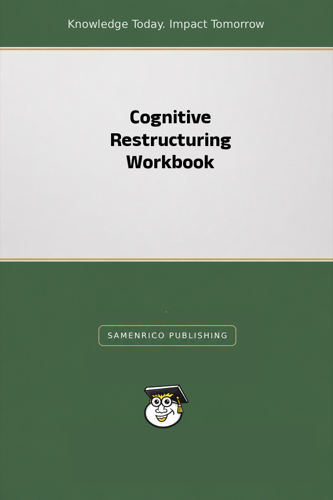
Cognitive Restructuring Workbook eBook
Includes worksheets, thought logs, and practice sc
Includes worksheets, thought logs, and practice scenarios for anger management.
Formats
Free sample
Chapter 1: The Anger Trap--You are not broken.Let me say that again, because you have probably spent years believing the opposite: You are not broken. If you picked up this book, chances are you have done things in anger that you later regretted. You have said words that cannot be unsaid. You have watched the face of someone you love crumple because of something that exploded out of you in three seconds of madness. You have felt the shame afterward—that hollow, sickening feeling that sits in your chest and whispers, What is wrong with me?Here is the truth that every anger management workbook worth its weight agrees on: nothing is wrong with you.
At least, not in the way you think.Anger is not a character flaw. It is not evidence of a "bad personality" or a "short fuse" that you were born with and must endure forever. Anger is an emotion—a biological signal—that every single human being experiences. It is as natural as joy, as sadness, as fear. In fact, anger evolved for a very specific and important purpose: to alert you to threats, to injustice, to boundary violations.
Your anger is trying to protect you. It is your brain's ancient alarm system, and it works exactly as designed.The problem is not the alarm. The problem is what you do after the alarm goes off.This entire book is built on a single, life-changing distinction: anger is not aggression. Anger is the feeling. Aggression is the behavior.
You can feel furious without yelling. You can feel enraged without slamming a door. You can feel absolutely blindsided by injustice without sending that text message you will regret at 2 AM. The goal of cognitive restructuring is not to eliminate your anger—that would be like disabling your smoke alarm because you do not like the noise. The goal is to separate the signal from the explosion, to slow down the space between trigger and reaction, and to give you back the choice that anger has been stealing from you.This chapter will do three things.
First, it will dismantle the most common and destructive myths about anger—the lies you have been told that keep you stuck. Second, it will introduce you to the science of neuroplasticity, which is the proof that you can change. Third, it will walk you through your first real exercises: identifying the hidden payoffs of your anger, calculating the true costs, and committing to a different path.By the end of this chapter, you will have a clear picture of where you are starting from and why change is not only possible but inevitable if you follow the steps in this book. Let us begin.The Myth of the "Angry Person"One of the most damaging beliefs you can carry is the idea that you are just an "angry person." This label—whether you gave it to yourself or someone else gave it to you—functions as a self-fulfilling prophecy. It suggests that anger is a fixed trait, like eye color or height.
It suggests that no matter how hard you try, you will always be this way.This is false.Research in affective neuroscience has shown that anger reactivity is not a permanent setting on your brain's dial. It is a combination of learned habits, environmental triggers, and cognitive patterns—all of which can be changed. The brain is not a stone tablet. It is a living, malleable organ that rewires itself based on what you practice. This is called neuroplasticity, and it is the single most hopeful fact in this entire book.Every time you react to a trigger with an automatic angry thought, you strengthen a neural pathway—like walking the same path through a field until it becomes a rut.
But every time you catch that thought, challenge it, and choose a different response, you begin to carve a new path. At first, the new path is barely visible. It requires effort, attention, and repetition. But over time—usually between sixty and ninety days of consistent practice—the new pathway becomes the default. The old rut grows over with grass.
Your brain literally changes its physical structure based on what you practice thinking.You are not an "angry person." You are a person who has practiced angry reactions. And you can practice something else.Myth #1: Venting Anger Is Healthy Walk into any gym and you will see punching bags. Walk into any therapist's office and you might see a "rage room" recommendation. The popular culture tells us that anger is like steam in a pressure cooker—if you do not let it out, you will explode. So we are encouraged to "vent," to "let it out," to "get it off our chests."The research says the opposite is true.Decades of studies on catharsis—the theory that expressing aggression reduces future aggression—have consistently shown that venting increases anger.
When you yell, punch a pillow, or rehearse your grievances out loud, you are not releasing pressure. You are practicing the neural pathways of aggression. You are teaching your brain that anger leads to action, and that action feels temporarily satisfying. The relief you feel after venting is not the release of trapped energy. It is the short-term reward of having expressed dominance or control.
And like any reward, it reinforces the behavior that produced it.What actually reduces anger is lowering physiological arousal—slowing your heart rate, relaxing your muscles, and giving your prefrontal cortex time to re-engage. This is why cognitive restructuring works. It does not ask you to "bottle up" your anger. It asks you to delay the reaction long enough to ask one simple question: What am I telling myself right now?That question is the most powerful tool you will learn in this book.Myth #2: Anger Is Genetic and Uncontrollable It is true that genetics play a role in temperament. Some people are born with a lower threshold for frustration, just as some people are born with a higher sensitivity to sound or light.
But genetics are not destiny. Temperament is the raw material; your habits are the sculpture you build from it.Research on identical twins raised apart has shown that while genetics account for about 30 to 40 percent of variance in anger expression, the remaining 60 to 70 percent comes from learning, environment, and choice. That is the part you can change. Moreover, studies of neuroplasticity have demonstrated that even the genetic component can be modulated by repeated cognitive practice. When you consistently challenge your angry thoughts, you change the expression of genes related to stress reactivity.
This field is called epigenetics, and it means that your choices influence how your DNA behaves.The belief that anger is uncontrollable is not a fact. It is a cognitive distortion—specifically, a form of learned helplessness. And like all distortions, it can be identified, challenged, and replaced.Myth #3: Suppressing Anger Is the Only Alternative to Exploding If venting is bad, many people assume the only other option is suppression—swallowing your anger, pretending it is not there, and smiling through clenched teeth. This is equally dangerous. Chronic anger suppression is linked to high blood pressure, depression, anxiety, and even…
This is the end of the free sample. Get the eBook to keep going. Buy now
About this book
Details
- Author
- Mcmillen Elmer
- Publisher
- SamEnrico
- Language
- English
- Genre
- Non-Fiction, Self-Help / Interactive
- Released
- 2026-06-06
- Pages (approx.)
- 147
- Available as
- eBook, Audiobook

Read better in the ZLOADR app
Your eBooks on your phone or tablet. Sign in with your SamEnrico account and start reading.
More by Mcmillen Elmer
 The LaDonna Harris StoryMcmillen Elmer$11.99
 Alcoholism Recovery in Rural AreasMcmillen Elmer$11.99
 Morning Gratitude Practice GuideMcmillen Elmer$11.99
 Procrastination Identity ShiftMcmillen Elmer$11.99
 Parkinson's Gut OriginMcmillen Elmer$11.99
 Self Talk For Chronic PainMcmillen Elmer$11.99
 Reddit Compulsive BrowsingMcmillen Elmer$11.99
 The Poisoned Trust: Canada's Deadly Inheritance Murders of the Roaring TwentiesMcmillen Elmer$11.99
 The Green Pioneers: Africa's Forgotten NaturalistsMcmillen Elmer$11.99
 A Collector's Handbook to the Alfa Romeo 1900Mcmillen Elmer$11.99
 The Essential Guide to Singer/songwriterMcmillen Elmer$11.99
 How to Produce High Gloss Exterior PaintMcmillen Elmer$11.99
You may also like
 Shopping Addiction WorkbookOconnor Christen$11.99
 Emotional Regulation WorkbookBolt Eufemia$11.99
 Pain Meditation WorkbookVinson Iesha$11.99
 Empathy Course WorkbookCherry Pandora$11.99
 Child Death Grief WorkbookCoffman Florentina$11.99
 Office Self Worth WorkbookClancy Avelina$11.99
 Positive Self Talk WorkbookShifflett Toby$11.99
 Overcoming Loneliness WorkbookHofman Delbert$11.99
 Time Management WorkbookFranklin Lillie$11.99
 Anticipatory Grief WorkbookMcintire Inocencia$11.99
 Anger in Relationships WorkbookGreene Wendy$11.99
 Senior Self Worth WorkbookGrier Cayla$11.99