
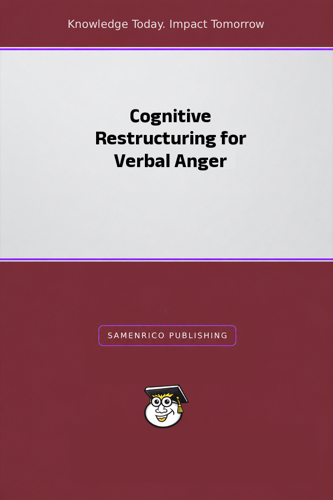
Non-FictionSelf-HelpVerbal Abuse
Cognitive Restructuring for Verbal Anger eBook
Stop yelling and name-calling by changing the thou
by Moser Liane
Stop yelling and name-calling by changing the thoughts that precede outbursts.
Formats
Free sample
Chapter 1: The Seven-Second Gap--Every person who has ever yelled and immediately regretted it has said the same four words: “I just snapped.”These words feel true. They arrive on the heels of shame, often whispered to a partner after the fight, muttered to oneself in the bathroom mirror, or offered as an explanation to a child who is still crying. I snapped. I lost control. I don’t know what came over me.
The phrase implies that the explosion came from nowhere—a sudden, unpredictable rupture in an otherwise reasonable person’s composure. Like a circuit breaker tripping in a storm. Like something that happened to you, not something you did.This chapter exists to deliver a piece of uncomfortable but liberating news: You did not snap. There is no such thing as snapping.What you experienced was not an electrical surge or a possession or a mystery. It was a sequence of events—a chain of psychological and physiological steps—that happened so quickly you never saw them.
And because you never saw them, you concluded they didn’t exist. That is the lie that keeps people trapped in verbal anger for years, decades, or entire lifetimes: the belief that the explosion was instantaneous, and therefore uncontrollable.The truth is that between the moment someone says something that annoys you and the moment you call them a name, there is a gap. A space. A few seconds of mental activity that you have been skipping past your entire life. In that gap, your brain does something specific, predictable, and—most importantly—changeable.
It interprets. It appraises. It tells a story about what just happened. And that story, not the trigger itself, is what causes the yell.This chapter will show you exactly where that gap is, what happens inside it, and why almost every anger management program fails because they try to fix the wrong part of the sequence. You will learn the Three-Part Anger Loop, the difference between low-arousal and high-arousal states, and the single most important decision you will ever make about your anger: which door you walk through in the seconds after a trigger.
By the end of this chapter, you will never be able to say “I snapped” with a straight face again. And that loss of innocence is the first step toward real change.The Anatomy of an Explosion Let us reconstruct a typical verbal outburst. Not a hypothetical, sanitized version—the real one. The kind that happened in your kitchen last week or in your car three days ago or in the hallway before dinner.A trigger occurs. Your teenager rolls their eyes when you ask about homework.
Your partner uses a certain tone—the one that means you are being dismissed. Your coworker sends an email that implies you dropped the ball. Your child leaves wet towels on the floor for the seventh time this month.What happens next, in your conscious experience, is nothing. A blank. Then: sound.
Your own voice, louder than you intended, saying something you immediately wish you could take back. What is wrong with you? Why can’t you ever listen? You are so lazy. Shut up.
I am done.Between the eye roll and the yell, there was a gap. You did not perceive it because your brain was moving too fast. But it was there. Neuroscientists who study emotion regulation have mapped this gap using f MRI and EEG. What they have found is that the brain does not go directly from perception to action.
It goes from perception to appraisal to action. The appraisal step takes somewhere between seven and ten seconds in most people—though it feels like zero because we have trained ourselves to execute it automatically, like breathing.Here is what happens in those seven seconds. Your sensory systems register the trigger: the visual of the eye roll, the auditory of the tone, the memory of the wet towel. That raw data travels to the thalamus, then to the amygdala—the brain’s threat-detection system. The amygdala does not think.
It categorizes. It asks one question very fast: Is this dangerous? If the answer is even maybe, the amygdala sends a signal to the hypothalamus, which activates the sympathetic nervous system. Adrenaline begins to release. Heart rate increases.
Muscles tense. You are now in a state of physiological readiness to fight.But here is what most people miss: The amygdala’s “danger” signal is not based on reality. It is based on interpretation. And the interpretation comes from somewhere else—the prefrontal cortex and the anterior cingulate cortex, which take those seven seconds to construct a story about what the trigger means.In those seven seconds, your brain asks: What just happened? Why did it happen?
What does it say about me? What does it say about the other person? What should I do about it?The answers to those questions are the appraisal. And the appraisal determines everything that follows.The Three-Part Anger Loop Every verbal outburst follows the same three-step sequence. Call it the Anger Loop.
Learn it. Memorize it. Because once you can see the loop, you can break the loop.Step One: The Trigger This is the external event. The eye roll. The tone.
The forgotten chore. The late arrival. The interrupted sentence. Triggers are usually neutral in themselves—they become charged only through interpretation. A person arriving ten minutes late is not inherently disrespectful.
A child forgetting a towel is not inherently lazy. An eye roll is a facial muscle movement. The trigger is just data.Step Two: The Cognitive Filter (The Appraisal)This is where the meaning happens. Your brain takes the raw data of the trigger and runs it through a filter made of your beliefs, expectations, past experiences, and cognitive habits. The filter produces a hot thought—a specific, often distorted interpretation that carries emotional charge.
They are doing this on purpose to hurt me. They have no respect for me. This proves they don’t care. I am being disrespected. I am losing status.
I am being treated unfairly.The hot thought is the engine of the explosion. Without the hot thought, the trigger produces at most mild annoyance. With the hot thought, the trigger produces rage.Step Three: The Verbal Action This is the yell. The name-calling. The insult.
The contemptuous remark. This is what everyone sees and hears. This is the part that causes shame. But notice where it falls in the sequence: last. The verbal action is the outcome, not the cause.
By the time you open your mouth, the real work has already been done by the cognitive filter.Most anger management programs try to intervene at Step Three. They teach breathing techniques, counting to ten, or walking away. These techniques work sometimes, but they are fighting the wrong battle. They are trying to stop a fire after the gasoline has already been poured. Cognitive restructuring works at Step Two.
It changes the filter so the gasoline never gets poured in the first place.This book is about Step Two.The Most Important Distinction You Will Ever Make Before we go any further, you need to understand a distinction that…
This is the end of the free sample. Get the eBook to keep going. Buy now
About this book
Details
- Author
- Moser Liane
- Publisher
- SamEnrico
- Language
- English
- Genre
- Non-Fiction, Self-Help, Verbal Abuse
- Released
- 2026-06-06
- Pages (approx.)
- 152
- Available as
- eBook, Audiobook

Read better in the ZLOADR app
Your eBooks on your phone or tablet. Sign in with your SamEnrico account and start reading.
More by Moser Liane
 PCOS Fertility Solution GuideMoser Liane$11.99
 Walking Meditation For Writers WorkbookMoser Liane$11.99
 The Emotional Labor Recovery GuideMoser Liane$11.99
 The European Civilian ExperienceMoser Liane$11.99
 The Spice Road Kings: How Axum's Merchants Built a Global EmpireMoser Liane$11.99
 Understanding Oculo-auriculo-vertebral DysplasiaMoser Liane$17.99
 Studying Medicine in China GuideMoser Liane$12.99
 Chemical Batch Production SequencingMoser Liane$12.99
 Wellness AmbassadorMoser Liane$11.99
 How to Become a Turning-machine-operator HelperMoser Liane$11.99
You may also like
 Hong Kong Handover 1997Dunn Johnnie$11.99
 Zumba For Postnatal Recovery CourseNeal Christian$11.99
 Zumba for BeginnersLadner Nikia$11.99
 YouTube Comment Mining GuideHumes Pandora$12.99
 Worry Box MeditationCarlin Rudy$11.99
 Workplace Stress MeditationNguyen Lynn$11.99
 Workplace Stress and Sleep RepairHawley Ivory$11.99
 Workplace Perfectionism CureDelaney Jeffry$11.99
 Workplace Injustice Anger GuideWallen Isabelle$11.99
 Work Addiction and Burnout LinkGreenwood Ester$11.99
 Women in Yoga and WellnessBeattie Galina$11.99
 Women in Stand Up ComedyChun Evangeline$11.99