
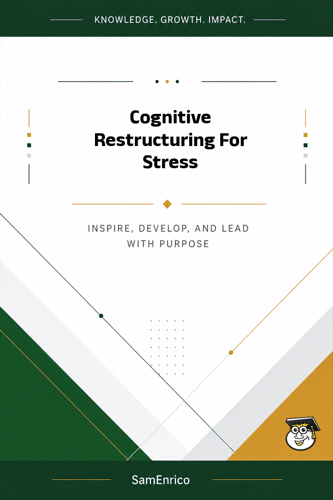
Non-FictionSelf-HelpCognitive Behavioral
Cognitive Restructuring For Stress Audiobook
Change thought patterns that drive overwork and le
by Fong Rona
Change thought patterns that drive overwork and learn sustainable mental habits.
Formats
Free sample
Chapter 1: The Identity Trap--–- Sarah had not taken a vacation day in four years. Not because her company denied her request—they practically begged her to use her accrued days—but because the thought of sitting still, disconnected from her inbox, triggered a low-grade panic that she had come to accept as normal. When her therapist asked her what she was afraid might happen if she stopped working, Sarah laughed. “I don’t know,” she said. “I think I’m afraid of who I’d be.”That moment—a VP of product development, six-figure salary, respected by peers, exhausted to the bone—captures the central paradox of overwork: Sarah was not running toward success.
She was running away from the void left in its absence. She had become so fused with her productivity that the idea of a quiet Tuesday afternoon with no deadlines felt less like relaxation and more like ego death. This is the identity trap, and it is the most overlooked driver of chronic stress in the modern workplace.The Quiet Epidemic of Fused Identity Stress management books tend to focus on tactics: breathe, delegate, prioritize, meditate. These interventions fail for a subset of high achievers not because the tactics are wrong, but because they address the symptom (overwork) rather than the cause (the fusion of self-worth with output). When your identity is built on productivity, rest feels like a threat.
Not a minor inconvenience—a genuine existential threat, processed by the same neural circuits that respond to physical danger.Consider the research from Stanford psychologist Dr. Alia Crum, who studies mindset interventions. Her work demonstrates that how we think about stress changes its physiological effects. But there is a prior question: how do we think about ourselves? For the overworker, the self-concept is a house of cards built from completed tasks, positive feedback, and visible busyness.
Remove one card—a slow day, a critique, a quiet afternoon—and the structure wobbles.This chapter traces the origins of this identity fusion, exposes the cognitive distortions that maintain it, and provides the first practical tools for decoupling your worth from your workload. Because until you separate what you do from who you are, no amount of breathing exercises or calendar blocking will set you free.A Brief History of the Busy Ethic The identity trap did not emerge from nowhere. It is the product of three cultural forces that converged over…
This is the end of the free sample. Get the Audiobook to keep going. Buy now
About this book
Details
- Author
- Fong Rona
- Publisher
- SamEnrico
- Language
- English
- Genre
- Non-Fiction, Self-Help, Cognitive Behavioral
- Released
- 2026-06-07
- Pages (approx.)
- 150
- Available as
- eBook, Audiobook

Listen in the VoxFlicks app
Audiobooks and audio dramas wherever you go. Sign in with your SamEnrico account and press play.
More by Fong Rona
 Uber Driver Destination Filter GuideFong Rona$11.99
 Trinity and Beyond: Atomic Bomb PhysicsFong Rona$11.99
 Assertive Text Messaging GuideFong Rona$11.99
 Metacognition Study PlanningFong Rona$11.99
 Citation Rules for Group Projects CourseFong Rona$11.99
 MDD Psychotherapy ApproachesFong Rona$11.99
 Carnegie HallFong Rona$11.99
 World War II Fighter AceFong Rona$11.99
 The Sun King’s Grandeur: Versailles and the Birth of Modern DiplomacyFong Rona$11.99
 The Storm Chasers of the Ancient Monsoons: Decoding Southeast Asia's Prehistoric Weather MysteriesFong Rona$11.99
 How to Start a Container Made of Plastic for Closed Transit Business (Beginners Guide)Fong Rona$11.99
 Cost Plus Pricing GuideFong Rona$12.99
You may also like
 Hong Kong Handover 1997Dunn Johnnie$11.99
 Zumba For Postnatal Recovery CourseNeal Christian$11.99
 Zumba for BeginnersLadner Nikia$11.99
 YouTube Comment Mining GuideHumes Pandora$12.99
 Worry Box MeditationCarlin Rudy$11.99
 Workplace Stress MeditationNguyen Lynn$11.99
 Workplace Stress and Sleep RepairHawley Ivory$11.99
 Workplace Perfectionism CureDelaney Jeffry$11.99
 Workplace Injustice Anger GuideWallen Isabelle$11.99
 Work Addiction and Burnout LinkGreenwood Ester$11.99
 Women in Yoga and WellnessBeattie Galina$11.99
 Women in Stand Up ComedyChun Evangeline$11.99