
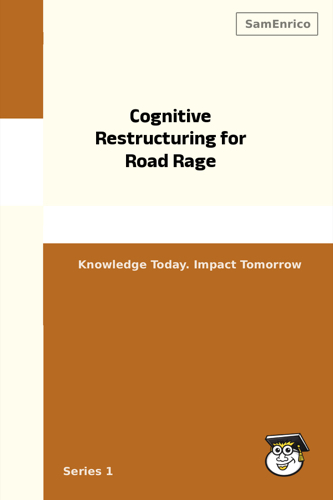
Cognitive Restructuring for Road Rage eBook
Challenge hostile attributions about other drivers
Challenge hostile attributions about other drivers and reduce aggressive driving.
Formats
Free sample
Chapter 1: The Commute Log--–- The first time I realized I had a problem was not in a therapist’s office. It was not after a fender bender or a court date. It was in my own driveway, sitting in a running car, with my knuckles white and my breath coming in short, angry bursts. My wife had stepped out of the house to greet me, as she often did, but this time she didn’t walk all the way to the driver’s side door. She stopped on the front porch.
She held up her hand, palm out, like a traffic cop stopping a speeding car. Then she said something I have never forgotten: “I don’t know who you are when you get home anymore. But I don’t want that person near me.”That was my wake-up call. Not the near-miss on the interstate the week before. Not the time I followed a slow driver through three red lights, honking the entire way.
Not even the moment I realized my children had stopped asking to ride with me. It was my wife’s palm facing me like a stop sign.What she saw that I could not see was the transfer of road rage from the highway to the home. I had been bringing my anger inside with me, carrying it across the threshold like a contagious disease. And I had no idea I was doing it.This book is designed to make sure you do not need a moment like mine. By the time you finish this chapter, you will have begun the single most important practice of this entire program: the Commute Log.
But before we get there, we need to understand what you are actually logging and why.The Anatomy of a Split-Second Driving is unique among human activities because it demands constant vigilance while offering almost no control over the behavior of others. You are strapped into a metal box moving at lethal speeds, surrounded by strangers who are also strapped into metal boxes. Your brain evolved to handle threats like predators and rival tribes, not the ambient chaos of rush hour traffic. And so your brain improvises. It uses shortcuts.These shortcuts are called Automatic Negative Thoughts, or ANTs for short.
They are called automatic because they arrive without your permission. You do not choose to think them. They simply appear, fully formed, like uninvited guests who walk through the front door and make themselves at home. They are called negative because they almost always assume the worst possible interpretation of events. And they are called thoughts because that is what they are—not facts, not reality, but mental events that your brain manufactures in milliseconds.Consider a common driving scenario: You are traveling at a steady speed in the left lane.
A car ahead of you brakes suddenly. What happens in your mind in the next half-second? For most drivers prone to road rage, the automatic thought is something like: “This idiot is brake-checking me on purpose.” Or: “He’s trying to make me crash.” Or: “She has no idea how to drive.”Notice what these thoughts have in common. They assign intention. They assume malice.
They transform a neutral event—a car braking—into a personal attack. Your brain has just committed what psychologists call the hostile attribution bias, which we will explore in depth in Chapter 2. But right now, we are not trying to fix these thoughts. We are only trying to catch them.This is harder than it sounds. Automatic thoughts are fast.
They occur in the space between the brake lights and your foot moving to the accelerator. They occur before you even know you have had a thought. By the time you consciously notice that you are angry, the automatic thought has already done its work. It has triggered your sympathetic nervous system, released cortisol and adrenaline into your bloodstream, tightened your muscles, narrowed your field of vision, and prepared your body for combat. All of this happens in less time than it takes to say the word “angry.”The only way to interrupt this cascade is to slow it down.
And you cannot slow down something you cannot see. That is why the first two weeks of this program are dedicated to observation only. You will not change your thoughts yet. You will not try to be calmer. You will not judge yourself for getting angry.
You will simply watch. You will become a scientist of your own mind, collecting data without interpretation or shame.The Commute Log: Your First Tool The Commute Log is a structured diary of your driving experiences. It is not a journal. It is not a place to vent or to tell stories. It is a data collection instrument, and like any good instrument, it requires precision.
Each entry has four parts, and each part serves a specific purpose.The first part is the Trigger. What happened immediately before you felt anger? Describe only the observable facts. Not what you thought about the event. Not what you assumed the other driver intended.
Just what you saw and heard. For example: “A car merged into my lane approximately ten feet in front of me without using a turn signal.” Or: “The driver in front of me came to a complete stop at a yellow light that I believed I could have made.” Or: “A pickup truck tailgated me for approximately thirty seconds before passing me on the right.”Notice how these descriptions are boring. They contain no emotion, no judgment, no labels like “idiot” or “jerk” or “moron.” That is intentional. The trigger is the raw material of the event, not the story you told yourself about it.The second part is the Thought. What went through your mind in the split-second after the trigger?
This is where you capture the automatic negative thought. Write it exactly as it appeared, including any harsh language or exaggerations. For example: “He cut me off on purpose because he’s a selfish jerk.” Or: “She’s trying to make me late.” Or: “This guy is going to cause an accident.”Do not censor yourself here. Do not soften the language. The automatic thought is not a reflection of your character.
It is a reflex, like jerking your hand away from a hot stove. You are simply recording the reflex so you can study it later.The third part is the Feeling. What emotion followed the thought? And how intense was it on a scale of one to ten? You might write “rage, 8” or “frustration, 6” or “anxiety, 4.” Be as specific as you can.
The difference between irritation and fury matters. So does the difference between fear and contempt. Different emotions respond to different interventions, and you cannot intervene effectively if you do not know what you are feeling.The fourth part is the Action. What did you do in response? Did you honk?
Tailgate? Flash your lights? Swerve? Roll down your window? Yell inside the car?
Grip the steering wheel tighter? Accelerate unnecessarily? Brake suddenly? Write it down without judgment. You are not confessing.
You are collecting data.Here is a complete example of a Commute Log entry:Trigger: A minivan pulled out from a side…
This is the end of the free sample. Get the eBook to keep going. Buy now
About this book
Details
- Author
- Fellows Pauletta
- Publisher
- SamEnrico
- Language
- English
- Genre
- Non-Fiction, Self-Help, Driving Psychology
- Released
- 2026-06-08
- Pages (approx.)
- 135
- Available as
- eBook, Audiobook

Read better in the ZLOADR app
Your eBooks on your phone or tablet. Sign in with your SamEnrico account and start reading.
More by Fellows Pauletta
 Walking Meditation For Amputees WorkbookFellows Pauletta$11.99
 Bakht Khan's Leadership AnalysisFellows Pauletta$11.99
 Positivity Memory Boost PlanFellows Pauletta$11.99
 The Berlin Hostage Standoff: A Post-War Crisis That Shook CanadaFellows Pauletta$11.99
 Understanding Ocular Convergence SpasmFellows Pauletta$17.99
 German University Apartment SearchFellows Pauletta$12.99
 Batch Size Reduction and SequencingFellows Pauletta$12.99
 Umbrella Bag DispensingFellows Pauletta$11.99
 10 Ways to Use Crostini (Recipe Book)Fellows Pauletta$11.99
You may also like
 Road Rage De escalation PlanBroyles Lurlene$11.99
 Traffic Anger TriggersMaas Christal$11.99
 Road Rage DeconstructionBenefield Jeanetta$11.99
 Road Rage Trigger GuideBowers Thomas$11.99
 Flow in DrivingHamlin Alexa$11.99
 Road Rage Trigger IdentificationDubose Virgilio$11.99
 Road Rage in RelationshipsFloyd Leslie$11.99