
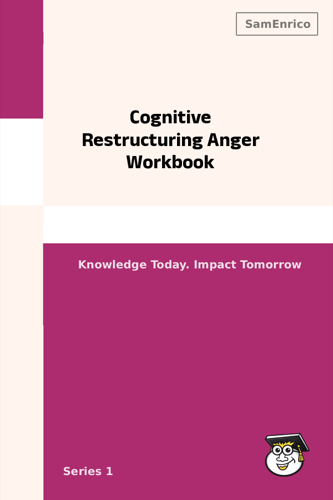
Cognitive Restructuring Anger Workbook eBook
Identify and challenge anger-triggering thoughts u
Identify and challenge anger-triggering thoughts using structured CBT worksheets and exercises.
Formats
Free sample
Chapter 1: The Construction Zone--–- You are standing in a wreckage. A relationship damaged, a doorframe with a fist-sized dent, words spoken that cannot be unsaid, a silence that has stretched into days. You tell yourself the explosion came from nowhere. You tell yourself you were provoked. You tell yourself this is simply who you are.All of these explanations are wrong.
And that is excellent news, because if anger were an uncontrollable force of nature, you would be powerless to change it. But anger is not a volcano. It is not a reflex. It is not a demon that possesses you. Anger is a construction—built in milliseconds, from raw materials you have been gathering for years, by a blueprint you never knew you were following.This entire workbook is about learning to read that blueprint, then redraw it.If you have tried to manage your anger before, you have probably been given strategies that address the wrong part of the problem.
Count to ten. Take a walk. Punch a pillow. These techniques are not useless, but they are incomplete. They try to shut down an explosion after the fuse has already been lit, rather than teaching you how to remove the gunpowder entirely.Cognitive restructuring takes a different approach.
Instead of managing the consequences of anger, it targets the cause: the automatic, lightning-fast thoughts that interpret events, assign meaning, and trigger the emotional cascade. Change the thought, and the anger changes automatically—without suppression, without effort, and without the sense of white-knuckling control that so often fails when you are tired, hungry, or stressed.This chapter will dismantle the three most dangerous myths about anger, introduce the cognitive model that serves as the foundation for this entire program, and give you the first three tools you will need to begin the work. By the end of this chapter, you will understand why the same trigger produces wildly different reactions in different people, why venting makes everything worse, and how to start observing your own anger episodes with the calm, curious attention of a scientist rather than the shame and self-criticism that have likely accompanied your previous attempts at change.The First Myth: Anger Is a Reflex The word "reflex" suggests something automatic, involuntary, and outside conscious control. When a doctor taps your patellar tendon with a rubber hammer, your leg kicks. There is no thought involved, no interpretation, no hidden sentence running through your mind.
That is a true reflex.Anger is not a reflex.If anger were a reflex, the same trigger would produce the same intensity of anger in every person, every time. But this is demonstrably false. Consider a single event: a driver cuts you off in traffic.Person A thinks: That driver must be rushing to the hospital. I hope everyone is okay. This person feels mild concern, perhaps a flicker of annoyance, and then moves on.
The entire episode lasts perhaps ten seconds.Person B thinks: That was careless, but I have done the same thing before. No harm done. This person feels mild irritation that fades within thirty seconds. They might mutter something under their breath, but by the next block, they have forgotten the incident entirely.Person C thinks: That driver deliberately disrespected me. They looked right at me and did it anyway.
They think they are better than me. Someone needs to teach them a lesson. This person feels enraged. Their heart pounds. Their hands grip the steering wheel until the knuckles whiten.
They chase the car, honk repeatedly, and arrive at work in a state of high arousal that lasts for hours. Three days later, they are still telling the story to anyone who will listen.Same trigger. Three completely different emotional and behavioral outcomes. The only variable that changed was the thought that ran through the mind between the trigger and the reaction.This is not philosophy. This is the foundational insight of cognitive-behavioral therapy (CBT), developed by Dr.
Aaron Beck in the 1960s and validated by tens of thousands of clinical studies since. The cognitive model is simple enough to write on a napkin and profound enough to change a life:Situation → Thought → Emotion → Behavior The situation is the external event. The thought is your interpretation of that event—usually automatic, lightning-fast, and unexamined. The emotion is the feeling that thought generates. The behavior is what you do next.Most people believe the arrow runs directly from situation to emotion to behavior: He insulted me → I got angry → I yelled back.
They skip the most important step entirely. The hidden thought is the engine. The emotion is only the exhaust.Here is the liberating implication: if the thought is the engine, then changing the thought changes everything downstream. You do not need to learn to suppress anger. You need to learn to recognize and revise the thoughts that produce it.The Second Myth: Venting Is Healthy In the 1970s, a popular psychological theory suggested that expressing anger was cathartic—that "letting it out" would release the pressure and leave you calmer.
This theory was intuitive, appealing, and almost completely wrong.Decades of subsequent research have shown the opposite effect. Venting anger does not reduce future aggression; it rehearses and strengthens it. Each time you replay an angry narrative in your mind, each time you describe the offense to a friend in vivid detail, each time you punch a pillow or scream into a void, you are not releasing pressure. You are deepening the neural pathways that make anger your default response to frustration.Consider the research of Dr. Brad Bushman at Ohio State University.
In a series of studies, Bushman found that people who vented anger by punching a bag became more aggressive afterward, not less. The physical act of aggression—even against an inanimate object—primed the brain for further aggression. Venting did not drain the swamp; it fed the alligators.Even verbal venting has been shown to be counterproductive. When you tell a friend about an injustice in vivid, emotionally charged detail, you are not processing the emotion. You are reliving it.
You are reactivating the same neural circuits that fired during the original event. You are practicing anger.This is not to say that talking about your feelings is bad. It is to say that how you talk about them matters enormously. Describing an event calmly, with curiosity about your own reaction, can be helpful. Rehearsing a grievance with escalating outrage is the opposite of helpful.This workbook takes a third path.
Cognitive restructuring does not ask you to express anger or suppress it. It asks you to restructure the thoughts that create anger in the first place. If the thought changes, the emotion changes automatically, without the need for venting or suppression.The Third Myth: You Must Get Angry to Be Respected This myth is particularly seductive because it contains a grain of truth. Passive people—those who never express displeasure, never set boundaries, never push back—are often taken advantage of. The solution, however, is not aggression.
The solution is assertiveness, which we will cover in depth in Chapter 8.The belief that you must get angry to be respected is a cognitive…
This is the end of the free sample. Get the eBook to keep going. Buy now
About this book
Details
- Author
- Linville Charise
- Publisher
- SamEnrico
- Language
- English
- Genre
- Non-Fiction, Self-Help, Cognitive Therapy
- Released
- 2026-06-08
- Pages (approx.)
- 141
- Available as
- eBook, Audiobook

Read better in the ZLOADR app
Your eBooks on your phone or tablet. Sign in with your SamEnrico account and start reading.
More by Linville Charise
 GPS Navigation Memory ReliefLinville Charise$11.99
 Body Scan for Construction WorkersLinville Charise$11.99
 Walking Meditation For Fibromyalgia GuideLinville Charise$11.99
 Forgiveness for Spiritual AbuseLinville Charise$11.99
 The Waltz of Emperors: Vienna’s Golden Court and the Birth of Modern MusicLinville Charise$11.99
 Technical Product Support SpecialistLinville Charise$11.99Technical Product Support SpecialistLinville Charise$11.99
 Production Schedule Optimization WorkbookLinville Charise$12.99
 German University for Medical SchoolLinville Charise$12.99
 10 Ways to Use Crocus Sativus (Recipe Book)Linville Charise$11.99
 Understanding Occupational Asthma Isocyanates and MetalsLinville Charise$17.99
You may also like
 Cognitive Behavioral Tools for SobrietyGeary Lenny$11.99
 Workplace Anger Cognitive RestructuringRusso Lavera$11.99
 Parental Anger Cognitive ReframingPalumbo Loree$11.99
 Money Anxiety Coping WorkbookEaves Tommye$11.99
 Meth Recovery Paranoia Reduction CourseDowling Sari$11.99
 Cognitive Distortions in Gambling AddictionWhittington Mariana$11.99
 The Cynicism Reset WorkbookHutchins Van$11.99
 Mind Over Smoke Mental TrainingOutlaw Chara$11.99
 Loneliness Thought ReframingHollingsworth Silas$11.99
 Overcoming Fantasy and Compulsive ThoughtsLytle Miss$11.99
 The Binge Eating Thought Log WorkbookPavao Tillie$11.99
 CBT for Work AddictionHeim Lizabeth$11.99