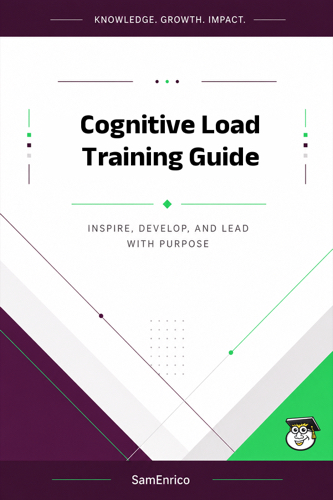
Cognitive Load Training Guide eBook
Teaches how to manage mental bandwidth for better
by Chen Digna
Teaches how to manage mental bandwidth for better decision making.
Formats
Free sample
Chapter 1: The Empty Fuel Gauge--–- It hits you somewhere between 2:47 and 3:22 PM. You know the feeling. You have been making decisions since you woke up—what to wear, whether to hit snooze, which email to open first, what to eat for breakfast, how to respond to that passive-aggressive message from a colleague, whether to attend the 11 AM meeting or use the time to actually work. By mid-afternoon, your brain feels like wet cement. A simple question like “What do you want for dinner?” feels like a personal attack.
You stare at a screen, knowing there is work to do, but the cursor just blinks back at you. You are not lazy. You are not unmotivated. You are not broken. You are simply out of fuel.This is not a metaphor.
This is the single most underappreciated fact of modern knowledge work: your brain has a finite daily budget of mental energy, and you are spending it without knowing where it goes. Most people wake up with a full tank—roughly four hours of high-quality decision-making capacity—and then bleed that fuel on trivial choices, task-switching, notifications, and mental clutter until nothing remains for what actually matters. They blame themselves. They try harder. They drink more coffee.
They work later. And none of it works, because you cannot outwork a leaky fuel tank.This chapter introduces the single most important framework you will learn in this book: the Three Types of Cognitive Load. If you understand these three types—and only these three—you will never look at your exhaustion the same way again. You will stop asking “What is wrong with me?” and start asking “Where is my fuel leaking?” That one shift in questioning is the difference between a lifetime of burnout and a sustainable relationship with your own mind.Welcome to the Cognitive Load Training Guide. By the end of this chapter, you will take a simple self-assessment that reveals your personal “fuel leak” score.
You will learn the vocabulary to describe exactly what exhausts you. And you will receive the most important instruction of this entire book: stop trying harder. Start plugging the leaks.The Myth of the Broken Brain Let us clear something up immediately. If you have ever said any of the following sentences, you are not alone—and you are also not correct:“I just don’t have the discipline I used to have.”“I must be getting lazier as I get older.”“Other people can handle this. Why can’t I?”“If I just tried a little harder, I could power through.”These statements share a common assumption: that exhaustion is a character flaw.
That your brain is a muscle that should get stronger the more you use it, and if it is failing, you are the one to blame. This assumption is not only wrong—it is actively harmful. It leads to a cycle of shame, overwork, and burnout that has been documented in every major cognitive psychology study of the last forty years.Here is what actually happens. Your brain, despite being only about two percent of your body weight, consumes approximately twenty percent of your daily metabolic energy. It runs on glucose and oxygen, and it has a hard limit on how much information it can process at once.
That limit is called working memory, and it is shockingly small. The classic psychological research puts the average working memory capacity at roughly four discrete items at any given moment. Four. That is it. You can hold a phone number, a mental to-do list, the sound of someone talking, and a growing sense of frustration—and then the system crashes.This is not a design flaw.
It is an evolutionary feature. Your brain is not supposed to process everything at once. It is supposed to filter, prioritize, and conserve energy for threats and opportunities. The problem is that the modern workplace has evolved much faster than your brain has. Ten thousand years ago, a “cognitively demanding day” meant tracking three animals and remembering which berries were poisonous.
Today, it means juggling seventeen Slack channels, two video calls, four email threads, a looming deadline, and a personal life that is also sending notifications. Your brain is running Civilization on a calculator and wondering why it keeps freezing.The exhaustion you feel at 3:00 PM is not a moral failure. It is a mathematical inevitability. And the only way out is not to try harder—it is to stop leaking.The Three Types of Cognitive Load: The Highway Metaphor To understand where your fuel goes, you need a map. The most useful map in all of cognitive load theory comes from the work of educational psychologist John Sweller, who first described the Three Types of Cognitive Load in the 1980s.
Since then, his framework has been validated across thousands of studies in medicine, aviation, software engineering, military command, and everyday decision-making. Here is what those three types are, presented through a metaphor you will remember.Imagine you are driving a car from one city to another. You have never made this trip before. The goal is to arrive safely, efficiently, and without crashing. Your brain is the driver, and your mental fuel is the gas in the tank.Intrinsic Load is the road itself.
Some roads are smooth, straight highways. Driving on them requires almost no conscious effort. Other roads are narrow, winding, potholed mountain passes. Driving on those roads requires every ounce of your attention. Intrinsic Load is the inherent difficulty of the task you are trying to accomplish.
A complex task—learning a new software system, having a difficult conversation, solving a novel problem—has high Intrinsic Load simply because of what it is. You cannot eliminate Intrinsic Load. The mountain pass is the mountain pass. But you can learn to navigate it without making it worse.Extraneous Load is the traffic jam that should not be there. Imagine you are driving on that mountain pass, and suddenly there is a detour sign that makes no sense, or a passenger yelling conflicting directions, or a phone buzzing with a text message, or a GPS that keeps rerouting you for no reason.
None of this is inherent to the drive. It is all unnecessary, artificial, and exhausting. Extraneous Load is the mental waste caused by poorly designed information, interruptions, multitasking, clutter, bad instructions, and anything else that steals your attention without adding value. This is the load you can—and must—eliminate. Every unit of Extraneous Load you remove is fuel returned to your tank.Germane Load is the effort of reading the map and building a mental model.
When you drive a new route for the first time, you have to pay attention to every turn, every landmark, every tricky intersection. That effort feels hard, but it is useful hard. It builds a mental map that will make the second drive much easier. The third drive even easier. Eventually, you can make the drive while listening to a podcast.
Germane Load is the good kind of mental effort—the work of building schemas, mental models, and long-term memory that make future tasks easier. Without Germane Load, you never learn anything. The trick…
This is the end of the free sample. Get the eBook to keep going. Buy now
About this book
Details
- Author
- Chen Digna
- Publisher
- SamEnrico
- Language
- English
- Genre
- Non-Fiction, Self-Help, Educational Psychology
- Released
- 2026-06-06
- Pages (approx.)
- 159
- Available as
- eBook, Audiobook

Read better in the ZLOADR app
Your eBooks on your phone or tablet. Sign in with your SamEnrico account and start reading.
More by Chen Digna
 Meal Prep Color Coding GuideChen Digna$11.99
 Gates Successor PlanningChen Digna$11.99
 Sheppard Case Physical EvidenceChen Digna$11.99
 Personal Brand Photography GuideChen Digna$11.99
 External Validation Detox GuideChen Digna$11.99
 Japanese Kamikaze Pilot SurvivorChen Digna$11.99
 Cyber Resilience MetricsChen Digna$11.99
 The Tides of Thought: Plato’s Academy and the Birth of Western PhilosophyChen Digna$11.99
 The Forgotten Labors of Herakles: The Twelve Trials Beyond MythChen Digna$11.99
 How to Trade Feeder CattleChen Digna$11.99
 A Collector's Handbook to the Armstrong Siddeley Lancaster 16Chen Digna$11.99
 Women Cooperative Entrepreneurship PrimerChen Digna$12.99