
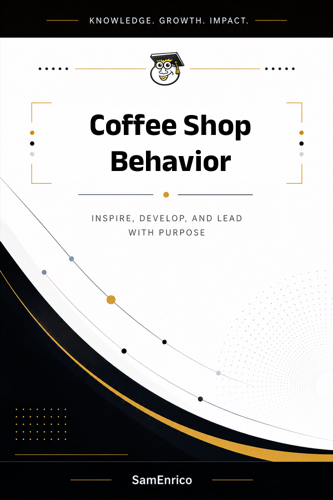
Non-FictionConsumer Mind ReportBeverage
Coffee Shop Behavior eBook
Compare Boomer daily routine visits against Gen Z
Compare Boomer daily routine visits against Gen Z aesthetic and social coffee experiences.
Formats
Free sample
Chapter 1: The Price of Patience...--The exact change landed on the counter with the dull clink of well-worn quarters, each coin a tiny verdict. The man’s fingers, thick-knuckled and deliberate, sorted the pile into two neat stacks—one for the coffee, one for the tip. He was maybe sixty-eight, with the kind of face that had been saying the same thing for forty years without needing to open his mouth: I was here first. I know what I’m doing. The world used to wait.Behind him, a young woman shifted her weight from one foot to the other, then back again.
She was maybe twenty-two. Her phone was already pressed to the payment terminal—Apple Pay, already authenticated, ready to fire in less than a second. But the terminal was not ready. The terminal was waiting for the old man to finish counting. The old man was not finished.
He was deliberating. Over coins. Over seventy-five cents in change that he had pulled from a leather pouch that looked older than the barista standing frozen behind the register.The young woman did not sigh. She had learned not to sigh. Sighing was aggressive.
Sighing was Boomer behavior. Instead, she did something worse. She looked at her phone, then at the ceiling, then at her phone again—a three-second loop of pure, distilled really? that said everything a sigh could have said and more. The old man did not notice.
Or maybe he noticed and did not care. He picked up the first stack of coins, examined them as if checking for counterfeits (in a coffee shop, for a three-dollar coffee), and placed them carefully into the barista’s palm.The barista—a twenty-four-year-old named Jordan who had been working here for eleven months and already had the hollowed-out stare of a eleven-year veteran—smiled the smile of someone who had stopped feeling feelings in the third week on the job. Jordan counted the coins. Twice. Then typed something into the register.
The receipt printed. The old man took it, folded it into his breast pocket, and stepped aside.The young woman’s phone touched the terminal. Bee-doop. One second. Done.
She grabbed her mobile order from the pickup counter—she had placed it while standing in line, because of course she had—and walked out without making eye contact with anyone. The old man was still standing at the counter, adjusting the receipt in his pocket. The barista was already moving to the next customer. The next customer was another Gen Z, phone out, already annoyed by the phantom delay of the old man who had already left.This is not an outlier. This is not a one-time thing.
This is the morning rush at every coffee shop in America where the parking lot has both a Buick and a Prius. And it is the perfect place to begin a book about the quiet, unacknowledged war that is being fought not with weapons, but with wallets.The First Point of Contact Before the order is placed. Before the oat milk is steamed. Before the first sip is photographed or taken or complained about, there is the transaction. And the transaction is where the two generations reveal everything about who they are, what they value, and why they will never understand each other.For Boomers—those born roughly between 1946 and 1964—paying for coffee is a ritual.
It is not merely a means to an end. It is an end in itself. The act of pulling out a wallet, selecting the correct card or the exact change, counting it, presenting it, waiting for the change, and then pocketing the receipt—this is a sequence that has been rehearsed tens of thousands of times over a lifetime. It is comfortable. It is predictable.
It is correct.For Gen Z—born between 1997 and 2012—paying for coffee is an obstacle. It is the thing standing between them and the coffee. The friction should be eliminated, reduced, optimized away. The phone should do it. The app should handle it.
The less time spent at the register, the more time spent living, posting, being. A transaction that takes more than three seconds is not a transaction; it is a hostage situation.These are not mere preferences. These are worldviews expressed through currency.The Boomer Wallet: A Biography in Leather Let us examine the Boomer wallet. It is almost always leather—real leather, not that vegan nonsense—and it has been in their pocket for anywhere from five to twenty years. It is worn at the corners.
It smells slightly of old money and new anxiety. Inside, there is a hierarchy of objects: driver’s license (always in the clear plastic window), three or four credit cards (one of which is for emergencies only and has not been used since 2019), a library card (just in case), a grocery store loyalty card (because saving twelve cents on tomatoes is a moral victory), a folded photograph of a grandchild or a dog, and a small compartment for cash.The cash is important. The cash is very important. Boomers who carry cash are not carrying it for convenience. They are carrying it as a hedge against the collapse of the digital payment system, which they are convinced is coming any day now.
“What happens when the power goes out?” they ask, not rhetorically. “What happens when the banks freeze your account?” They have seen It’s a Wonderful Life. They know how a run on the bank works. Their cash is their lifeboat, and their exact change is the oar.This is not paranoia. This is lived experience.
Boomers grew up in a world where you balanced a checkbook—by hand, with a calculator and a pen—and if you made a mistake, the bank did not call you to apologize. The bank charged you a fee. Money was tangible. Money was paper and metal. Money had weight.When a Boomer pulls out a ten-dollar bill and a handful of coins to pay for a $9.25 latte, they are not being slow.
They are being careful. They are verifying that the change is correct because they have been burned before. They are counting the coins because the alternative—trusting the register, trusting the teenager behind the counter, trusting the universe—feels like an abdication of responsibility. They are performing a ritual that has kept them solvent for fifty years. And they are not about to stop because the young woman behind them has a flight to catch or a selfie to post.The Gen Z Phone: A Portal, Not a Purse Now examine the Gen Z phone.
It is not a phone. It is an extension of the self, a sixth finger, a prosthetic memory. It is always in the hand or on the table or being looked at. The case is probably clear or pastel or covered in stickers from bands the barista has never heard of. The screen has a small crack in the corner that has been there for eight months and will never be fixed because “it still works fine.”Inside that phone is everything.
Not just Apple Pay, but the coffee shop’s app, the loyalty points, the mobile order history, the saved “usual” order…
This is the end of the free sample. Get the eBook to keep going. Buy now
About this book
Details
- Author
- Wooden Karleen
- Publisher
- SamEnrico
- Language
- English
- Genre
- Non-Fiction, Consumer Mind Report, Beverage
- Released
- 2026-06-10
- Pages (approx.)
- 132
- Available as
- eBook, Audiobook

Read better in the ZLOADR app
Your eBooks on your phone or tablet. Sign in with your SamEnrico account and start reading.
More by Wooden Karleen
 Dual Diagnosis Cannabis and Mental HealthWooden Karleen$11.99
 Women in Esports HistoryWooden Karleen$11.99
 Psychopathy Defense in CourtWooden Karleen$11.99
 Spaced Repetition SettingsWooden Karleen$11.99
 Alzheimer's Caregiver StressWooden Karleen$11.99
 Social Comparison Mindset FixWooden Karleen$11.99
 Custom URL OptimizationWooden Karleen$11.99
 The Unseen Canvas: How Jean-Michel Basquiat Defied the Art WorldWooden Karleen$11.99
 The Architect's Gambit: Designing the Impossible in the City of KingsWooden Karleen$11.99
 How to Produce a Garbage DisposalWooden Karleen$11.99
 Understanding MacrencephalyWooden Karleen$11.99
 How to Produce Slow-releaseWooden Karleen$11.99
You may also like
 Hong Kong Handover 1997Dunn Johnnie$11.99
 Zumba For Postnatal Recovery CourseNeal Christian$11.99
 Zumba for BeginnersLadner Nikia$11.99
 YouTube Comment Mining GuideHumes Pandora$12.99
 Worry Box MeditationCarlin Rudy$11.99
 Workplace Stress MeditationNguyen Lynn$11.99
 Workplace Stress and Sleep RepairHawley Ivory$11.99
 Workplace Perfectionism CureDelaney Jeffry$11.99
 Workplace Injustice Anger GuideWallen Isabelle$11.99
 Work Addiction and Burnout LinkGreenwood Ester$11.99
 Women in Yoga and WellnessBeattie Galina$11.99
 Women in Stand Up ComedyChun Evangeline$11.99