
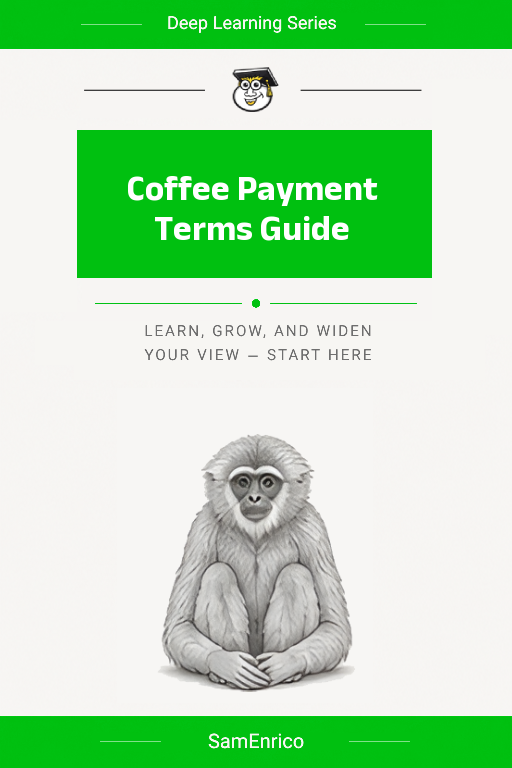
Non-FictionBusiness BriefAgricultural Trade
Coffee Payment Terms Guide eBook
Secure payment terms for coffee export to Europe.
Secure payment terms for coffee export to Europe. Letters of credit and financing options.
Formats
Free sample
Chapter 1: The Trust Trap...--–- The coffee was perfect. The buyer was reputable. The relationship had lasted three years. And yet, when the price of arabica crashed thirty percent in six weeks, the emails stopped, the invoices went unpaid, and a cooperative in northern Nicaragua lost USD 480,000 – not because their beans were bad, but because they had never learned a single truth that this book will drill into you from this page forward: a relationship is not a payment term.This chapter is called The Trust Trap for a reason. It is the most expensive mistake in coffee export, and it is almost invisible to the exporter until the moment the money fails to arrive.
You will meet exporters who have shipped for a decade on a handshake and never lost a dollar. You will meet others who lost everything on their second container. The difference is not luck. The difference is understanding that trust and payment terms are separate variables, and that confusing the two is a mathematical error, not a moral one.This chapter builds the foundational framework that will carry you through the next eleven chapters. By the time you finish reading, you will understand exactly why the confirmed irrevocable letter of credit at sight is the gold standard for new relationships, why open account is a trap for the unprepared, and why every single coffee contract you sign must answer three questions before you discuss a single bag of green beans.Let us begin by dismantling the most dangerous myth in coffee trade.The Myth of the Handshake Walk into any coffee origin country – Colombia, Vietnam, Ethiopia, Uganda, Brazil – and you will hear variations of the same story.
The exporter who has been selling to the same European roaster for a decade. The importer who never misses a payment. The relationship built on trust and sealed with nothing more than an email that says “confirmed.”Here is what the statistics do not tell you. The International Coffee Organization and major credit insurers like Euler Hermes and Coface have tracked default patterns for decades. The data is clear: defaults spike when the C-price falls more than twenty percent between contract signing and arrival.
In those periods, buyers are statistically three times more likely to claim quality issues, demand discounts, or simply delay payment indefinitely. This is not random. This is behavioral finance dressed in coffee bags.The pattern works like this. You contract to sell a container at USD 2.50 per pound. By the time the ship reaches Rotterdam, the market has dropped to USD 1.80.
The buyer now faces a choice. They can honor the contract and lose USD 0.70 per pound relative to the current market. Or they can find a reason – any reason – to reject the coffee, renegotiate, or delay payment until you are desperate enough to accept a discount. The third option, paying on time, is the most expensive choice for them. The rational buyer, in a purely economic sense, will exploit any ambiguity in the contract.The handshake does not protect you from this.
The handshake is the reason you lose.Consider the case of a Guatemalan cooperative that appears in trade arbitration records from 2021. They had supplied a German roaster for eighteen months. Every payment had arrived within thirty days. The relationship felt solid. When the roaster asked to switch from letters of credit to open account – meaning the cooperative would ship first and wait for payment later – the cooperative agreed.
No formal contract was signed beyond email exchanges. Six months later, the roaster was acquired by a private equity firm. The new owners reviewed the coffee contracts, saw that open account terms were in place, and simply stopped paying. The cooperative spent USD 60,000 on legal fees to recover less than half of what they were owed. The roaster’s legal team argued that the email exchanges did not constitute a binding contract under German law.
They were largely correct.The chapter’s first rule, and perhaps the most important rule in this entire book, is this: a relationship is not a payment term. You can trust someone with your children and still demand a confirmed letter of credit for your coffee. The two have nothing to do with each other. One is about human connection. The other is about counterparty risk, bank solvency, and the laws of cross-border commerce.The Risk-Reward Spectrum for New Relationships Because this book is a guide, not a philosophy seminar, we need a framework.
The Risk-Reward Spectrum presented here is that framework. It is a six-point scale that ranks payment terms from safest for the exporter to riskiest. Every term on this spectrum has a legitimate use case, but the critical distinction – and this is where many coffee guides get it wrong – is that the spectrum applies differently to new relationships versus mature ones.For the purpose of this chapter, and for any exporter selling to a buyer for the first time or the first several times, the spectrum looks like this.At the safest extreme, Cash in Advance. The buyer pays the full invoice amount before you load a single bag onto a truck. Exporter risk is zero.
Buyer risk is one hundred percent. In coffee trade, this is almost never agreed except for very small sample shipments of one or two bags. A buyer who pays cash in advance for a full container has no leverage if the coffee arrives damaged or off-grade. They will not agree to this. Neither would you in their position.One step down, but still firmly in the safe zone, is the Confirmed Irrevocable Letter of Credit at Sight.
This is the gold standard for new relationships. The buyer’s bank issues a letter of credit in your favor. A second bank – typically a bank in your own country – adds its confirmation, meaning it guarantees payment even if the buyer’s bank fails. You present shipping documents that prove you have loaded the coffee onto a vessel in good order. The confirming bank pays you.
The buyer pays their bank later. You never rely on the buyer’s solvency. You rely on a bank in your jurisdiction.One step further down, the Unconfirmed Letter of Credit. The buyer’s bank issues the L/C, but no second bank guarantees it. If the issuing bank collapses – and banks do collapse, as SVB and Credit Suisse reminded the world – you become an unsecured creditor.
You will wait years for pennies on the dollar. The difference between confirmed and unconfirmed is the difference between sleeping well and watching the financial news at 3AM.Next, Documents against Payment. You ship the coffee. You send the shipping documents to your bank, which forwards them to the buyer’s bank. The buyer’s bank releases the documents – including the all-important bill of lading that controls the goods – only when the buyer pays in full.
This is cheaper than an L/C because there are no confirmation fees. It is also riskier because the buyer can simply refuse to pay. Your coffee sits at port accruing demurrage charges of USD 50 to 200 per day while you scramble to find another buyer or ship it back.Second from the…
This is the end of the free sample. Get the eBook to keep going. Buy now
About this book
Details
- Author
- Thorton Charise
- Publisher
- SamEnrico
- Language
- English
- Genre
- Non-Fiction, Business Brief, Agricultural Trade
- Released
- 2026-05-30
- Pages (approx.)
- 149
- Available as
- eBook, Audiobook

Read better in the ZLOADR app
Your eBooks on your phone or tablet. Sign in with your SamEnrico account and start reading.
More by Thorton Charise
 YouTube Creator Comparison CourseThorton Charise$11.99
 West Papua Sea CucumberThorton Charise$11.99
 Burnout Recovery Body AwarenessThorton Charise$11.99
 The Cognitive Reserve Building GuideThorton Charise$11.99
 George Jones No Show JonesThorton Charise$11.99
 The Beast of Gévaudan: A Wolf’s Shadow in the French WildsThorton Charise$11.99
 Japanese Scholarship DeadlinesThorton Charise$12.99
 Understanding Shaver's DiseaseThorton Charise$17.99
 How to Become a Polishing-wheel SetterThorton Charise$11.99
 Scanning Probe Lithography TechnicianThorton Charise$11.99
You may also like
 Hong Kong Handover 1997Dunn Johnnie$11.99
 Zumba For Postnatal Recovery CourseNeal Christian$11.99
 Zumba for BeginnersLadner Nikia$11.99
 YouTube Comment Mining GuideHumes Pandora$12.99
 Worry Box MeditationCarlin Rudy$11.99
 Workplace Stress MeditationNguyen Lynn$11.99
 Workplace Stress and Sleep RepairHawley Ivory$11.99
 Workplace Perfectionism CureDelaney Jeffry$11.99
 Workplace Injustice Anger GuideWallen Isabelle$11.99
 Work Addiction and Burnout LinkGreenwood Ester$11.99
 Women in Yoga and WellnessBeattie Galina$11.99
 Women in Stand Up ComedyChun Evangeline$11.99