
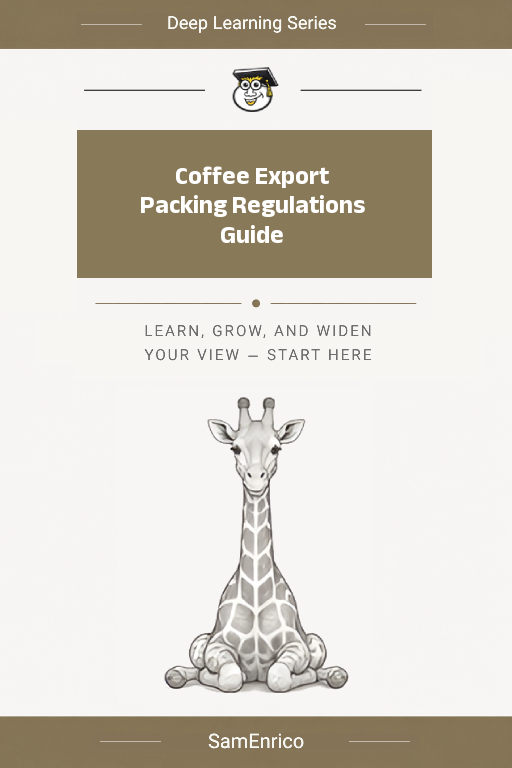
Coffee Export Packing Regulations Guide eBook
Use new food grade jute or grain pro bags labeled
by Duval Dania
Use new food grade jute or grain pro bags labeled with country of origin and lot number.
Formats
Free sample
Chapter 1: The Fifty-Cent Catastrophe--The email arrived at 11:47 PM on a Tuesday. Maria Vargas, export manager for a mid-sized Colombian coffee cooperative, had been asleep for three hours when her phone buzzed with the subject line that still gives her nightmares: “URGENT – Container CMAU7892345 REJECTED – Port of Hamburg.”By 1:00 AM, she had confirmed the worst. Her cooperative’s finest microlot—19.2 metric tons of washed Excelso, contracted at $4.20 per pound to a German specialty roaster—had been denied entry. The reason was not the coffee’s cup score, which had been 87 points. It was not the moisture content, which was perfect at 10.8 percent.
It was not a phytosanitary issue with the beans themselves.It was the bags.Specifically, the 320 jute bags used to pack the container had been manufactured with recycled fibers that previously held industrial lubricants. The off-odor—described by the German customs lab as “a distinct kerosene-like volatile compound”—had permeated the green coffee. Every single bean in that container was now classified as “unfit for human consumption” under EU Food Contact Material regulations. The entire shipment would be destroyed. The buyer canceled the contract.
The cooperative lost 187,000inproductvalueplus187,000 in product value plus 187,000inproductvalueplus14,000 in freight and detention fees. And Maria spent the next six months rebuilding relationships with buyers who now questioned every shipment from her region.The cause of this disaster? A $0.50-per-bag savings on jute.This is the reality of coffee export packing in the modern regulatory era. The humble bag—whether jute, Grain Pro, or compostable—is no longer a passive container. It is a legally binding document, a phytosanitary barrier, a traceability device, and a food contact material all in one.
And when it fails, the cost is measured not in cents but in containers, contracts, and careers.The Mathematics of Disaster Let us begin with a simple equation that will appear throughout this book. I call it The Fifty-Cent Catastrophe.A standard 69-kilogram jute bag suitable for specialty coffee export costs between 1.80and1.80 and 1.80and2.50 when purchased new from a certified mill in India or Bangladesh. A recycled or “second-quality” bag—one made from mixed fibers, previously used for non-food cargo, or manufactured without food-grade certification—costs approximately 1.30to1.30 to 1.30to2.00. The difference is often less than one US dollar. In many cases, as low as fifty cents.That fifty cents buys you the following risks:Container detention fees: 150to150 to 150to500 per day while customs inspects or holds your shipment Re-bagging labor: 2to2 to 2to5 per bag if the shipment must be transferred into new bags at port Phytosanitary treatment: 500to500 to 500to2,000 per container for fumigation if pests are found in bag seams Full container rejection: 50,000to50,000 to 50,000to250,000 in lost product value, freight costs, and contractual penalties Importer blacklisting: One rejected shipment often triggers enhanced inspection on all subsequent shipments from that exporter (FDA Import Alert or EU RASFF notification)Reputational damage: The loss of a buyer relationship that took years to build The fifty-cent defect does not always lead to the $50,000 disaster.
But it happens often enough that major importers now write packing specifications directly into their purchase contracts. I have reviewed over 300 coffee export contracts in the past five years, and the trend is unmistakable. Section 12 or thereabouts—once reserved for force majeure and arbitration clauses—now contains language like this:*“Packing: New, food-grade jute bags, 69kg net weight, double-stitched, with inner Grain Pro liner. Bags must be free from off-odors, prior cargo residues, and pest infestation. Bag Mill Certificate (BMC) attesting to these specifications must be provided prior to shipment.”*This is not a suggestion.
It is a legally enforceable term. And failure to comply is a breach of contract, not just a customs problem.The Three Pillars of Packing Compliance Throughout this book, we will organize every regulation, every inspection protocol, and every decision around a simple framework. I call it the Three Pillars of Packing Compliance. Every chapter from here forward will reference one or more of these pillars, and every checklist in the appendix is built upon them.Pillar One: Material Integrity The bag itself must be safe for direct contact with food. This means virgin fibers (no recycled jute from unknown prior cargo), food-grade certification from the mill, and no chemical residues or off-odors that could taint the coffee.
Material integrity also covers physical durability: the bag must withstand the weight of its contents, the pressure of stacking, and the rigors of international transport without bursting or tearing.Chapter 2 and Chapter 3 are dedicated entirely to this pillar, with detailed protocols for visual and olfactory inspection of incoming bags and standardized documentation from bag mills.Pillar Two: Label Veracity Every bag must tell the truth—and tell it in a language and format that customs officials, importers, and food safety auditors can read and verify. This includes the country of origin (specific legal phrasing varies by destination), a unique lot number that traces back to the farm or cooperative, net weight in metric units, and any destination-specific language requirements (French for Canada, Chinese for China, etc.).Chapters 6, 7, and 8 cover this pillar in depth, including the lot numbering systems required for the EU Deforestation Regulation and the bilingual labeling mandates that trip up even experienced exporters.Pillar Three: Structural Soundness A bag that arrives intact but with contaminated fibers fails Pillar One. A bag that arrives perfectly labeled but torn open fails Pillar Three. Structural soundness covers everything that happens after the bag is filled: proper sealing (heat seal for hermetic liners, double-stitching for jute), correct palletization and stacking to prevent burst pressure, and container loading that accounts for humidity, temperature shifts, and the physical forces of ocean transport.Chapters 9, 10, and 12 address this pillar, with engineering-based guidance on stacking limits and loading diagrams.When all three pillars are strong, your shipment will pass inspection, your buyer will receive the product as specified, and your reputation will grow. When any pillar fails, you risk The Fifty-Cent Catastrophe.The Brazilian Kerosene Case Let me return to the opening story, because it contains lessons that will recur throughout this book.
The Brazilian exporter who lost the Hamburg shipment did not knowingly buy contaminated bags. They purchased from a broker who offered “mill seconds” at a discount. The bags looked fine. They smelled fine when received at the warehouse in Santos—or so the warehouse manager believed.But jute fibers are porous. They absorb volatile organic compounds from their environment.
The recycled fibers in those bags had previously been used to transport industrial lubricants from a factory in Kolkata to a distribution center in Mumbai. The bags were washed before being shredded and rewoven into “new” bags. But washing does not remove all chemical residues from porous natural fibers. When the bags were loaded with green coffee in Santos and sealed inside a shipping container for the 30-day voyage to Hamburg, the confined space and warm temperatures caused the residual kerosene compounds to volatilize. The coffee beans—themselves porous and highly absorbent—adsorbed those compounds like activated charcoal.By the time the container arrived, every bean had taken on the taste and smell of a mechanic’s workshop.
No amount of roasting could remove it. The coffee was destroyed.The forensic investigation traced the problem to the bag mill.…
This is the end of the free sample. Get the eBook to keep going. Buy now
About this book
Details
- Author
- Duval Dania
- Publisher
- SamEnrico
- Language
- English
- Genre
- Non-Fiction, Business Brief
- Released
- 2026-06-01
- Pages (approx.)
- 147
- Available as
- eBook, Audiobook

Read better in the ZLOADR app
Your eBooks on your phone or tablet. Sign in with your SamEnrico account and start reading.
More by Duval Dania
 Lidocaine Patch GuideDuval Dania$11.99
 ABCDE Paper Planner GuideDuval Dania$11.99
 Postpartum Stillbirth Grief GuideDuval Dania$11.99
 The Audience Connection GuideDuval Dania$11.99
 Storyboard Scenario TestingDuval Dania$11.99
 Dish Soap Toxin PreventionDuval Dania$11.99
 Alcohol Recovery Timeline GuideDuval Dania$11.99
 Sheppard Case Defense WitnessesDuval Dania$11.99
 Dream Altar for Problem SolvingDuval Dania$11.99
 The Last Brushstroke: The Secret Life of Leonardo da Vinci’s Lost MasterpieceDuval Dania$11.99
 The Siege of Tabriz: Shah Abbas' Last Stand Against the OttomansDuval Dania$11.99
 The Alchemist of Wall Street: How a Rogue Trader Turned a Fortune into DustDuval Dania$11.99
You may also like
 Hong Kong Handover 1997Dunn Johnnie$11.99
 Zumba For Postnatal Recovery CourseNeal Christian$11.99
 Zumba for BeginnersLadner Nikia$11.99
 YouTube Comment Mining GuideHumes Pandora$12.99
 Worry Box MeditationCarlin Rudy$11.99
 Workplace Stress MeditationNguyen Lynn$11.99
 Workplace Stress and Sleep RepairHawley Ivory$11.99
 Workplace Perfectionism CureDelaney Jeffry$11.99
 Workplace Injustice Anger GuideWallen Isabelle$11.99
 Work Addiction and Burnout LinkGreenwood Ester$11.99
 Women in Yoga and WellnessBeattie Galina$11.99
 Women in Stand Up ComedyChun Evangeline$11.99