
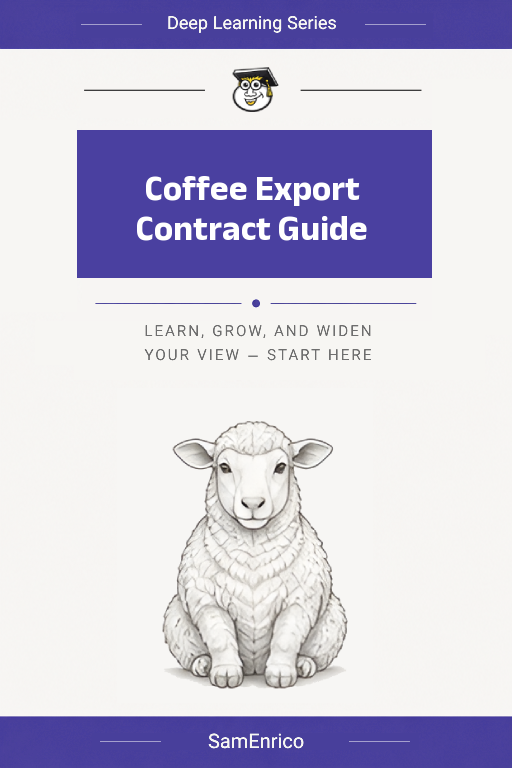
Non-FictionBusiness BriefAgricultural Trade
Coffee Export Contract Guide eBook
Draft export contracts for coffee to Europe. Inco
Draft export contracts for coffee to Europe. Inco terms, quality arbitration, and payment.
Formats
Free sample
Chapter 1: The Five Questions--–- Most coffee exporters discover they have a bad contract only when something goes wrong. A container arrives with mold. A buyer rejects shipment because prices dropped. A vessel is delayed, and demurrage charges appear on the exporter's invoice. It is only at that moment—when money is already lost—that the exporter pulls out the contract and reads it carefully for the first time.This is exactly backwards.The contract is not a document to be filed away and forgotten.
It is the single most powerful tool an exporter has to prevent disputes before they begin. But to use that tool effectively, an exporter must understand a fundamental truth about European coffee trading: the standard contract forms used by European buyers—the Green Coffee Association rules, the European Coffee Contracts, and the International Coffee Organization model contracts—are not neutral. They are drafted to protect the interests of the party who is familiar with them. And that party is rarely the exporter.This chapter does not teach you how to draft a contract from scratch. Instead, it teaches you something more valuable: how to read any coffee contract like a lawyer, ask the five questions that separate a fair deal from a trap, and know when to walk away.
By the end of this chapter, you will never sign another contract without first understanding exactly where your risks lie.The Fatal Error of the Generic Template The most common mistake coffee exporters make is downloading a generic sales contract template from the internet or accepting a buyer's one-page purchase order without question. On the surface, this seems harmless. A contract is just paperwork, after all. The real deal is the coffee, the price, and the relationship.This thinking has cost exporters millions of dollars in arbitration awards, rejected shipments, and unpaid invoices.Generic contracts are dangerous because they lack coffee-specific provisions. A standard international sales contract might have a section called "Quality" that says something vague like "goods to be of merchantable quality." But what does "merchantable" mean for green coffee?
Does it include moisture content? Screen size? Cup score? Defect count? A European arbitrator cannot measure "merchantable." They can only measure what is written in numbers and tolerances.When a generic contract is silent on these details, the legal system defaults to the United Nations Convention on Contracts for the International Sale of Goods, known as the CISG or the Vienna Convention.
The CISG is an excellent piece of international law—for general merchandise. But it has no rules for coffee-specific issues like pre-shipment samples, cupping standards, container rain, or the seven-day arbitration window that governs most quality disputes. In the absence of coffee-specific rules, arbitrators look to trade customs and industry standards. But trade customs are notoriously difficult to prove, especially for an exporter in Colombia, Vietnam, or Uganda arguing against a European buyer with decades of local legal precedent.The result is that the exporter enters arbitration at a significant disadvantage, fighting not just the buyer's claim but also the ambiguity of their own contract.The Three Governing Frameworks You Must Know Before you can ask the right questions about a contract, you need to understand the three dominant legal frameworks that govern European coffee contracts. These are not optional standards that buyers use only for large transactions.
They are the default rules of the trade. If your contract does not explicitly name one of them, you are almost certainly operating under one of them anyway, because European buyers will insist on terms they know.The first framework is the Green Coffee Association, or GCA. The GCA rules are the most common standard for transatlantic and European coffee trade. They originated in the New York green coffee market but have been adopted widely across Europe. GCA rules provide detailed procedures for quality sampling, arbitration timelines, and neutral laboratory analysis.
Critically, GCA arbitration happens in New York under American arbitration law. This is not necessarily bad for an exporter, but it is a fact that must be understood. New York arbitration is known for being efficient and predictable, but it is also expensive and requires familiarity with U.S. procedural rules.The second framework is the European Coffee Contracts, or ECC. The ECC is favored for Mediterranean and intra-European shipments.
It is similar to GCA in many respects but has different default timelines and different arbitration seats, typically London or Geneva. ECC rules are often perceived as more buyer-friendly for European importers because the arbitration seats are closer to their home jurisdictions. However, ECC rules also have some provisions that benefit exporters, particularly around force majeure and documentation requirements.The third framework is the International Chamber of Commerce rules, primarily for payment under UCP600 for letters of credit. The ICC is not a coffee-specific body, but its payment rules are universal. Any letter of credit that follows UCP600 is governed by ICC rules, regardless of what the rest of the contract says about quality or arbitration.Understanding these three frameworks is not an academic exercise.
Each one has different deadlines, different procedural requirements, and different costs. Signing a contract that says "GCA rules apply" without knowing what that means is like boarding a flight without knowing the destination.The Hierarchy of Terms: What Overrides What Every coffee contract contains multiple layers of rules. Understanding how these layers interact is essential to knowing which terms actually matter.At the very top of the hierarchy is mandatory law. These are laws that apply regardless of what the contract says. For international coffee sales, the most important mandatory law is the CISG.
The CISG applies automatically to contracts between parties in different countries that have ratified the convention. Most major coffee-exporting countries (including Colombia, Brazil, Vietnam, and Uganda) and most European importing countries are signatories. The CISG provides default rules for contract formation, delivery, payment, and remedies for breach. You cannot opt out of the CISG entirely, but you can vary most of its provisions by explicit agreement in your contract.The second layer is standard trade terms. These are the GCA rules, ECC rules, or ICO model contracts mentioned above.
Standard trade terms fill the gaps that the CISG leaves open. For example, the CISG says that goods must be of "merchantable quality," but it does not define what that means for coffee. GCA rules do define it, in considerable detail, including specific defect counts, moisture tolerances, and sampling procedures. If your contract says "GCA rules apply," you have incorporated hundreds of pages of detailed provisions by reference.The third layer is individual negotiated clauses. These are the specific terms you and the buyer agree to that override the standard trade terms.
For example, the GCA rules might default to a 7-day arbitration filing window, but your negotiated clause could extend that to 14 days. Or the GCA rules might specify that quality arbitration happens in New York, but your clause could move it to London. Individual negotiated clauses sit at the top of the hierarchy within the contract, overriding both standard trade terms and even some provisions of the CISG if they are explicit enough.The key insight is that most exporters focus only on…
This is the end of the free sample. Get the eBook to keep going. Buy now
About this book
Details
- Author
- Smithson Boris
- Publisher
- SamEnrico
- Language
- English
- Genre
- Non-Fiction, Business Brief, Agricultural Trade
- Released
- 2026-05-29
- Pages (approx.)
- 128
- Available as
- eBook, Audiobook

Read better in the ZLOADR app
Your eBooks on your phone or tablet. Sign in with your SamEnrico account and start reading.
More by Smithson Boris
 Pattern Recognition in AstronomySmithson Boris$11.99
 Randy Travis Forever and EverSmithson Boris$11.99
 Remote Company Retreats Annual PlanningSmithson Boris$11.99
 Burnout Prevention Perfectionism CureSmithson Boris$11.99
 The Non Resident US Tax WithholdingSmithson Boris$11.99
 The Silk and the Brush: The Untold Story of Lady Wei and the Birth of Chinese Ink PaintingSmithson Boris$11.99
 Understanding Sharma–kapoor–ramji SyndromeSmithson Boris$17.99
 How to Become a Library Technical AssistantSmithson Boris$11.99
 Japanese Scholarship Interview GuideSmithson Boris$12.99
 Sausage MakerSmithson Boris$11.99
You may also like
 Hong Kong Handover 1997Dunn Johnnie$11.99
 Zumba For Postnatal Recovery CourseNeal Christian$11.99
 Zumba for BeginnersLadner Nikia$11.99
 YouTube Comment Mining GuideHumes Pandora$12.99
 Worry Box MeditationCarlin Rudy$11.99
 Workplace Stress MeditationNguyen Lynn$11.99
 Workplace Stress and Sleep RepairHawley Ivory$11.99
 Workplace Perfectionism CureDelaney Jeffry$11.99
 Workplace Injustice Anger GuideWallen Isabelle$11.99
 Work Addiction and Burnout LinkGreenwood Ester$11.99
 Women in Yoga and WellnessBeattie Galina$11.99
 Women in Stand Up ComedyChun Evangeline$11.99