
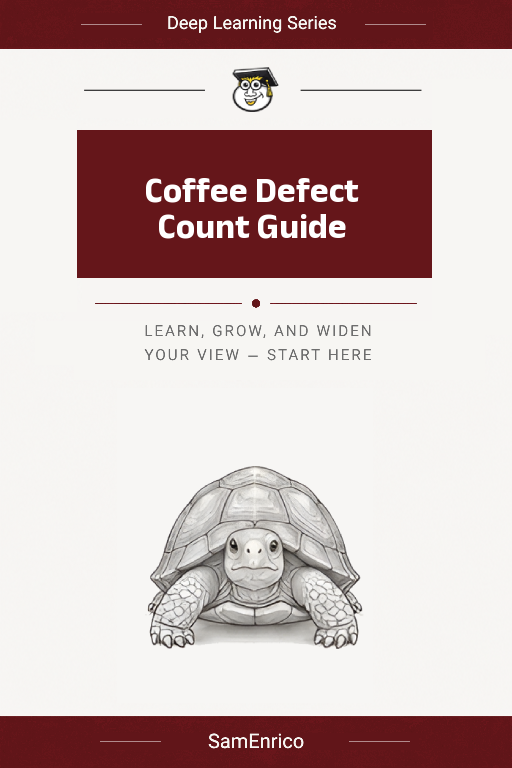
Non-FictionBusiness BriefDefect Management
Coffee Defect Count Guide eBook
Limit coffee defect count to below 5 full defects
Limit coffee defect count to below 5 full defects per 300 grams for Europe specialty. Defects include black beans, sours, and insect damage affecting taste.
Formats
Free sample
Chapter 1: The Five-Bean Lie...--–- The email arrived at 11:47 PM on a Tuesday. Marco, a fourth-generation coffee importer based in Trieste, had spent twenty years building relationships with producers across Central America. That night, he stared at his screen in disbelief. A container of specialty-grade green coffee from a trusted farm in Nicaragua—coffee he had personally cupped and approved—had been rejected at the port of Hamburg. The reason: a defect count of seven full defects per 300 grams.
Not forty-seven. Not twenty-seven. Seven. The European buyer's quality report attached a single photograph: a small pile of beans spread on a black mat, with arrows pointing to two full black beans, one stinker, and a scattering of insect-damaged beans that added up to the offending total. Marco lost the contract, worth €38,000, over beans that represented less than 0.3 percent of the sample.
His producer lost a customer. The coffee was resold at a commercial-grade discount, and the farmer's entire harvest season's profit margin evaporated because of seven beans.This is not an isolated story. It happens every week, somewhere in the global coffee supply chain. And the underlying cause is almost never malicious intent or even gross negligence. It is a failure to understand one specific, unforgiving number: five.The Number That Separates Specialty from Everything Else The Specialty Coffee Association (SCA) has established a green coffee grading standard that is simultaneously simple and brutal.
For a coffee to be classified as specialty grade—the kind that commands premium pricing, appears in competition routines, and earns the right to carry flavor notes like "jasmine" or "bergamot"—it must contain fewer than five full defects per 300 grams of green coffee. That is the legal definition. Not four. Not six. Five is the absolute ceiling.But here is where the confusion begins, and where this chapter will draw a distinction that many professionals get wrong: the standard technically permits a lot to contain up to four full defects and still be called specialty.
This includes the possibility of a single full black bean, since one is less than five. However, as we will explore throughout this book, there is a vast difference between what is permissible and what is practical. The buyer who rejected Marco's coffee was enforcing a common unwritten rule among European specialty importers: any visible full black bean in the green sample triggers automatic rejection, regardless of the total count. The standard says four is acceptable. The market says zero black beans.This gap between the written rule and the practiced standard is what this chapter calls the Five-Bean Lie—not a lie in the sense of deception, but a lie in the sense of false comfort.
Many producers and even some roasters believe that as long as their defect count comes in at four or below, their coffee is safe for specialty. They are wrong. European buyers, particularly those supplying high-end cafés in Berlin, London, Copenhagen, and Oslo, have effectively raised the bar. Their internal quality manuals often specify "zero full black beans, zero stinkers, and zero Quakers in the roasted sample"—standards that are stricter than the SCA's published guidelines.Understanding this distinction is the first and most important lesson of this book. The remainder of this chapter will unpack the origins of the sub-five standard, compare the major grading systems used around the world, explain the mathematics of sensory contamination, and finally address the nuanced question of European tolerance for different types of ferment defects.
By the end, you will understand why five is not just a number—it is a business threshold.The Three Grading Systems: SCA, ICO, and Brazil/New York Before we can understand why the sub-five standard exists, we must understand how it fits into the broader universe of coffee grading. Three major systems dominate global trade, and each defines "defect" differently.The SCA System: Specialty's Gatekeeper The SCA system, codified in the SCA Green Coffee Defect Handbook, is the most rigorous. It distinguishes between primary defects (full black, full sour, stinker, large stick, large stone) and secondary defects (partial black, slight insect damage, broken/chipped, shell, immature, floaters). The conversion rule, which we will explore in exhaustive detail in Chapter 9, translates secondary defects into full defect equivalents. The threshold for specialty is fewer than five full defects per 300 grams, with an additional requirement that the coffee must cup at 80 points or higher on the SCA cupping protocol.Crucially, the SCA system is designed for green coffee grading.
It does not explicitly address defects that only become visible after roasting, such as Quakers—though industry best practice, and the standard adopted in this book, requires zero Quakers in the roasted sample for specialty classification. (We will revisit this in Chapter 6.)The ICO System: Commercial Grade Realities The International Coffee Organization (ICO) operates a different system designed for the vast commodity coffee trade. The ICO standard allows 10 to 20 full defects per 300 grams for "commercial grade" coffee, depending on the specific classification. This is the coffee that fills supermarket cans, powers office coffee machines, and serves as the base for most instant coffee. The ICO system is not concerned with the sensory nuances that define specialty; it is concerned with safety, basic cleanliness, and minimum quality thresholds.
A lot that passes ICO grading would fail SCA specialty grading almost every time.The Brazil/New York System: Secondary Defect Points The Brazilian classification system, also used in the New York green coffee futures market, takes a different approach. Instead of counting primary defects directly, it assigns points to secondary defects. For example, one black bean might count as one point, but one broken bean might count as two points. A lot is classified as "Fine Cup" (the Brazilian equivalent of specialty) if it scores below a certain point total. This system is more granular but also more confusing for newcomers.
Its primary advantage is that it allows for finer gradations between lots that are close to the specialty threshold.Why This Matters for the Sub-Five Standard The key takeaway from this comparison is that the sub-five standard is not universal. A producer who has spent years selling into the Brazilian domestic market may believe that a defect count of ten is perfectly acceptable. When that same producer attempts to export to Europe, they face a rude awakening. Conversely, a European buyer who rejects a lot with three defects and one Quaker might be seen as unreasonable by an ICO-graded origin, but they are entirely within their rights under SCA specialty rules—and their customers expect nothing less.For a full side-by-side comparison of these three systems, including conversion tables and point equivalencies, see Appendix B. For the remainder of this book, unless otherwise specified, all defect counts refer to the SCA system as interpreted for European specialty buyers.The Mathematics of Taste: How One Bean Ruins a Batch Let us return to Marco's rejected container.
The coffee contained seven full defects per 300 grams. That means approximately 2.3 percent of the sample (by bean count, not weight) consisted of defective beans. How could such a small percentage trigger a total rejection?The answer lies in the chemistry of coffee roasting and extraction. A single full…
This is the end of the free sample. Get the eBook to keep going. Buy now
About this book
Details
- Author
- Rhoades Winfred
- Publisher
- SamEnrico
- Language
- English
- Genre
- Non-Fiction, Business Brief, Defect Management
- Released
- 2026-05-29
- Pages (approx.)
- 140
- Available as
- eBook, Audiobook

Read better in the ZLOADR app
Your eBooks on your phone or tablet. Sign in with your SamEnrico account and start reading.
More by Rhoades Winfred
 Meth Mouth Restoration HandbookRhoades Winfred$11.99
 1031 Exchange Net Investment Income TaxRhoades Winfred$11.99
 Dual Process Grief Model GuideRhoades Winfred$11.99
 Resume Middle East GuideRhoades Winfred$11.99
 Mobile Home Park InvestingRhoades Winfred$11.99
 Chunking for Medical TerminologyRhoades Winfred$11.99
 Hayloft Nap GuideRhoades Winfred$11.99
 Larry Page EnergyRhoades Winfred$11.99
 Female Combat PilotRhoades Winfred$11.99
 The Visionary and the Void: How Christopher Nolan Redefined Blockbuster FilmmakingRhoades Winfred$11.99
 The Van Gogh Heist That Shook the WorldRhoades Winfred$11.99
 The Banquet of the Timbuktu Scholars: Where Knowledge Feasted on GoldRhoades Winfred$11.99
You may also like
 Hong Kong Handover 1997Dunn Johnnie$11.99
 Zumba For Postnatal Recovery CourseNeal Christian$11.99
 Zumba for BeginnersLadner Nikia$11.99
 YouTube Comment Mining GuideHumes Pandora$12.99
 Worry Box MeditationCarlin Rudy$11.99
 Workplace Stress MeditationNguyen Lynn$11.99
 Workplace Stress and Sleep RepairHawley Ivory$11.99
 Workplace Perfectionism CureDelaney Jeffry$11.99
 Workplace Injustice Anger GuideWallen Isabelle$11.99
 Work Addiction and Burnout LinkGreenwood Ester$11.99
 Women in Yoga and WellnessBeattie Galina$11.99
 Women in Stand Up ComedyChun Evangeline$11.99