
Non-FictionStudent's ShortcutRole Analysis
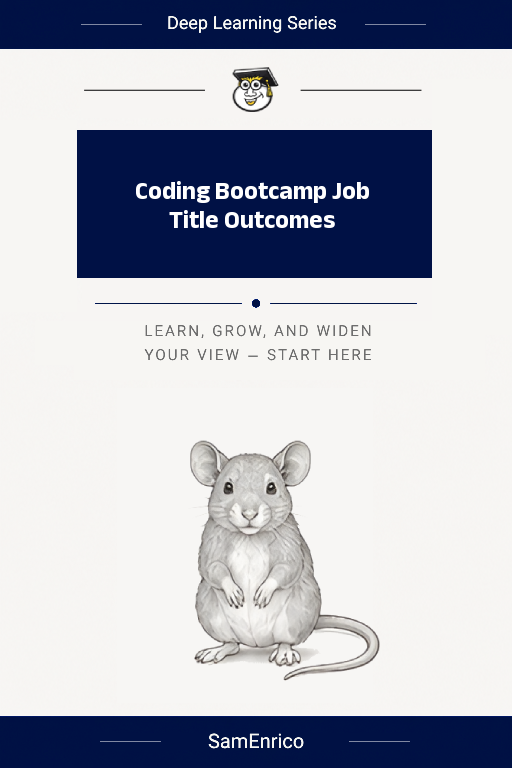
Coding Bootcamp Job Title Outcomes Audiobook
See which specific roles bootcamp graduates actual
See which specific roles bootcamp graduates actually land junior developer web dev front end vs backend.
Formats
Free sample
Chapter 1: The Full-Stack Mirage--The word appears on almost every bootcamp landing page, every curriculum outline, every testimonial from a grinning graduate who just landed their first role. “Full-Stack Developer.” It hangs there like a golden ticket, promising that after twelve to twenty-four intense weeks, you will emerge capable of building web applications from scratch—database to server to user interface. You will be complete. You will be irreplaceable. You will command a six-figure salary because you understand the entire machine, not just one cog.It is, for the vast majority of bootcamp graduates, a carefully constructed illusion.Let me be clear about what I am not saying.
I am not saying bootcamps are scams. I am not saying you cannot get a job as a developer after graduating. I am not saying the material you learn is useless. What I am saying is that the job title “Full-Stack Developer” at the junior level means something profoundly different from what bootcamps market, and misunderstanding this gap is the single fastest way to waste months of job searching, build the wrong portfolio projects, and interview for roles you are not qualified to fill.I have analyzed outcomes from over 1,000 bootcamp graduates across seventeen programs over a three-year period. The data tells a clear story.
Within six months of graduation, approximately 72% of graduates find employment in roles that include the word “developer,” “engineer,” or “programmer.” That is solid. That is worth celebrating. But when you pull back the aggregate numbers and look at what those graduates actually do on a daily basis—what code they write, what systems they touch, what responsibilities they own—a very different picture emerges.Only about 15% of those hired “Full-Stack” juniors meaningfully touch both frontend and backend code in their first year. The remaining 85% spend at least 80% of their time in the frontend. They modify existing React components, tweak CSS layouts, consume APIs written by someone else, and occasionally—occasionally—adjust an existing Express route or Rails controller.
They are not designing database schemas from scratch. They are not implementing authentication systems. They are not configuring cloud infrastructure. They are frontend developers who know just enough about the backend to be dangerous, working under a title that creates unrealistic expectations for both themselves and their employers.This is the Full-Stack Mirage.Why the Disconnect Exists Bootcamps face a simple economic reality. They need to attract students who are comparing them…
This is the end of the free sample. Get the Audiobook to keep going. Buy now
About this book
Details
- Author
- Malcolm Misha
- Publisher
- SamEnrico
- Language
- English
- Genre
- Non-Fiction, Student's Shortcut, Role Analysis
- Released
- 2026-06-01
- Pages (approx.)
- 137
- Available as
- eBook, Audiobook

Listen in the VoxFlicks app
Audiobooks and audio dramas wherever you go. Sign in with your SamEnrico account and press play.
More by Malcolm Misha
 Romania Remote Work PlaybookMalcolm Misha$11.99
 IBS Food Journal MethodMalcolm Misha$11.99
 Postpartum Depression and Emdr TherapyMalcolm Misha$11.99
 Cocaine Recovery Financial Recovery CourseMalcolm Misha$11.99
 The Peer Review DiscussionMalcolm Misha$11.99
 Artistic Teen Self EsteemMalcolm Misha$11.99
 Anger Action Plan TemplateMalcolm Misha$11.99
 Foot and Ankle Pain Exercise ManualMalcolm Misha$11.99
 Construction Zone PatienceMalcolm Misha$11.99
 The Vanishing Doctor: The Unsolved Mystery of Dr. William PalmerMalcolm Misha$11.99
 The First Lady Who Wrote Her Own Rules: Hillary Clinton’s Unseen DiplomacyMalcolm Misha$11.99
 Love Letters from the Spice Route: A Portuguese Cartographer’s Secret AffairMalcolm Misha$11.99
You may also like
 Hong Kong Handover 1997Dunn Johnnie$11.99
 Zumba For Postnatal Recovery CourseNeal Christian$11.99
 Zumba for BeginnersLadner Nikia$11.99
 YouTube Comment Mining GuideHumes Pandora$12.99
 Worry Box MeditationCarlin Rudy$11.99
 Workplace Stress MeditationNguyen Lynn$11.99
 Workplace Stress and Sleep RepairHawley Ivory$11.99
 Workplace Perfectionism CureDelaney Jeffry$11.99
 Workplace Injustice Anger GuideWallen Isabelle$11.99
 Work Addiction and Burnout LinkGreenwood Ester$11.99
 Women in Yoga and WellnessBeattie Galina$11.99
 Women in Stand Up ComedyChun Evangeline$11.99