
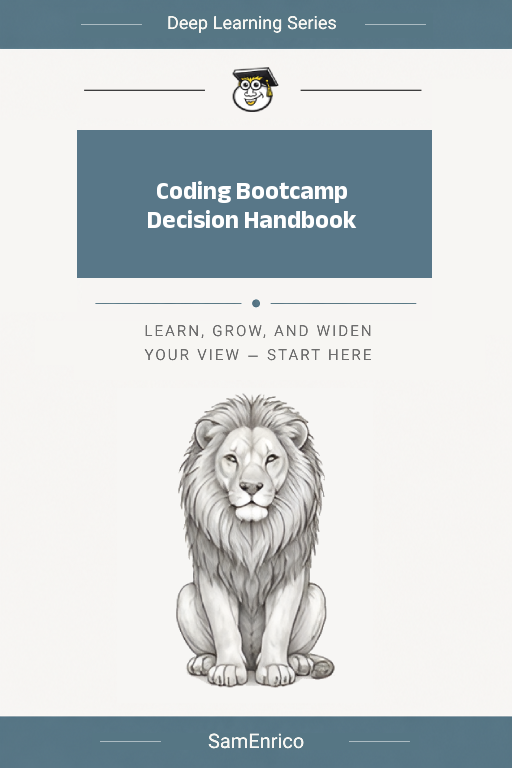
Non-FictionStudent's ShortcutHandbookData-Driven Guide
Coding Bootcamp Decision Handbook eBook
Evaluate bootcamp outcomes, income share agreement
Evaluate bootcamp outcomes, income share agreements, and accreditation worldwide. Includes employer surveys and alumni outcome data from North America, Europe, and Asia.
Formats
Free sample
Chapter 1: The Mirror Test--–- Before you spend a single dollar on a coding bootcamp, before you research income share agreements or compare curriculum schedules, before you even open a new browser tab for "best bootcamps 2026," you must first answer a question that has nothing to do with schools and everything to do with yourself. That question is not "Can I learn to code?" The question is: What am I actually trying to solve, and is a bootcamp the right tool for that problem?This chapter is not motivational. It is not designed to pump your enthusiasm or convince you that anyone can become a software engineer if they just believe hard enough. The bootcamp industry has spent billions of dollars on marketing that tells you exactly that—that passion and grit are all you need. That narrative sells tuition.
But it does not predict success. What predicts success is a cold, honest assessment of your starting position, your financial runway, your prior education, and your genuine tolerance for risk.Consider this chapter your diagnostic intake. Before a surgeon operates, they run tests. Before a pilot flies, they run a pre-flight checklist. Before you sign a contract that could cost you $20,000 or more—and potentially lock you into years of debt—you will run a series of self-assessments designed to separate realistic candidates from those who would be better served by free resources, traditional degrees, or a different career path entirely.The bootcamp industry has a dirty secret that it does not advertise.
The students who succeed are not the ones who want it the most. They are the ones who arrive with a specific profile: a prior bachelor's degree, some existing exposure to logic or analytical thinking, enough savings to survive six months without income, and a clear understanding that a bootcamp is a career accelerator, not a career creator from scratch. The 2020 industry-wide survey data is unambiguous on this point: seventy-four percent of successful bootcamp graduates already held a bachelor's degree before enrolling. That means nearly three out of four people who landed jobs after bootcamp were not career-switching from retail or food service; they were degree-holders adding technical skills to an existing professional foundation.This chapter will not tell you whether you can succeed. It will tell you, based on data and pattern-matching across thousands of bootcamp graduates, whether you are likely to succeed.
Those are two very different things. And that honest answer is the only thing that will protect you from making a $20,000 mistake.The Two Profiles: Career Switcher vs. Skill Enhancer Before any financial calculation or school comparison, you must identify which of two fundamental profiles you occupy. These profiles determine your risk level, your realistic salary expectations, and the type of bootcamp you should consider—if any.Profile A: The Career Switcher You are currently employed in a field that has nothing to do with technology. You might be a teacher, a retail manager, a warehouse supervisor, an administrative assistant, or a recent graduate with a liberal arts degree working in food service.
You have never written a line of code professionally. You have never worked on a software team. You have no professional network in tech. You are considering a bootcamp because you have heard that software engineers make good money and you are unhappy in your current situation.If this is you, you are a Career Switcher. Your risk profile is high.
Very high. Not because you cannot learn to code—many successful engineers started exactly where you are—but because your entire professional identity, network, and resume are unrelated to the field you are trying to enter. You are not adding a skill; you are attempting a complete professional rebirth.Here is what the data says about Career Switchers. According to a 2023 analysis of bootcamp outcomes conducted by the Council on Integrity in Results Reporting (CIRR), Career Switchers without prior degrees or technical experience had a job placement rate of approximately 42 percent within six months of graduation, compared to 78 percent for candidates with prior degrees or adjacent experience. That is not a small gap.
That is the difference between a successful investment and a financial disaster.But the news is not all bad. The same data shows that Career Switchers who did find jobs saw an average salary increase of 55 percent, from approximately 38,000beforebootcampto38,000 before bootcamp to 38,000beforebootcampto59,000 afterward. The problem is the word "average." That average conceals the reality that the majority of Career Switchers did not find jobs at all, and those who did were disproportionately represented by switchers from adjacent fields like data entry, IT support, or technical sales—roles that provided some transferable context.Profile B: The Skill Enhancer You are already employed in a technology-adjacent role. You might be a product manager who wants to speak more fluently with engineers, a data analyst who wants to move into data engineering, a technical project manager who wants to write code, a quality assurance tester who wants to become a developer, or a recent computer science graduate who wants practical project experience. You have some exposure to code, even if minimal.
You have a professional network that includes engineers. You understand how software teams operate.If this is you, you are a Skill Enhancer. Your risk profile is moderate to low. You are not betting your entire career on a twelve-week program. You are adding a specific skill to an existing foundation.
Your resume already includes the word "technology" or "analytics" or "product." Your professional network can help you find interviews.The data for Skill Enhancers is dramatically better. CIRR data shows that Skill Enhancers with prior degrees or adjacent experience had a job placement rate of 83 percent within six months of graduation. Their average salary increase was 47 percent, but because their starting salaries were higher (approximately 62,000beforebootcamp),theirendingsalariesaveraged62,000 before bootcamp), their ending salaries averaged 62,000beforebootcamp),theirendingsalariesaveraged91,000. These graduates were not switching careers; they were advancing within careers they already had.The Self-Assessment Matrix To determine your profile, complete the following four-question self-assessment. Be brutally honest.
No one will see your answers except you, and lying to yourself will only cost you money later.Question 1: Do you currently hold a bachelor's degree?Yes (2 points). No (0 points). In progress (1 point).*Question 2: Is your current job title or industry technology-adjacent?* Technology-adjacent means you work with data, software, technical teams, or analytical tools. Examples: data entry, IT support, technical sales, product management, business analysis, quality assurance, digital marketing analytics. Yes (2 points).
No (0 points).*Question 3: Have you completed at least 40 hours of self-directed coding using free resources (CS50, Free Code Camp, The Odin Project)?* Yes (2 points). No (0 points). Partially (1 point).Question 4: Do you have at least six months of living expenses saved that would cover your rent, food, and bills if you quit your job or reduced your hours? Yes (2 points). No (0 points).
Partially (1 point).Score Interpretation:6-8 points: You are a Skill Enhancer. Bootcamp is a reasonable risk for you, provided you select the right school and financing.3-5 points: You are a Career Switcher with some advantages. Proceed with caution. Your success will depend heavily on school selection and your ability to supplement the bootcamp with extensive self-study.0-2 points: You are…
This is the end of the free sample. Get the eBook to keep going. Buy now
About this book
Details
- Author
- Christie Milford
- Publisher
- SamEnrico
- Language
- English
- Genre
- Non-Fiction, Student's Shortcut, Handbook, Data-Driven Guide
- Released
- 2026-05-29
- Pages (approx.)
- 139
- Available as
- eBook, Audiobook

Read better in the ZLOADR app
Your eBooks on your phone or tablet. Sign in with your SamEnrico account and start reading.
More by Christie Milford
 The Three Minute Breathing SpaceChristie Milford$11.99
 Iranian Revolution Economic CollapseChristie Milford$11.99
 Luteal Phase Fatigue WorkbookChristie Milford$11.99
 GAD Workplace Accommodations GuideChristie Milford$11.99
 Medical Trauma Dream ProcessingChristie Milford$11.99
 Whiskey and Whispers: The Untold Story of Chicago's Ghost SpeakeasiesChristie Milford$11.99
 The Vanishing Diamond Heist: How a Master Thief Outsmarted the WorldChristie Milford$11.99
 Understanding Hartsfield–bixler–demyer SyndromeChristie Milford$17.99
 Assistant United States AttorneyChristie Milford$11.99
 Artificial Intelligence Energy OutlookChristie Milford$12.99
 How to Start a Cauliflower Growing Business (Beginners Guide)Christie Milford$11.99
You may also like
 Hong Kong Handover 1997Dunn Johnnie$11.99
 Zumba For Postnatal Recovery CourseNeal Christian$11.99
 Zumba for BeginnersLadner Nikia$11.99
 YouTube Comment Mining GuideHumes Pandora$12.99
 Worry Box MeditationCarlin Rudy$11.99
 Workplace Stress MeditationNguyen Lynn$11.99
 Workplace Stress and Sleep RepairHawley Ivory$11.99
 Workplace Perfectionism CureDelaney Jeffry$11.99
 Workplace Injustice Anger GuideWallen Isabelle$11.99
 Work Addiction and Burnout LinkGreenwood Ester$11.99
 Women in Yoga and WellnessBeattie Galina$11.99
 Women in Stand Up ComedyChun Evangeline$11.99