
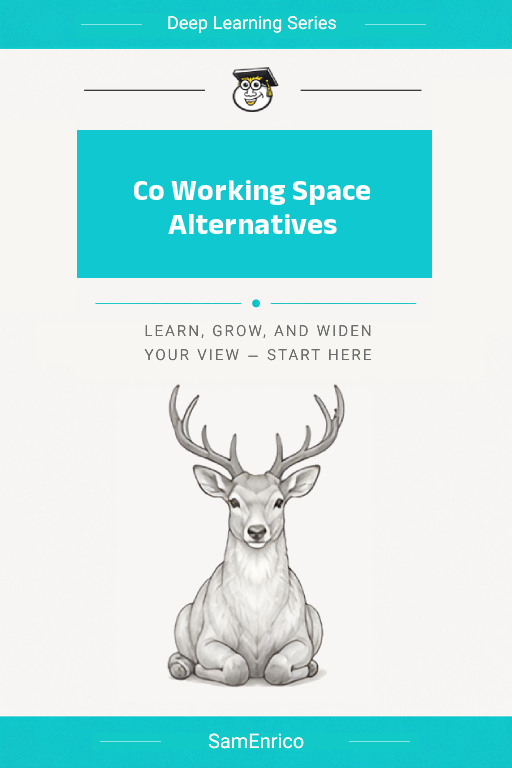
Non-FictionBusiness BriefWorkspace
Co Working Space Alternatives eBook
Work from home, libraries, or coffee shops instead
by Storey Clyde
Work from home, libraries, or coffee shops instead of expensive co working spaces to save cash.
Formats
Free sample
Chapter 1: The Membership Trap--–- Let me guess. You’re reading this because you just Venmo’d $350 to a co-working space you visited twice last month. You told yourself it was an “investment in your business.” It wasn’t. It was a subscription to guilt. Every morning, that charge sits on your bank statement like a judge.
“Work harder,” it says. “Come sit in this overpriced chair and pretend to be important.” I know because I was you.My name is not important, but my bank account history is. For eighteen months, I paid $425 per month for a “hot desk” at a sleek co-working space in a mid-sized city that had no business charging Manhattan prices. The coffee was free. The loneliness was not.
The Wi-Fi was fast. The existential dread was faster. And one Tuesday afternoon, I watched a grown man cry into his laptop because his startup had just failed, while the person sitting three feet away from him filmed a Tik Tok dance without headphones. That was the day I realized: co-working spaces aren’t selling productivity. They’re selling the illusion of belonging.
And I had been buying it in monthly installments.This chapter is not a gentle exploration of alternatives. This chapter is an intervention. Before we talk about libraries, coffee shops, home offices, or park benches, we have to talk about the elephant in the room—the expensive, open-plan, beer-on-tap elephant that has convinced an entire generation of freelancers, remote employees, and side-hustlers that they cannot work without paying rent for air.The Billion-Dollar Lie Let’s start with a number: 47billion.Thatishowmuchtheglobalco−workingmarketwasvaluedin2023.By2030,itisprojectedtoreach47 billion. That is how much the global co-working market was valued in 2023. By 2030, it is projected to reach 47billion.Thatishowmuchtheglobalco−workingmarketwasvaluedin2023.By2030,itisprojectedtoreach130 billion.
We Work—the most famous name in the industry—was once valued at 47billiononpaperbeforeitsspectacular2019IPOcollapse.Adam Neumann,thecompany’sco−founder,walkedawaywitha47 billion on paper before its spectacular 2019 IPO collapse. Adam Neumann, the company’s co-founder, walked away with a 47billiononpaperbeforeitsspectacular2019IPOcollapse.Adam Neumann,thecompany’sco−founder,walkedawaywitha1.7 billion exit package after leading a company that lost money on every desk it rented. The business model was never about productivity. It was about real estate arbitrage dressed up in hoodies and kombucha.I am not here to shame anyone who has used or enjoyed a co-working space. Many have.
They serve a purpose for specific people at specific times. But the industry has done something insidious: it has convinced knowledge workers that a paid desk is a necessity rather than a luxury. This is not an accident. It is marketing. And you have been the target.Think back to the last advertisement you saw for a co-working space.
What did it promise? “Community.” “Networking.” “Energy.” “Focus.” “Belonging.” What did it not show? The guy who takes speakerphone calls in the “quiet zone.” The woman who eats tuna salad at the shared table. The monthly bill that arrives whether you show up or not. The performative busyness of people who stay until 8 PM not because they are working, but because they are trying to justify the expense.The lie is not that co-working spaces are useless.
The lie is that you cannot succeed without one.The Hidden Costs You’re Not Counting When people tell me they pay $300 per month for a co-working membership, I ask them a simple question: “Is that all?” They look confused. Of course that is all, they say. That is the price on the website.But the website does not include the commute. Let us say your co-working space is fifteen minutes from your home. That is thirty minutes round trip.
If you go five days per week, that is 2.5 hours per week, 10 hours per month, 120 hours per year. What is your hourly rate? If you bill at 50perhour,thatcommuteiscostingyou50 per hour, that commute is costing you 50perhour,thatcommuteiscostingyou6,000 in lost time annually. If you bill at 100perhour,itis100 per hour, it is 100perhour,itis12,000. You are not paying 300permonth.Youarepaying300 per month.
You are paying 300permonth.Youarepaying300 plus the value of ten hours of your life.Then there is the coffee shop tax. Even with “free coffee,” most co-working spaces have terrible coffee. So you walk next door and buy a latte. That is 5.Thenyoubuylunchbecauseyouforgottopacksomething—5. Then you buy lunch because you forgot to pack something—5.Thenyoubuylunchbecauseyouforgottopacksomething—15.
Then you buy an afternoon snack because the 3 PM slump is real—4.Thatis4. That is 4.Thatis24 per day in incidental spending that you would not incur at home. Over twenty working days per month, that is 480.Youarenowpaying480. You are now paying 480.Youarenowpaying780 per month to work away from home, before accounting for the membership fee itself.I have run this calculation with over two hundred remote workers. The average “true cost” of a co-working space—membership, commute, food, coffee, parking, and incidentals—is 1,150permonth.Thatis1,150 per month.
That is 1,150permonth.Thatis13,800 per year. For a desk. For air. For permission to exist in a room with other people who are also paying for permission.Let that number sink in.The Sunk Cost Fallacy at Your Desk Behavioral economists have a name for why you stay until 6 PM even when you finish your work at 2 PM. It is called the sunk cost fallacy.
The more you pay for something, the more you feel compelled to use it, regardless of whether it continues to serve you.Your co-working membership is a textbook example. You pay $350 on the first of the month. On the third day of the month, you finish your deep work by noon. You are energized. You are ahead of schedule.
You could go home, go for a walk, see a friend, or start a passion project. But you do not. Instead, you sit at your desk for four more hours, checking email, scrolling Twitter, reorganizing your Google Drive folders, and waiting for 5 PM so you can feel like you “got your money’s worth.”This is not productivity. This is theater. And you are the actor, the audience, and the ticket holder.I have sat in co-working spaces where people literally fell asleep at their desks.
I have watched people cry in phone booths. I have seen the same person refresh their email 400 times in a single afternoon because they had finished all their real work by 11 AM but felt trapped by their membership. The architecture of the co-working space—the exposed brick, the neon signs, the “community manager” who smiles at you—is designed to make you forget that you are in a transaction. You are paying for a seat. That is all.
The seat does not care if you work. The seat does not care if you thrive. The seat just sits there, collecting your money while you perform busyness for an invisible audience.Fake Urgency: The Noise That Steals Your Focus There is another psychological trap buried inside the co-working model, and it is more subtle than the sunk cost fallacy. I call it fake urgency.Here is how it works. You are sitting in an open-plan co-working space.
Around you, twenty other people are typing, clicking, whispering on calls, and occasionally laughing at something on their screens. Your brain…
This is the end of the free sample. Get the eBook to keep going. Buy now
About this book
Details
- Author
- Storey Clyde
- Publisher
- SamEnrico
- Language
- English
- Genre
- Non-Fiction, Business Brief, Workspace
- Released
- 2026-06-01
- Pages (approx.)
- 135
- Available as
- eBook, Audiobook

Read better in the ZLOADR app
Your eBooks on your phone or tablet. Sign in with your SamEnrico account and start reading.
More by Storey Clyde
 Innovation for Industrial EngineersStorey Clyde$11.99
 MDD Differential Diagnosis GuideStorey Clyde$11.99
 Music Theory CardsStorey Clyde$11.99
 Social Lubricant Myth GuideStorey Clyde$11.99
 Preeclampsia PreventionStorey Clyde$11.99
 Ernie Els Big Easy StoryStorey Clyde$11.99
 Animal Phobia GuideStorey Clyde$11.99
 Source Monitoring Errors in TestimonyStorey Clyde$11.99
 The Inferno of Palermo: The Mafia's Fire Campaign in 1860s SicilyStorey Clyde$11.99
 The Siege of Fort Victoria: Canada's Forgotten Mafia StandoffStorey Clyde$11.99
 Service Providers Guide to Pressure WashingStorey Clyde$11.99
 How to Produce Household Storage DrawersStorey Clyde$11.99
You may also like
 Hong Kong Handover 1997Dunn Johnnie$11.99
 Zumba For Postnatal Recovery CourseNeal Christian$11.99
 Zumba for BeginnersLadner Nikia$11.99
 YouTube Comment Mining GuideHumes Pandora$12.99
 Worry Box MeditationCarlin Rudy$11.99
 Workplace Stress MeditationNguyen Lynn$11.99
 Workplace Stress and Sleep RepairHawley Ivory$11.99
 Workplace Perfectionism CureDelaney Jeffry$11.99
 Workplace Injustice Anger GuideWallen Isabelle$11.99
 Work Addiction and Burnout LinkGreenwood Ester$11.99
 Women in Yoga and WellnessBeattie Galina$11.99
 Women in Stand Up ComedyChun Evangeline$11.99