
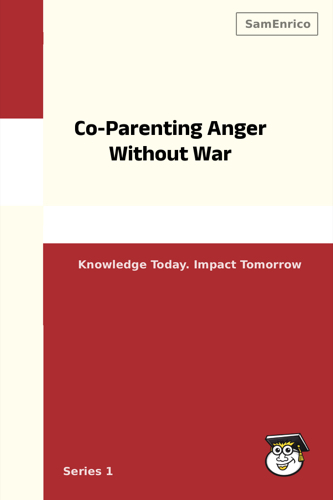
Non-FictionSelf-Help / Co-Parenting
Co-Parenting Anger Without War eBook
Teaches ex-partners to manage anger during drop-of
Teaches ex-partners to manage anger during drop-offs and decision-making, protecting children from conflict.
Formats
Free sample
Chapter 1: The Drop-Off Ambush--The car door slams. Your child’s backpack is zipped. You have done everything right—packed the night before, left early, rehearsed your neutral face in the rearview mirror. And then you see it: the other parent’s car, pulling into the parking lot twenty feet away. Your jaw clenches.
Your shoulders rise toward your ears. Your heartbeat shifts from resting to racing in less than three seconds. You have not spoken a single word yet, and you are already angry.This is not a personality flaw. It is not a sign that you are “too emotional” or “can’t let go.” This is your nervous system doing exactly what evolution designed it to do: detecting a threat and preparing you to fight. The problem is that the threat is not a predator in the grass.
The threat is your co-parent, arriving to pick up your child for a regularly scheduled visit. And your body cannot tell the difference.Welcome to the drop-off ambush. It is the single most dangerous moment in co-parenting—not because physical harm is likely, but because everything about the exchange is neurologically engineered to make you explode. Your brain has learned a simple equation: ex’s car equals danger. By the time you park, your fight-or-flight response is already activated.
You are primed to snap before anyone says a word.This chapter will teach you why transitions trigger explosions, what happens inside your child’s nervous system during those ninety seconds of contact, and how to dismantle the ambush using a simple, repeatable protocol called The 60-Second Rule. By the end of this chapter, you will understand that the explosion is rarely about today’s minor annoyance—it is about the accumulated grief, fear, and helplessness of the entire divorce, wired directly into your nervous system. And once you see that clearly, you can begin to interrupt the pattern.The Physiology of the Ambush Let us start with what happens inside your body. You pull into the parking lot. You see the other parent’s car.
In that instant, your amygdala—the almond-shaped cluster of neurons in your brain responsible for threat detection—sounds an alarm. This alarm bypasses your rational thinking brain (the prefrontal cortex) and goes straight to your hypothalamus, which activates your sympathetic nervous system. Adrenaline floods your bloodstream. Your heart rate increases. Your breathing quickens.
Blood moves away from your digestive system and toward your large muscles, preparing you to run or fight.This is the fight-or-flight response. It evolved over millions of years to help humans survive predators. It is exquisitely designed for one purpose: keeping you alive in life-threatening situations. It is terribly designed for co-parenting drop-offs.Here is the cruel irony. Your brain has learned, through repeated exposure, that seeing your ex equals emotional pain.
Each hostile text, each sarcastic comment, each memory of the marriage’s collapse has been filed away. Now, the mere sight of their car is enough to trigger the same physiological response as seeing a bear in the woods. Your body does not know the difference between a legitimate predator and an ex-spouse who once forgot to pick up the kids on time. It just knows threat.This is called classical conditioning. Ivan Pavlov famously trained dogs to salivate at the sound of a bell by pairing the bell with food.
Your ex has trained your nervous system to activate at the sight of their car by pairing that sight with years of conflict, betrayal, and grief. You are not weak. You are conditioned. And conditioning can be unlearned—but only if you first understand that it exists.The Transfer Glitch: What Happens to Your Child While your nervous system is preparing for battle, your child is experiencing their own physiological storm. The Transfer Glitch is the name for what happens to children during and immediately after transitions between homes.
You have seen it before. Your child is perfectly calm during the exchange—quiet, compliant, maybe even cheerful. They get into the other parent’s car, and within five minutes, they are crying, whining, or acting out. Or the reverse happens: they are anxious and clingy at the exchange, then settle within minutes of driving away.This is not manipulation. This is not your child “playing favorites” or “trying to make you feel guilty.” This is a child’s nervous system releasing held tension.
During the exchange, your child is hypervigilant. They are watching both parents’ faces, listening to tone of voice, scanning for signs of danger. They are holding their breath emotionally. They are trying to be “good” so neither parent gets upset. And the moment they are safely in one car, with only one parent present, the held breath releases.
The crying or acting out is not a problem to be solved. It is a pressure valve opening.Research on children in high-conflict divorce shows that their cortisol levels—the primary stress hormone—spike significantly during exchanges, even when there is no visible fighting. The child’s body knows there is tension even when the parents are pretending to be civil. Children are exquisitely sensitive to nonverbal cues: the tight jaw, the averted eyes, the clipped tone of voice. You cannot fake calm with a child.
They can smell the smoke even when there is no flame.This is why the drop-off ambush is so dangerous. Your child is already stressed. You are already primed for fight-or-flight. And then someone says something—or doesn’t say something—and the whole thing ignites. The explosion is not the beginning of the problem.
It is the final stage of a process that started the moment you saw the other parent’s car.The Accumulated Grief Theory Here is the most important insight in this chapter, and possibly in this entire book. The explosion at drop-off is almost never about what just happened. It is about everything that happened before.You are not angry that the other parent is three minutes late. You are angry about the three years of feeling unheard in the marriage. You are not furious about the sarcastic comment about your parenting.
You are furious about the years of criticism that preceded the divorce. You are not enraged that they forgot to pack the child’s jacket. You are enraged that they forgot your birthday, your anniversary, your needs, over and over again.The drop-off is simply the stage where accumulated grief finally finds an exit. The minor annoyance of today is the spark that ignites a warehouse full of fuel that has been stockpiled for months or years. The explosion is not disproportionate to the trigger.
It is proportionate to the accumulated pain. The problem is that the trigger—a late arrival, a missing jacket, a tone of voice—is the only thing visible to your child, to your ex, and even to you in the moment. So everyone walks away thinking, “They lost their mind over a jacket.” No one sees the three years of grief that were actually on fire.This reframe is not an excuse for exploding. It is an explanation that points toward a solution. If the explosion is fueled by accumulated grief, then the…
This is the end of the free sample. Get the eBook to keep going. Buy now
About this book
Details
- Author
- Knott Frances
- Publisher
- SamEnrico
- Language
- English
- Genre
- Non-Fiction, Self-Help / Co-Parenting
- Released
- 2026-06-06
- Pages (approx.)
- 139
- Available as
- eBook, Audiobook

Read better in the ZLOADR app
Your eBooks on your phone or tablet. Sign in with your SamEnrico account and start reading.
More by Knott Frances
 Ethical Hacker Stress GuideKnott Frances$11.99
 The Listening In Sickness GuideKnott Frances$11.99
 The IBS and Eating DisordersKnott Frances$11.99
 The Values And Mission Alignment ScalingKnott Frances$11.99
 The Bootlegger's Pyramid: How a Prohibition-Era Ponzi Scheme Collapsed a CityKnott Frances$11.99
 Social Media Poll ValidationKnott Frances$12.99
 Payment Tax Withholding GuideKnott Frances$12.99
 Release ManagerKnott Frances$11.99
 Understanding Thrombocytopenia Chromosome BreakageKnott Frances$17.99
 How to Start a Doors (retail) Business (Beginners Guide)Knott Frances$11.99
You may also like
 Hong Kong Handover 1997Dunn Johnnie$11.99
 Zumba For Postnatal Recovery CourseNeal Christian$11.99
 Zumba for BeginnersLadner Nikia$11.99
 YouTube Comment Mining GuideHumes Pandora$12.99
 Worry Box MeditationCarlin Rudy$11.99
 Workplace Stress MeditationNguyen Lynn$11.99
 Workplace Stress and Sleep RepairHawley Ivory$11.99
 Workplace Perfectionism CureDelaney Jeffry$11.99
 Workplace Injustice Anger GuideWallen Isabelle$11.99
 Work Addiction and Burnout LinkGreenwood Ester$11.99
 Women in Yoga and WellnessBeattie Galina$11.99
 Women in Stand Up ComedyChun Evangeline$11.99