
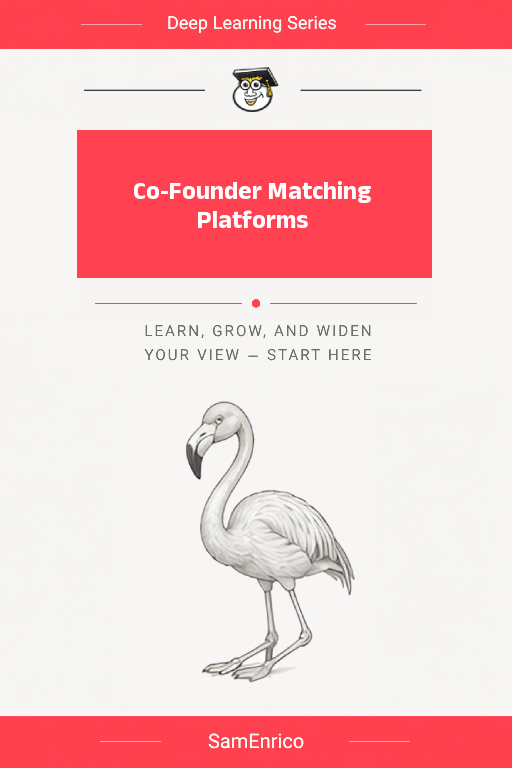
Non-FictionFirst 30 DaysPlatform StrategySkill Matching
Co-Founder Matching Platforms eBook
Create profiles on Y Combinator Co-Founder Matchin
by Hein Ashly
Create profiles on Y Combinator Co-Founder Matching, Indie Hackers, and FounderDating to find complementary skills.
Formats
Free sample
Chapter 1: The Solo Graveyard--–- The funeral was on a Tuesday. Not a real funeral, of course—no casket, no flowers, no grieving relatives. Just a former founder named Jake, sitting alone in a We Work phone booth at 2 PM on a Tuesday, deleting 18 months of code from a Git Hub repository. His startup had raised zero dollars. His product had acquired zero paying customers.
His co-founder count had remained zero throughout. Jake was not a failure because his idea was bad. His idea was actually quite good—a B2B invoicing tool for freelancers that integrated with Slack. The market was there. The timing was there.
The thing Jake lacked was the one variable that predicts startup success more accurately than IQ, more accurately than funding, more accurately than market size: a co-founder.This chapter is an autopsy of the solo founder delusion. It exists to kill the romantic myth—cherished by every first-time entrepreneur—that the lone genius coding in a dark room will emerge, blinking into the sunlight, clutching a billion-dollar exit. That myth has destroyed more startups than bad products ever will. We will begin with the data, which is brutal and unambiguous. Then we will examine why finding a co-founder is harder than romantic dating, and why falling in love with your idea without a partner to check your blind spots is a form of entrepreneurial suicide.
Finally, we will give you a diagnostic framework to determine exactly what kind of co-founder you need: the Hacker, the Hustler, or the Hipster. By the end of this chapter, you will understand that looking for a co-founder is not a sign of weakness. It is the single most strategic decision you will make.The Y Combinator Autopsy Report Let us start with a number that should be tattooed on the inside of every aspiring founder's eyelids: four. Y Combinator, the most successful startup accelerator in history, has funded thousands of companies. Among its top 100 performing companies by valuation—the billion-dollar unicorns and decacorns—only four were founded by a single individual.
Four percent. That means ninety-six percent of the most valuable companies in YC's portfolio had at least two founders.Let that land.The solo founder is not an underdog. The solo founder is a statistical anomaly, and not in a good way. When YC published its internal data on founder dynamics, the pattern was clear and consistent: two-founder teams outperform solo founders by every metric. They raise more money.
They grow faster. They survive longer. They are less likely to ghost their investors. They are less likely to burn out. They are less likely to wake up one day and realize they have been talking to themselves for six months while the world moved on without them.Why?
The reasons are structural, not romantic. A solo founder has no one to argue with, which sounds like a blessing but is actually a curse. Arguments are not bugs in the startup process; they are features. When two people disagree about product direction, pricing, or hiring, they are forced to refine their thinking. The solo founder enjoys the quiet tyranny of unilateral decision-making, which means they also enjoy the solitude of never being corrected.
Every bad idea survives until it hits the market. By then, it is too late.A solo founder has no one to share the emotional load. Startups are not games of intellect; they are games of endurance. The lows are lower than you can imagine. You will have days when your product breaks, your customer churns, your bank account hits triple digits, and your mother asks when you are getting a real job.
On those days, a co-founder is not a luxury. A co-founder is a lifeline. Someone who says, "I saw the bug. I fixed it. Order pizza.
We keep going."The data does not lie. But the data also does not capture the full picture. The solo founder tax is not just statistical. It is psychological, operational, and financial. Let us break down each component.The Three Taxes of Solo Founding The Emotional Tax is the first and most underestimated.
Humans are not designed to endure high-stakes uncertainty in isolation. The startup journey is a roller coaster of micro-failures—rejected investor emails, buggy deploys, feature requests that spiral into rewrites. Each failure triggers a small cortisol spike. Alone, those spikes accumulate. There is no one to laugh with when the database crashes at 2 AM.
There is no one to high-five when the first paying customer signs up. The solo founder experiences the full spectrum of emotional volatility with no buffer. Over months, this erodes judgment. You start making desperate decisions—discounting too early, hiring too fast, pivoting too often—not because the data suggests it, but because you are tired and scared and alone. A co-founder acts as an emotional shock absorber.
When you are spiraling, they are steady. When they are spiraling, you are steady. The two of you create a closed-loop emotional system that can withstand far more than either of you could alone.The Skill Gap Tax is the second. No single human being possesses all the skills required to build and scale a startup. Even the most impressive polymath has limits.
A brilliant engineer may know nothing about sales. A master marketer may write terrible code. A product visionary may struggle with operations. The solo founder has two choices: learn every skill themselves (which takes years) or outsource the missing skills (which takes money they do not have). Both are losing propositions.
A co-founder solves this instantly. The technical founder builds. The business founder sells. The designer founder makes it beautiful. The sum is greater than the parts not because of some magical synergy, but because of basic division of labor.
Two people working forty hours each is not twice as productive as one person working eighty hours. It is four times as productive, because each person operates in their zone of genius while the other covers the gaps.The Accountability Tax is the third and most insidious. The solo founder answers to no one. This sounds like freedom. It is actually quicksand.
Without external accountability, deadlines slip. Priorities blur. You tell yourself you will finish the landing page by Friday, but Friday comes and you watched four hours of You Tube instead, and no one knows. No one calls you out. No one asks why.
The solo founder's worst enemy is not the competition; it is the quiet permission to underperform that comes from having no one watching. A co-founder changes the game entirely. When you commit to a deadline in front of another person, your brain treats it differently. The social contract matters. The fear of letting someone down is a powerful motivator—more powerful than the fear of letting yourself down.
Co-founders create a virtuous cycle of mutual accountability. You ship because they shipped. They ship because you shipped.The Marriage Metaphor (With Teeth)Here is where most advice on co-founders gets soft and sentimental. You will hear people say a co-founder is like a marriage. They mean it in the warm, fuzzy sense—partnership, trust, shared dreams.
That is not quite right. A co-founder is like a marriage in the cold, legal, contractual sense. You are binding…
This is the end of the free sample. Get the eBook to keep going. Buy now
About this book
Details
- Author
- Hein Ashly
- Publisher
- SamEnrico
- Language
- English
- Genre
- Non-Fiction, First 30 Days, Platform Strategy, Skill Matching
- Released
- 2026-05-30
- Pages (approx.)
- 144
- Available as
- eBook, Audiobook

Read better in the ZLOADR app
Your eBooks on your phone or tablet. Sign in with your SamEnrico account and start reading.
More by Hein Ashly
 Anxiety Focus BreakHein Ashly$11.99
 Persuasive Project CharterHein Ashly$11.99
 Lutein Eye Protection GuideHein Ashly$11.99
 Police Interrogation TellsHein Ashly$11.99
 Clinical Trial SurvivorHein Ashly$11.99
 Weekly Prioritization WorkbookHein Ashly$11.99
 Stress and Hyperhidrosis GuideHein Ashly$11.99
 Teeth Falling Dream SymbolHein Ashly$11.99
 Loss Aversion In BusinessHein Ashly$11.99
 Tangaroa's Deep: The Oceanic Hymns of the First NavigatorsHein Ashly$11.99
 Whispers in the Pines: The Vanishing of the Boy Scouts of 1978Hein Ashly$11.99
 The Navigators of the Indian Ocean: The Swahili Maritime EmpireHein Ashly$11.99
You may also like
 Hong Kong Handover 1997Dunn Johnnie$11.99
 Zumba For Postnatal Recovery CourseNeal Christian$11.99
 Zumba for BeginnersLadner Nikia$11.99
 YouTube Comment Mining GuideHumes Pandora$12.99
 Worry Box MeditationCarlin Rudy$11.99
 Workplace Stress MeditationNguyen Lynn$11.99
 Workplace Stress and Sleep RepairHawley Ivory$11.99
 Workplace Perfectionism CureDelaney Jeffry$11.99
 Workplace Injustice Anger GuideWallen Isabelle$11.99
 Work Addiction and Burnout LinkGreenwood Ester$11.99
 Women in Yoga and WellnessBeattie Galina$11.99
 Women in Stand Up ComedyChun Evangeline$11.99