
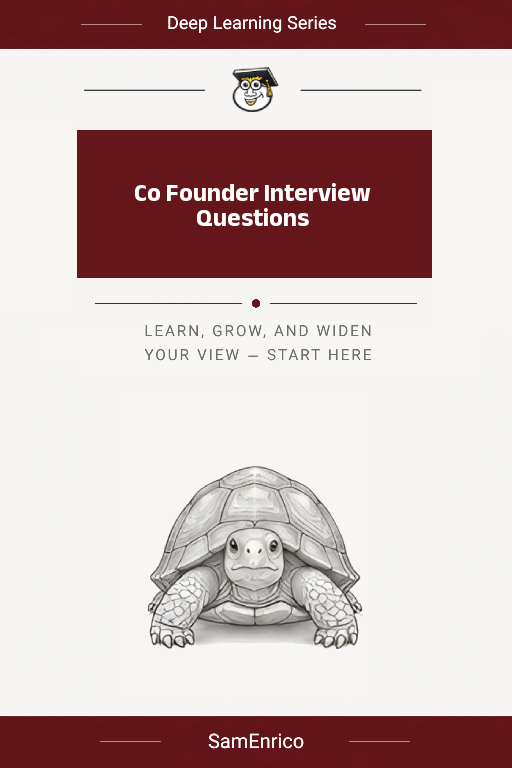
Non-FictionFirst 30 DaysInterview Guide
Co Founder Interview Questions eBook
Ask 50 essential questions about work style, value
Ask 50 essential questions about work style, values, and startup vision during co-founder interviews.
Formats
Free sample
Chapter 1: The Handshake That Kills--–- Most founders sign their death warrant with a handshake.Not the kind that involves a pen and a term sheet. The kind that happens at a coffee shop, after two hours of excitement, when one person says, “We should do this,” and the other says, “Let’s do it,” and they shake on it. No vesting schedule. No conflict protocol. No conversation about what happens when one of them stops caring.That handshake feels like a beginning.
In reality, it is a ticking time bomb.I have watched this scene play out more than forty times across a decade of advising startups. The pattern is so predictable that I could script it. Two smart, ambitious people meet. They discover complementary skills—one codes, one sells; one designs, one operates. They feel the electric charge of possibility.
They agree to split equity fifty-fifty because that feels fair and adult and collaborative. They tell themselves they will figure out the details later.Later never comes. Or rather, later comes in the form of a screaming match at 11 PM, a passive-aggressive Slack thread, or a sudden departure that leaves the company stranded.The data on this is not ambiguous. According to research cited by Lloyed Lobo, co-founder of Boast.AI and author of the WSJ bestseller From Barefoot to Billionaire, roughly 99 percent of venture-backed failures stem not from a bad idea, not from market competition, not from running out of money—but from founder fallout, burnout, or outright replacement. Ninety-nine percent.
Read that again.Let that number land. The market can shift. The product can miss. The technology can fail. But the single most reliable predictor of a startup’s death is the relationship between the people who started it.And yet, almost no one prepares for that relationship like a relationship.
We prepare for product-market fit with customer interviews and spreadsheets. We prepare for fundraising with pitch decks and data rooms. We prepare for hiring with rubrics and take-home tests. But when it comes to the single most important decision we will make—the choice of a co-founder—we rely on chemistry, gut instinct, and a handshake.This book exists because that is not enough. This chapter exists because the handshake that kills usually feels wonderful at the time.The Myth of the Natural Partnership There is a story we tell ourselves about great co-founder pairs.
It goes like this: Steve and Woz. Ben and Jerry. Larry and Sergey. They just clicked. They shared a vision.
They trusted each other implicitly. No contracts needed. No awkward conversations. Just magic.That story is a lie. Or, more generously, it is an incomplete truth.What those histories leave out are the near-breakups, the bitter fights, the moments when one founder wanted to walk away and the other had to pull them back.
They leave out the equity renegotiations, the family interventions, the therapy sessions, and the legal documents that ultimately saved those partnerships. We remember the magic because the magic survived. We forget the mess because the mess is uncomfortable to discuss.I once interviewed a founder who had sold his company for nine figures. He told me about his co-founder with genuine affection. They had worked together for fifteen years.
They had raised three rounds together. They had weathered the 2008 crash and the 2020 pandemic together.“When did you know he was the right partner?” I asked.He laughed. “About six years in,” he said. “Before that, I was just hoping.”Six years. Most startups do not survive six months with a mismatched co-founder.
But this pair survived because they eventually did the work—the hard, uncomfortable work of asking each other the questions they had been avoiding since day one.This book accelerates that timeline. Instead of six years of hoping, you get a weekend of interrogation. Instead of learning through crisis, you learn through conversation. Instead of discovering your partner’s deal-breakers during a board meeting, you discover them over a glass of whiskey.The Three Lies We Tell Ourselves About Co-Founders Before we get to the fifty questions—the heart of this book—we must first clear away the debris of bad assumptions. Almost every founder walks into a co-founder search carrying three lies.
These lies are seductive because they feel like wisdom. They are dangerous because they are wrong.Lie #1: “Skills are what matter most.”This is the most common mistake. Aspiring founders treat co-founder selection like a hiring process. They build a skills matrix. They look for complementary abilities: technical and business, product and marketing, operations and vision.
They assume that if the skills fit, the relationship will follow.This is backwards. Skills are table stakes. You need a co-founder who can build or sell or design. But thousands of people can build. Thousands can sell.
The question is not whether they can do the job. The question is whether they can do the job with you, in the dark, for years, without destroying each other.I have seen brilliant technical co-founders destroy companies because they could not communicate their decisions. I have seen charismatic sales co-founders burn through cash because they could not tolerate process. Their skills were excellent. Their alignment was zero.The right question is not “What can you do?” The right question is “How do you work, what do you value, and what happens when we disagree?”Lie #2: “We can figure it out as we go.”This lie feels responsible.
It acknowledges that there will be challenges but trusts that two smart people can solve them in real time. This is how marriages without prenups start. It is also how they end.The problem is that “figuring it out as we go” becomes impossible once there is money on the table, employees who depend on you, and investors watching your every move. The time to resolve a conflict is before the conflict exists. The time to set a vesting schedule is before the equity is worth anything.
The time to agree on a break-up plan is when you still like each other.I have never met a founder who regretted asking hard questions early. I have met dozens who regretted avoiding them.Lie #3: “If we trust each other, we don’t need a contract.”Trust is beautiful. Trust is also fragile. And trust is not a substitute for clarity.The founders who refuse to put things in writing are not more trusting than the founders who do. They are more naive.
A written agreement is not a sign of suspicion. It is a sign of respect. It says: “I care about this relationship enough to protect it from future versions of ourselves who might be tired, stressed, or scared.”The handshake that kills is the one that comes with no paper trail. The partnership that survives is the one that puts its promises in ink.Why This Book Exists (And Why It Is Different)There are many books about startups. There are many books about leadership.
There are books about culture, about hiring, about fundraising, about product development. But there is almost nothing dedicated entirely to the question of co-founder fit.The existing literature treats co-founder relationships as a subplot.…
This is the end of the free sample. Get the eBook to keep going. Buy now
About this book
Details
- Author
- Davidson Hubert
- Publisher
- SamEnrico
- Language
- English
- Genre
- Non-Fiction, First 30 Days, Interview Guide
- Released
- 2026-05-30
- Pages (approx.)
- 131
- Available as
- eBook, Audiobook

Read better in the ZLOADR app
Your eBooks on your phone or tablet. Sign in with your SamEnrico account and start reading.
More by Davidson Hubert
 Trance Logic Explained GuideDavidson Hubert$11.99
 Counting Breaths BackwardsDavidson Hubert$11.99
 Caring for the CarerDavidson Hubert$11.99
 Acupuncture for NeuropathyDavidson Hubert$11.99
 TikTok Productivity Porn GuideDavidson Hubert$11.99
 The Sky Pioneer: Bertha Benz and the First African Air Medical Rescue (1910-1930s)Davidson Hubert$11.99
 Silicon Valley’s Secret Weapon: How a College Dropout Built a Tech EmpireDavidson Hubert$11.99
 Understanding DysgerminomaDavidson Hubert$17.99
 Business Stock Phone GuideDavidson Hubert$12.99
 Concrete Truck DriverDavidson Hubert$11.99
 How to Start a School BusinessDavidson Hubert$11.99
You may also like
 Hong Kong Handover 1997Dunn Johnnie$11.99
 Zumba For Postnatal Recovery CourseNeal Christian$11.99
 Zumba for BeginnersLadner Nikia$11.99
 YouTube Comment Mining GuideHumes Pandora$12.99
 Worry Box MeditationCarlin Rudy$11.99
 Workplace Stress MeditationNguyen Lynn$11.99
 Workplace Stress and Sleep RepairHawley Ivory$11.99
 Workplace Perfectionism CureDelaney Jeffry$11.99
 Workplace Injustice Anger GuideWallen Isabelle$11.99
 Work Addiction and Burnout LinkGreenwood Ester$11.99
 Women in Yoga and WellnessBeattie Galina$11.99
 Women in Stand Up ComedyChun Evangeline$11.99