
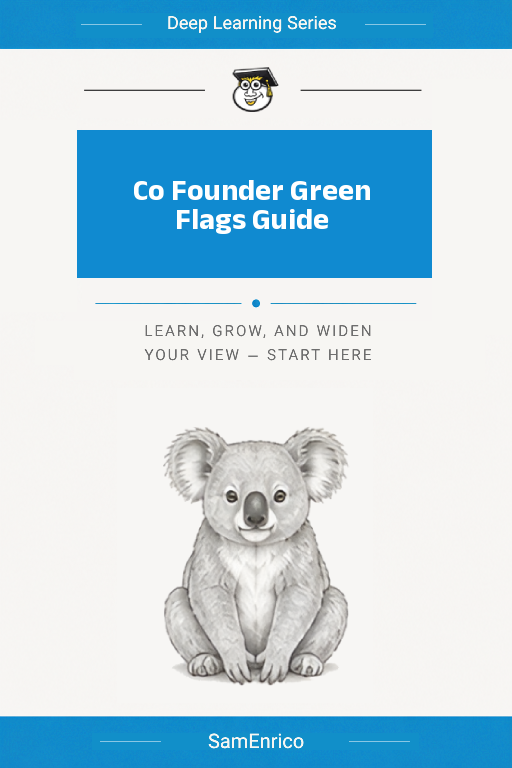
Non-FictionFirst 30 DaysGreen Flags
Co Founder Green Flags Guide eBook
Look for complementary skills, shared values, tran
by Gurley Orval
Look for complementary skills, shared values, transparent communication, and proven reliability.
Formats
Free sample
Chapter 1: The Desert Island Test--The first time I watched a co-founder relationship die, it didn’t end with a lawsuit or a screaming match. It ended with a spreadsheet.Two founders, let’s call them Maya and James, had built a promising B2B software company over eighteen months. They raised a seed round, hired eight people, and landed three enterprise customers. On paper, they were succeeding. But at 2:47 PM on a Tuesday, Maya sent James a Google Sheet titled “Equity Reconciliation – Final.” It contained a column-by-column accounting of every hour she had worked, every introduction she had made, every late night she had pulled.
James’s column was shorter. The email had no subject line. Three weeks later, the company was dissolved.Here is what no one tells you about co-founder conflict: it rarely announces itself with fireworks. It arrives as a spreadsheet. A passive-aggressive Slack message.
A “we need to talk” that never happens. A slowly widening gap between what you thought you agreed on and what you actually agreed on. And by the time you notice the gap, you are already incorporated, already funded, already entangled in a legal and emotional partnership that costs more to unwind than to endure.The founders I work with almost always make the same mistake. They spend months conducting due diligence on investors—background checks, reference calls, term sheet negotiations, market analysis. Then they spend approximately four hours choosing the person who will have more impact on their startup’s survival than any investor, any employee, any customer.
That person is their co-founder.This book exists because that math is broken.The Promise of This Chapter By the time you finish this chapter, you will understand why the vast majority of co-founder conflict traces back to a single failure: the values conversation that never happened. You will learn a simple, repeatable exercise called the Desert Island Test that reveals values alignment in under an hour. And you will know exactly what to listen for when a potential co-founder says things like “I’m flexible on values” or “We’ll figure it out as we go.”More importantly, you will learn why shared hobbies, shared networks, and shared enthusiasm are not the same as shared values—and why confusing them has destroyed more startups than bad products ever have.The Great Values Confusion Let me start with a distinction that sounds academic but will save you years of therapy. There are two kinds of values: core values and peripheral values. Core values are the non-negotiable principles that guide decisions when the stakes are high and the answer is unclear.
Peripheral values are preferences, tastes, and habits that feel important but are actually flexible.Core values sound like this: integrity, customer obsession, work-life balance, radical transparency, growth at any cost, financial independence, team harmony, speed, precision, autonomy. Peripheral values sound like this: preferring Mac Books over PCs, liking open floor plans, believing agile is better than waterfall, enjoying late-night work sessions, favoring Slack over email.Here is the trap. When you first meet a potential co-founder, you bond over peripheral values because they are easy to see and pleasant to share. You both hate meetings. You both love the same productivity tools.
You both think remote work is the future. These agreements feel profound because they are rare and specific. But they tell you almost nothing about whether you will survive a real crisis.I have watched founders spend weeks celebrating that they both prefer the same project management software while never once discussing whether they would lay off an employee to preserve runway. I have watched partners bond over their shared disdain for corporate culture while never once defining what they actually want to build. I have watched co-founders assume alignment because they laughed at the same jokes, only to discover eighteen months later that one wanted to sell the company and the other wanted to run it for twenty years.Peripheral alignment is a trap because it feels like real alignment.
But peripheral values change. Core values do not. And when core values clash, no amount of shared taste in coffee or coding languages will save you.The Three Silent Killers Drawing from decades of research including Noam Wasserman’s foundational work in The Founder’s Dilemmas, I have identified three specific axes of core values that destroy co-founder relationships more than any others. I call them the Three Silent Killers because they rarely cause immediate conflict. Instead, they create slow, cumulative resentment that explodes under the first real pressure.Silent Killer One: Money Values How you think about money is not a preference.
It is a core value. Some founders view money as a scorecard—a way to measure success, attract talent, and validate their vision. Others view money as fuel—necessary but not meaningful, a means to an impact-based end. Still others view money as security—something to preserve, protect, and grow carefully.These orientations are not better or worse. But they are often incompatible.
The founder who wants to raise venture capital, grow aggressively, and sell in five years has a fundamentally different money value system than the founder who wants to bootstrap, grow organically, and run a profitable lifestyle business. Neither is wrong. But they will fight about every financial decision from pricing to salaries to office expenses.The green flag on money values is not agreement on a specific number. It is alignment on the function of money in your shared enterprise. When you discuss hypotheticals, you should land in the same neighborhood without persuasion.Silent Killer Two: Ethics and Trade-offs Every startup faces moments where values collide.
Do you launch a feature that is slightly misleading but will double conversions? Do you hire a brilliant engineer who has a reputation for bullying junior staff? Do you take money from an investor whose other portfolio companies you find problematic? Do you clone a competitor’s feature even if it feels derivative?These questions have no universally correct answers. But they have answers that reveal whether you and your co-founder share ethical values.
The founder who believes “growth justifies almost everything” will eventually resent the founder who wants to “win the right way.” The founder who prioritizes team harmony will clash with the founder who prioritizes radical candor.The green flag on ethics is not that you agree on every hypothetical. It is that you use the same decision-making framework. When you ask “What would make this decision wrong?” you should arrive at similar answers.Silent Killer Three: Speed and Quality Some founders believe that speed is the only competitive advantage. Move fast, break things, iterate, launch imperfectly, fix later. Other founders believe that quality is the only durable advantage.
Measure twice, cut once, build reputation through excellence, never ship anything that embarrasses you.These orientations exist on a spectrum, not a binary. But founders who are far apart on this spectrum will fight about everything from product roadmaps to hiring standards to customer support responses. The speed-oriented founder will see the quality-oriented founder as paralyzed by perfectionism. The quality-oriented founder will see the speed-oriented founder as reckless and untrustworthy.The green flag on speed and quality is not…
This is the end of the free sample. Get the eBook to keep going. Buy now
About this book
Details
- Author
- Gurley Orval
- Publisher
- SamEnrico
- Language
- English
- Genre
- Non-Fiction, First 30 Days, Green Flags
- Released
- 2026-05-29
- Pages (approx.)
- 139
- Available as
- eBook, Audiobook

Read better in the ZLOADR app
Your eBooks on your phone or tablet. Sign in with your SamEnrico account and start reading.
More by Gurley Orval
 Digital Legacy GuideGurley Orval$11.99
 Logrolling Negotiation TechniqueGurley Orval$11.99
 Gambling Addiction and Employment SearchGurley Orval$11.99
 WhatsApp Group ComparisonGurley Orval$11.99
 Notion Gantt Chart Timeline ViewGurley Orval$11.99
 The Attention and Memory LinkGurley Orval$11.99
 Interruption Success StoriesGurley Orval$11.99
 Gray Divorce RecoveryGurley Orval$11.99
 The Bloodhound and the Ballot: How Dogs Sniffed Out Voter Fraud in 2000Gurley Orval$11.99
 The Quantum Leap: How a Forgotten Genius Almost Changed the WorldGurley Orval$11.99
 Growing BartlettinaGurley Orval$11.99
 Generative AI Brand Voice GuideGurley Orval$12.99
You may also like
 Hong Kong Handover 1997Dunn Johnnie$11.99
 Zumba For Postnatal Recovery CourseNeal Christian$11.99
 Zumba for BeginnersLadner Nikia$11.99
 YouTube Comment Mining GuideHumes Pandora$12.99
 Worry Box MeditationCarlin Rudy$11.99
 Workplace Stress MeditationNguyen Lynn$11.99
 Workplace Stress and Sleep RepairHawley Ivory$11.99
 Workplace Perfectionism CureDelaney Jeffry$11.99
 Workplace Injustice Anger GuideWallen Isabelle$11.99
 Work Addiction and Burnout LinkGreenwood Ester$11.99
 Women in Yoga and WellnessBeattie Galina$11.99
 Women in Stand Up ComedyChun Evangeline$11.99